
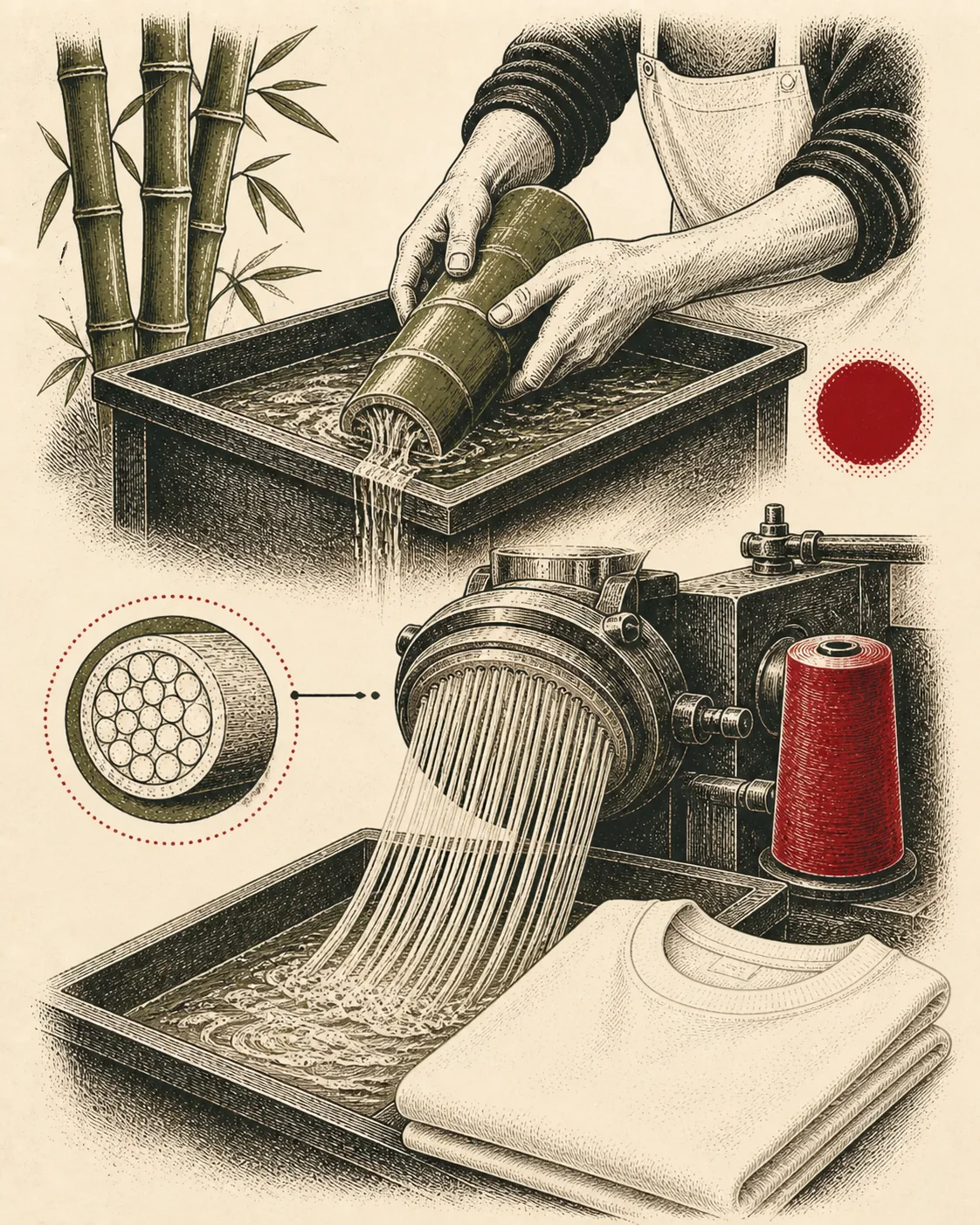
Almost all clothing sold as bamboo is rayon. The bamboo did real work in the supply chain, as the plant the cellulose came from, but by the time that cellulose has been dissolved in chemicals and regenerated into thread, nothing of the plant’s original fiber structure survives the process. What is on the hanger is viscose rayon, chemically identical to rayon made from eucalyptus, pine, or any other cellulose source. Bamboo supplied the raw material. Rayon is what got woven.
What the label is actually allowed to say
The Textile Fiber Products Identification Act, at 15 U.S.C. 70b, requires a garment’s label to name the fiber the product actually is, not the plant or tree that supplied the pulp. A manufacturer violates that statute by writing “bamboo” on a rayon garment’s tag. A shirt spun from bamboo-derived viscose is legally a rayon shirt, and the FTC’s own guidance says a company may write “rayon made from bamboo,” naming the process and the source together, but may not drop “rayon” and call the fabric bamboo alone.
Retailers have tested that line for over a decade, and the FTC has enforced it twice at meaningfully different scales.
The first round of fines, and the second
In January 2013, the FTC settled with four national retailers over exactly this labeling. Sears paid $475,000, Amazon paid $455,000, Macy’s paid $250,000, and Leon Max, Inc. paid $80,000, a combined $1.26 million. The FTC said the size of each penalty tracked two things: how long the company kept selling the mislabeled garments after the agency’s 2010 warning letters, and how many units it sold. That detail matters more than the total. It means the fines were not a flat cost of doing business; they scaled with how long a company chose to keep selling a product it had already been told was mislabeled.
Nine years later, the agency went after two bigger targets with a bigger number. In April 2022, the FTC used its Penalty Offense Authority, a mechanism that lets it seek civil penalties directly against companies on notice of a prior FTC finding, to pursue Walmart and Kohl’s over the same rayon-as-bamboo mislabeling. It asked for $3 million from Walmart and $2.5 million from Kohl’s, a combined $5.5 million and, at the time, the largest civil penalty the agency had sought in this specific area. The 2022 complaints added a second charge the 2013 cases did not carry: both companies had also marketed the mislabeled rayon as produced through a clean, non-toxic, environmentally friendly process, dating back to at least January 2015. The FTC’s position was direct. Converting bamboo into rayon runs through carbon disulfide and sodium hydroxide, and it produces hazardous byproducts a mill has to manage, the opposite of what the marketing claimed.
The chemistry the label is hiding
Viscose is not a synonym for bamboo processing; it is a specific industrial sequence, applied to bamboo the same way it is applied to wood pulp from any tree. Cellulose is first treated with concentrated sodium hydroxide to form alkali cellulose. That alkali cellulose is then reacted with carbon disulfide, converting it into cellulose xanthate, an orange-red compound that gives the process its distinctive intermediate. The xanthate is dissolved in a dilute sodium hydroxide solution to form a thick, honey-like liquid, the “viscose” the process is named for, which is aged for a set period so the xanthate groups distribute evenly through the solution. That viscose is then forced through a spinneret into a bath of dilute sulfuric acid, which strips the xanthate groups back off and regenerates pure cellulose as a continuous filament. What comes out the other end is chemically cellulose again, structurally nothing like the bamboo cane it started as.
None of the plant’s original cell walls, its bundled fiber structure, or its natural strength survives that bath. Regeneration is the correct word for the process, and it is also the reason a rayon label, not a bamboo label, is the legally accurate one: the fiber was dissolved to nothing and rebuilt.
A fiber older than the plant it’s sold under
Viscose itself predates the bamboo marketing by more than a century, and none of its invention had anything to do with bamboo at all. Charles Frederick Cross, Edward John Bevan, and Clayton Beadle patented the process in Britain in May 1892, filed as “Improvements in Dissolving Cellulose and Allied Compounds,” working from wood pulp and cotton linters, not bamboo. Courtaulds licensed their patents in 1904 and began commercial production at Coventry in November 1905, selling the fiber as artificial silk. For most of the twentieth century, viscose rayon’s marketing leaned on that silk comparison, not a plant-source story. The bamboo framing is a recent layer on an old industrial process, added because a bamboo grove photographs better on a hangtag than a wood-pulp mill does, and because bamboo carries an unearned reputation for being grown without pesticides or much water, a claim about farming that says nothing about what a chemical bath does to the fiber afterward.
That is also what made the FTC’s 2022 cases procedurally different from 2013. The agency invoked its Penalty Offense Authority, a provision of Section 5 of the FTC Act that lets it seek civil penalties directly, without first winning a new cease-and-desist order, against a company that had actual notice its conduct matched something the FTC had already found unlawful in a prior litigated order. The agency builds that notice by sending companies a formal Notice of Penalty Offenses; once a company has received one and kept doing the listed thing anyway, the FTC can go straight to court for money. That mechanism, not a new legal theory about bamboo, is why the 2022 penalties could reach $5.5 million combined while the 2013 case, which proceeded as an ordinary Textile Act enforcement action, topped out at $1.26 million across four companies.
The version that is not rayon
The correction runs the other way too. Mechanically processed bamboo linen genuinely exists, made the way flax becomes linen: the stalks are retted, a controlled rotting that breaks down the pectin binding the fiber bundles together, then the loosened fibers are combed and spun with no chemical dissolution step at all: real bamboo fiber survives into the finished cloth, unlike anything regenerated through a viscose bath.
It is also a small fraction of what is sold as bamboo, and for a specific structural reason. Flax and hemp have long bast fibers that separate cleanly once retted, which is why linen has been a viable mechanical fabric for thousands of years. Bamboo does not cooperate the same way. Its fibers are short, heavily lignified, and bound with silica that resists mechanical separation, so retting bamboo yields coarse, short fragments that are slow to comb and difficult to spin at commercial volume. The labor and the yield loss both push the price up, which is exactly why the viscose route dominates the market: it is cheap, fast, and scalable in a way mechanical bamboo processing is not. Bamboo linen is a real, minor, expensive fabric, and the much larger bamboo-viscose market has spent two decades borrowing credibility from its name.
What that means for the tag in your hand
A shopper who wants the mechanically processed fabric has one reliable signal and it is not the word “bamboo.” Federal labeling rules require the generic fiber name, so a garment made through the chemical process should read “rayon” or “viscose” somewhere on the tag, sometimes with “from bamboo” appended, precisely because bamboo alone is not a legal fiber name for a regenerated product. A tag that says only “bamboo,” with no rayon or viscose printed anywhere, is not evidence of the rare mechanical fabric. Given how the market actually shakes out, it is closer to evidence of exactly the mislabeling the FTC has now fined retailers over twice, nine years apart, at two very different scales of penalty.
We do not cut bamboo fabric of either kind. Our shirts are cotton and cotton-canvas, chosen for weight and how they wear over years, which is a separate question from whether a given bamboo hangtag is telling the truth about what is actually in the weave.