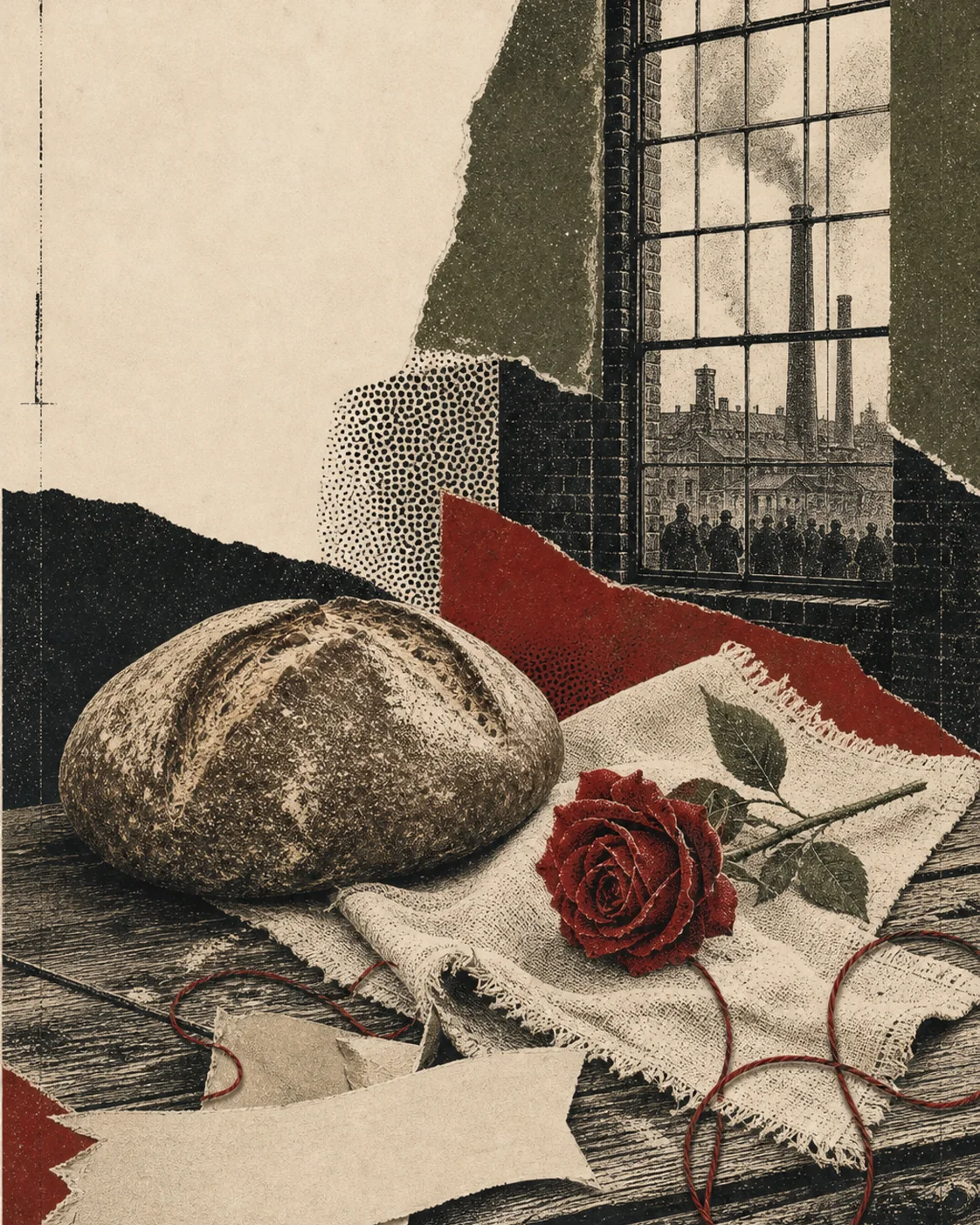
The math that started it fits on a receipt. On January 1, 1912, a Massachusetts law took effect cutting the maximum mill work week for women and children from 56 hours to 54. The mill owners of Lawrence complied precisely: they cut two hours of pay. For workers averaging under nine dollars a week, the difference bought several loaves of bread. When the first short pay envelopes were opened on January 11, weavers in the Everett Mill stopped their looms, and the next day thousands more walked out shouting a phrase that needed no translation: short pay.
Lawrence was as close to a company town as New England had: a planned mill city on the Merrimack, its workforce drawn from more than two dozen countries. The owners believed the workforce’s diversity made organization impossible, since Italians, Poles, Lithuanians, Syrians, and Franco-Belgians shared no language and often no neighborhood. The Industrial Workers of the World treated that as an engineering problem: strike committees were organized by language group, each electing delegates to a central council, with every decision translated around the table. The structure held for nine weeks in a Massachusetts winter, which remains one of the most underrated logistical feats in American labor history.
The militia came early, and a striker named Anna LoPizzo was shot dead in a January confrontation. Two strike leaders, Joseph Ettor and Arturo Giovannitti, were jailed for her death on the theory that their speeches had incited it, though both were miles away; their eventual acquittal became its own cause. Dynamite “discovered” in town, and breathlessly reported as strikers’ arsenal, turned out to have been planted; a local undertaker was convicted for it, and testimony implicated men connected to the mills.
What broke the stalemate wasn’t a battle but a logistics program with children in it. Strikers’ families were running out of food, so the committee organized the exodus: children sent by train to volunteer host families in New York, Philadelphia, and elsewhere, fed and cared for until the strike ended. It was relief and publicity in one. When Lawrence authorities decided to stop a departure by force, police clubbing mothers and children at the rail station in front of reporters, the story went national, Congress opened hearings, and mill-town testimony from fourteen-year-old workers did what pamphlets couldn’t.
In March the American Woolen Company folded: raises on a sliding scale weighted toward the lowest paid, overtime pay, and no reprisals. Mills across New England matched the terms within weeks rather than face their own Lawrence, which means the strike gave a raise to hundreds of thousands of workers who never walked a picket.
The poem came first, the strike came second, and memory fused them. Nobody has found the famous banner, and the phrase was probably attached to Lawrence afterward by people who understood what the strike had been about better than a banner could have said it.
What the record does show is harder to put on a banner and worth more. A city of strangers organized across roughly twenty-five languages, ran its own relief kitchens, sent its children out of the city to keep them fed, buried its dead, held through a New England winter, and won a raise.