
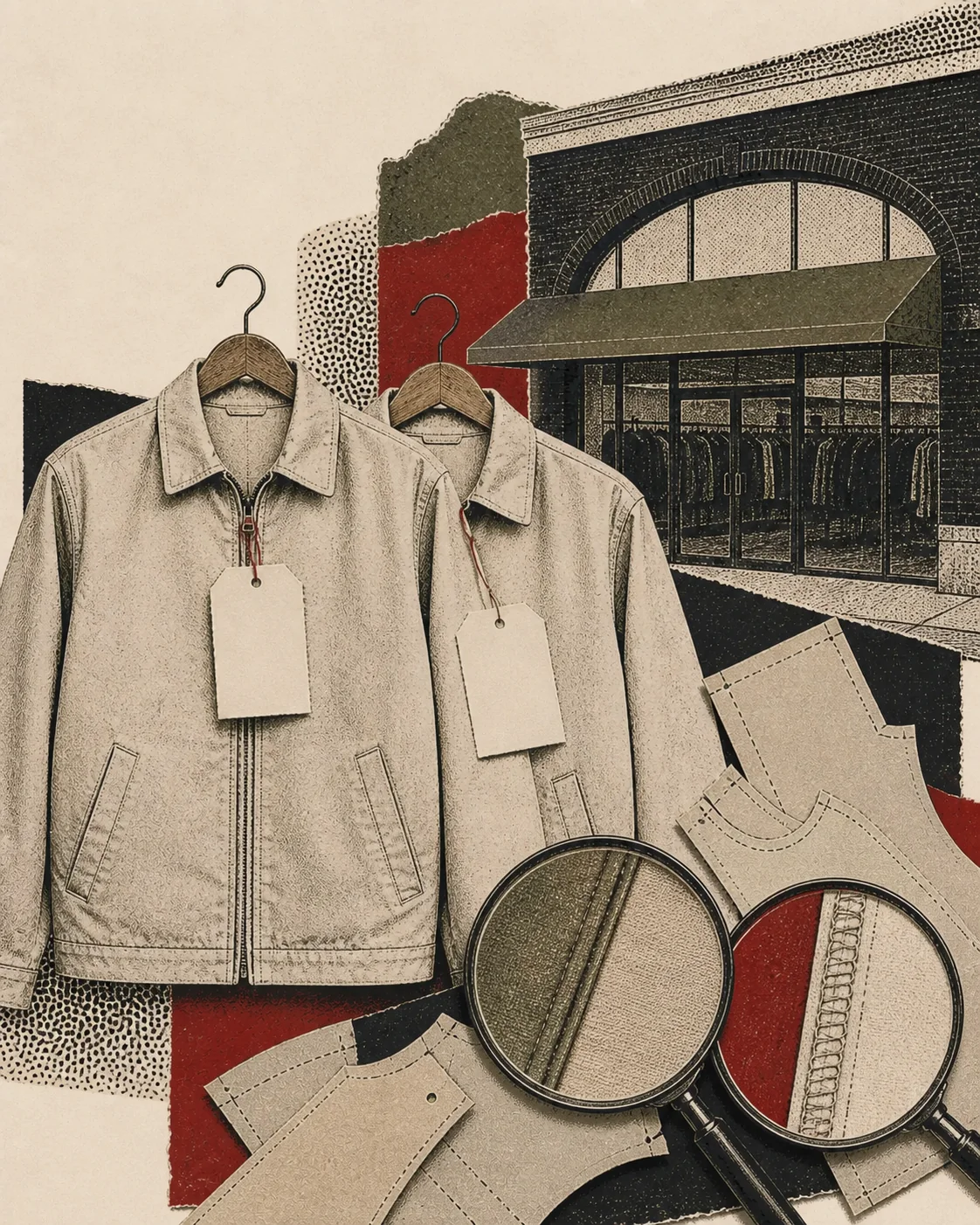
Most of what hangs in an outlet store was cut, sewn, and priced for that store from the start, never sold anywhere else at any price. The number crossed out on the tag describes a garment that never existed at the flagship. Four members of Congress made that argument to the Federal Trade Commission in a letter dated January 30, 2014, and a string of lawsuits against national retailers has made it again in the decade since.
What the 2014 letter actually said
Senators Sheldon Whitehouse and Richard Blumenthal, Senator Ed Markey, and Representative Anna Eshoo wrote to FTC Chairwoman Edith Ramirez asking her to investigate outlet pricing. Their letter stated that “upwards of 85% of the merchandise sold in outlet stores was manufactured exclusively for these stores,” and argued that displaying an inflated “retail price” next to the outlet price on an item that never carried that price violates the FTC’s own Guides Against Deceptive Pricing. The lawmakers also asked the FTC to consider a standardized definition of “factory outlet,” since some retailers separate their outlet lines under a different label and others do not, leaving a shopper with no way to tell the difference on sight.
The letter raised a second point beyond pricing: goods made for the outlet channel are, in the lawmakers’ words, “often of lower quality than goods sold at non-outlet retail locations.” Lower quality is not automatically deceptive. A brand is free to sell a lighter-weight version of a jacket at a lower price under a different label. The problem the letter named was that some retailers mark that distinction and some do not, so a shopper comparing an outlet jacket to the memory of a flagship jacket has no way to know whether they are looking at the same construction at a discount or a different, cheaper construction dressed up to look like one.
The FTC never opened the rulemaking the letter asked for. It published a consumer-advice blog on getting value at outlet stores instead. The gap between the letter and the response is itself part of the record: a documented request for federal action, and a documented decision not to take it.
Where the 80-to-85 percent figure comes from
The letter’s number and the range most often repeated since, 80 to 85 percent, trace back to retail analysts rather than a government audit or a retailer’s own disclosure. Checkbook.org’s survey of roughly forty outlet brands cites that range and quotes Gonca Soysal, a marketing professor who studies retail pricing: outlet stores, in her description, are channels where merchandise is “exclusively manufactured for the outlet,” not surplus pulled from a flagship stockroom. No retailer publishes an audited breakdown of what share of its outlet racks came from a factory line built for that channel versus its regular collection, so the figure is an informed estimate from people who study the sector, not a measured total. Treat it that way and it still does the job: it says the made-for-outlet share is a majority, not a minority, and has been for years.
Not every retailer’s own numbers match the higher end of that range, and the differences are worth naming rather than smoothing over. Nordstrom Rack’s own description says its stores carry “merchandise from Nordstrom stores and Nordstrom.com, as well as specially purchased items from many of the top brands sold at Nordstrom,” and Checkbook.org’s researchers, working from that language and their own comparison shopping, put the actual mix closer to 50-50 between overstock and made-for-Rack goods. That is lower than the 80-to-85-percent figure the same researchers cite for outlets generally, a reminder that the practice varies by retailer even where the broader trend is consistent.
The lawsuits, by name and date
Congress’s letter was 2014. The lawsuits came in waves after it, mostly over the same mechanic: an outlet tag showing a struck-through “MSRP” or “compare at” price for a garment that was never sold at that price anywhere.
Tressa Gattinella and Kristin Lengyel sued Michael Kors in the Southern District of New York in 2014 over exactly that, and the company settled for $4,875,000 in 2015. Coach faced a nearly identical claim, Marino v. Coach, Inc., filed in the same district in February 2016; that one settled with final court approval in March 2021, after Coach agreed to bring its pricing and labeling into compliance with federal and state rules and to pay class members in vouchers or cash. Columbia Sportswear was sued in the Northern District of California in 2015, Stathakos v. Columbia Sportswear Co., over a “Reference Price” printed on outlet tags for items the plaintiffs said Columbia had never sold at that higher price in a regular store.
Michael Kors was sued a second time in 2023 over the same underlying practice at its outlet stores. That case reached a settlement worth up to $2,000,000, preliminarily approved in November 2025, and Michael Kors denied wrongdoing throughout, as companies settling these suits generally do; a settlement resolves a claim, it does not establish that a court found the pricing illegal. J.Crew Factory was sued in 2023 as well, Calderon v. J.Crew Group, over false reference pricing on factory-store items. That suit never reached the pricing question on its merits: a federal judge dismissed it in a four-page order dated November 6, 2023 and sent the case to arbitration, because the plaintiff had agreed to an arbitration clause when she used the J.Crew website.
That pattern matters for how to read the whole record. None of these cases produced a trial verdict holding that made-for-outlet pricing is illegal as a general matter. What they produced is a repeated allegation, filed against different retailers in different courts across nine years, that a struck-through price on a tag described a garment that never existed at that price, and a repeated pattern of settling rather than litigating it to a finding.
Why “overflow” stopped being the right word
The outlet model that shoppers still picture, a factory clearing last season’s stock at a discount, describes the outlets of the 1980s better than the outlets most people shop today. Outlet malls grew fastest in the 1990s and 2000s not by moving flagship overflow but by opening a second, cheaper production line under the same brand name and building stores to sell only that line. A shirt bought at a Coach outlet or a Michael Kors outlet was, most of the time, made for that store, cut from lighter material or finished with fewer steps, and never crossed a flagship register. The “compare at” tag on it is comparing the outlet price to a number that describes nothing that ever shipped.
Some retailers are straightforward about this split. J.Crew Factory carries its own style numbers, separate from J.Crew’s mainline SKUs, so a shopper who wants to check whether a factory item matches something sold at the regular store at least has a number to look up. Plenty of outlet operations give the shopper no such tool, which is the gap the 2014 letter and the lawsuits that followed were both, in their own language, asking someone to close.
What this has to do with a compare-at tag on any garment
The FTC’s own rule on comparative pricing, which governs when a retailer can advertise a “was” price at all, applies to every store, outlet or not; it just bites harder at an outlet, because an outlet’s whole pitch is the gap between the two numbers on the tag. We do not run outlet stores or a made-for-outlet line. Every DRESS ← garment is printed to order in the one run a customer buys, at the one price listed, and there is no second channel selling a cheaper version of the same shirt under a fictional discount.
The tag on an outlet rack is telling a true story about a channel and a false one about a price. The channel exists to sell garments made for it, cheaper to produce and priced accordingly, and there is nothing wrong with that on its own. The lie is the number crossed out above it, standing in for a sale that a different shirt, in a different store, never had.