
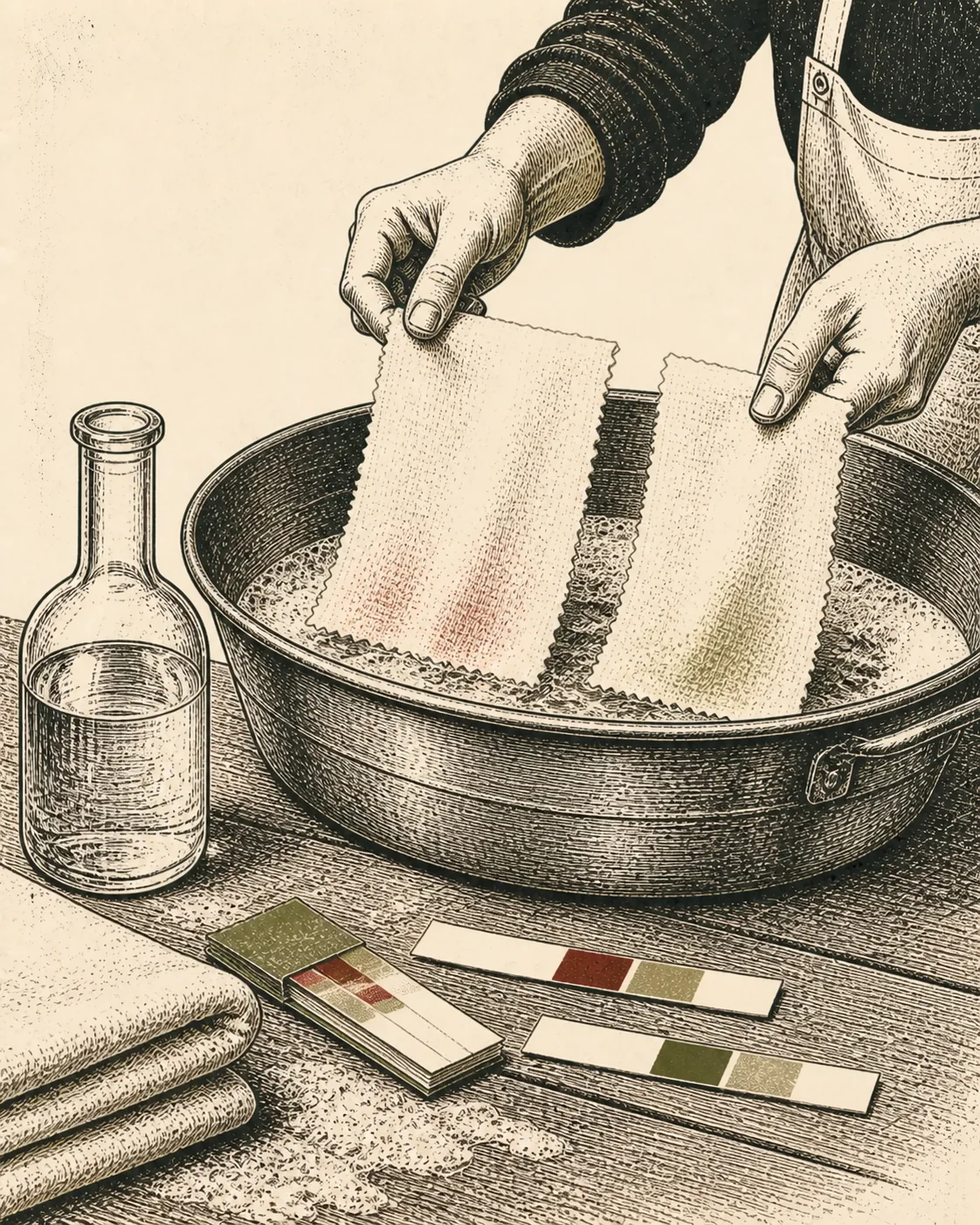
Vinegar softens, brightens, deodorizes, and cuts residue: four separate claims, repeated as one piece of common knowledge across a hundred years of home-economics columns and ten thousand blog posts that all cite each other instead of a lab. Ask which of those four claims has ever been tested against a control load, by anyone, and none of the writers cites a study. Test them one at a time and exactly one survives.
What is actually in the bottle
Distilled white vinegar is water and roughly 5 percent acetic acid, with a pH around 2.4. Mainstream liquid and powder laundry detergent runs alkaline, typically pH 9 to 11, built that way on purpose because an alkaline bath helps lift acidic soils like sweat and food oils and keeps the detergent’s surfactants working. Those two numbers sit at opposite ends of the scale, and that gap explains most of what vinegar can and cannot do in a wash.
An acid and a base partially neutralize each other on contact. That is not folk chemistry, it is the definition of the reaction, and it is why Tide’s own consumer research page advises against adding vinegar to a load alongside detergent: doing so, the company states, increases the risk of poorer cleaning performance. The people who formulate the detergent are telling customers that the two products fight each other in the drum. Nobody selling vinegar has published data showing otherwise.
The enzymes carrying most of a modern detergent’s cleaning power make the same point from a different direction. Protease and amylase enzymes are built to work in the alkaline range a standard detergent creates, and detergent chemists have gone to the trouble of patenting formulations specifically designed to inhibit those same protease enzymes with acid when a milder, more fabric-gentle wash is the goal. That an acidic ingredient shows up in patent literature as a deliberate enzyme inhibitor is a second, independent line of evidence that vinegar and enzyme detergent are working against each other, not alongside each other, in the same load.
The one claim that holds: mineral and residue removal
Acetic acid dissolves calcium and magnesium carbonate, the same reaction that lets a splash of vinegar descale a coffee maker or a kettle. Hard water leaves exactly that carbonate scale on fabric fibers over repeated washes, along with a film of alkaline detergent residue that never fully rinses out. An acidic rinse converts the insoluble carbonate into a soluble acetate salt that goes down the drain with the rinse water. That is straightforward, well-documented chemistry, not a chemistry adjacent to vinegar’s reputation, and it is the one use the American Cleaning Institute’s own guidance credits: removing residue and buildup, including the blue detergent staining that sometimes shows up on dark fabric.
Run that rinse and towels can genuinely feel less stiff afterward, because the mineral crust that was making them stiff is gone. That is a real, measurable effect with a real mechanism behind it. It is also the only one of the four claims that clears that bar.
The one claim everyone gets backward: softening
A vinegar rinse feeling softer gets misread as vinegar softening the fabric, which is not what is happening. Commercial fabric softener works by coating fibers in a cationic surfactant, a fatty compound that makes yarn feel slick and smooth under a fingertip, the same additive DRESS’s own care guidance and most garment labels tell people to skip on cotton because it dulls print and absorbency over time. Vinegar contains no such compound. What it does is subtractive: dissolve the mineral crust described above, and a fiber that was stiff from scale returns closer to its unencumbered hand. Rinse a load in soft water with no mineral buildup to begin with, and there is no fiber left for the vinegar to act on, no softening, and no residue to strip.
That distinction matters because it predicts when the trick works and when it does not. A household on hard well water sees a real difference. A household on municipal soft water, or already using a water softener, is adding acid to a rinse with nothing in it for the acid to dissolve.
The two claims nobody has tested: odor and brightening
Acetic acid is a documented disinfectant. A 2014 study in the peer-reviewed journal mBio, led by Claudia Cortesia and Howard Takiff, found that a 6 percent acetic acid solution killed drug-resistant tuberculosis bacteria after 30 minutes of direct contact, including strains resistant to multiple standard drugs. That is a genuine antimicrobial effect, and it is the study most odor-control claims for vinegar trace back to, whether the writer realizes it or not.
A load of laundry looks nothing like that study. A wash and rinse cycle dilutes a half cup of vinegar into many liters of water, delivers it for a few minutes rather than thirty, and runs at a fraction of the 6 percent concentration the study used. No source found in reporting this piece, published or manufacturer-issued, has tested whether vinegar at laundry-rinse concentration and contact time measurably reduces odor-causing bacteria on fabric. The absence is not the same as proof it fails. It means nobody has published the test in either direction, which is a different and weaker claim than the blog posts make.
Brightening runs into the identical gap. The proposed mechanism, that acetic acid dissolves the detergent film dulling white fabric, is chemically plausible and follows the same logic as the residue claim above. But plausible is not measured. No lab comparison, trade-group study, or manufacturer test surfaced in this piece’s research shows vinegar restoring brightness to yellowed whites against a control load washed without it. Tide’s technical guidance states the opposite directly, that only detergent delivers real whitening and brightening performance, and no independent source contradicts that with data. Odor and brightening land in the same place: neither claim has been measured against a control, in either direction, which is a narrower and more useful conclusion than calling either one true or false.
Why the machine’s own maker says leave it out of the drum
There is a mechanical cost to the habit beyond the wash itself. Whirlpool’s own care guidance warns that vinegar’s acidity weakens rubber seals and hoses with repeated exposure, gradually reducing the flexibility those parts need to hold a watertight seal, and recommends dedicated washing machine cleaners for routine maintenance instead of vinegar in the drum or dispenser. Maytag publishes the same warning under its own brand. Two manufacturers whose business is keeping washing machines running for a decade or more are telling owners, in their own official guidance, not to make vinegar a routine ingredient in the machine that holds those seals.
None of this rules out vinegar for the one job it actually does. A splash in the rinse or the fabric softener dispenser, used occasionally on hard water, dissolves mineral scale and detergent film and leaves fabric measurably less stiff, exactly the kind of narrow, specific claim the evidence supports. What it does not do is replace detergent, disinfect a gym bag, or turn a yellowed undershirt white again.
The four claims travel together because the one true claim lends the other three its credibility. Descaling is real, checkable chemistry, easy to demonstrate the first time someone pours vinegar over a kettle full of scale and watches it fizz and clear. That demonstration is convincing enough that a person reasonably assumes the same bottle does the softening, the odor removal, and the brightening too, since it is, after all, an acid doing something visible to a household surface. Acids are not interchangeable in what they dissolve, and mineral scale, sweat bacteria, and yellowed dye are three different chemical problems that happen to share a shelf.
The bottle in the laundry cabinet earns its place on the shelf for the descaling job alone. It just does not earn the rest of the reputation that came along with it.