
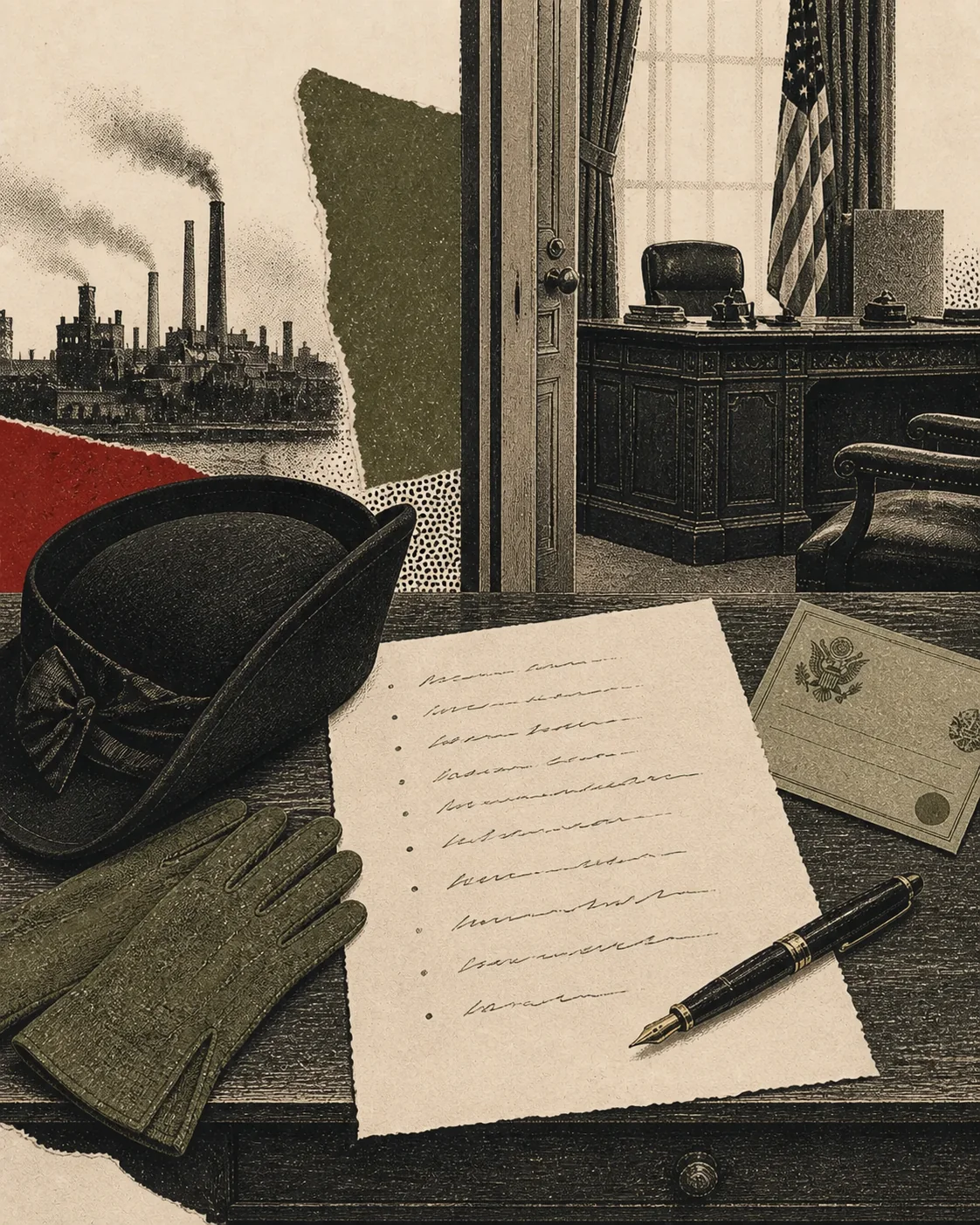
In February 1933, in her own apartment on Madison Square, Frances Perkins sat across from the president-elect and told him what it would cost him to have her. Franklin Roosevelt wanted her for Secretary of Labor. Perkins had a piece of paper, or at least a fixed idea in her head that reads like one on the page of her own memoir: a forty-hour work week, a federal minimum wage, unemployment insurance, old-age insurance, workers’ compensation, direct federal aid to the states for unemployment relief, an end to child labor, a revitalized federal employment service, and health insurance that covered everyone. Take those or find another labor secretary, she told him. He said he would back her.
The account is hers alone
Only one version of that conversation exists, and it is Perkins’s. She wrote it down in “The Roosevelt I Knew,” published in 1946, more than a decade after the meeting and after Roosevelt was dead and could not confirm or correct it. There is no transcript, no third-party witness, no letter from that week describing the exchange. What corroborates the story is not another account of the room but what happened afterward: a labor secretary who spent the next twelve years building, almost item for item, the list she says she gave him. Treat the scene as Perkins’s own telling, because it is, and treat the list as real because the legislative record backs it.
What was actually on it, and what became law
Roosevelt signed the Wagner-Peyser Act on June 6, 1933, three months into her tenure, creating the federal-state employment service she had named. The Social Security Act followed in 1935 with unemployment insurance and old-age insurance, two more items checked off, though a third, health insurance for everyone, was cut from that bill before passage after opposition from the American Medical Association and never returned as federal law. The Fair Labor Standards Act closed out the list in 1938 with a federal minimum wage and a maximum work week, phased down toward forty hours, and a ban on child labor in the trades it covered. Workers’ compensation and direct federal aid to the states for unemployment relief she pursued through relief agencies and state programs across the same years. Eight of nine items reached statute on her watch. The ninth, universal health coverage, is still not federal law in 2026, ninety years after she asked for it and lost.
Why the correction matters
The version of Perkins that survives in most retellings puts her on the sidewalk outside the Asch Building on March 25, 1911, watching workers jump from the ninth floor of the Triangle Shirtwaist factory because the exit doors were locked, and then follows her into a career as the sober administrator who cleaned up after that horror. Both things are true. But the sidewalk made her an investigator; the list made her a legislator with terms attached, and the second fact is the harder one to find repeated. A woman who had never held elected office negotiated her own mandate with an incoming president before she would take his cabinet seat, wrote it down as a condition rather than a hope, and then spent twelve years converting five of nine promises into federal statute inside a single decade. The witness story explains why she cared. The list explains why the New Deal’s labor law looks the way it does.
Before the list, the investigation
Perkins’s authority to make that kind of demand did not come from nowhere. After the Triangle fire, the New York legislature formed the Factory Investigating Commission on June 30, 1911, chaired by state senator Robert Wagner with assemblyman Al Smith as vice chairman. Perkins worked for it as an investigator, walking Wagner and Smith through factories herself so the men who would have to vote on safety laws saw the conditions firsthand rather than reading about them in a report. She held that role into 1913, and in 1912, while still working for the commission, she also took the post of executive secretary of the New York Committee on Safety, the advocacy group formed in the fire’s immediate aftermath to push the commission’s findings into statute. The fire-safety and labor laws the commission produced became a template other states copied. Twenty years later, when she sat across from Roosevelt naming her price, Wagner was a United States senator, and he was the one who introduced the bill that became the Wagner-Peyser Act that June. The two of them had built a working relationship on factory floors two decades before either had a national office to use it from.
What the wage floor and the hours limit actually said
The Fair Labor Standards Act, the piece of the list that took longest to reach statute, set a starting minimum wage of twenty-five cents an hour when it took effect on October 24, 1938, and capped the work week at forty-four hours, stepping down to forty-two the following October and forty the October after that, with time and a half owed past the limit. It also barred employers from putting anyone under sixteen to work in manufacturing or mining, or anyone under eighteen into a hazardous job outright. That single 1938 statute closed three of the nine items on the list at once: the wage floor, the hours ceiling, and the child labor ban. It took five years and two prior failed attempts in Congress to get there from the day Perkins first named it as a condition of taking the job.
The years the tenure actually covers
Perkins was sworn in on March 4, 1933, the same day as Roosevelt’s first inauguration, and left the office on June 30, 1945, having served three full Roosevelt terms and three months of a fourth under Harry Truman after Roosevelt’s death that April. Twelve years and four months is still the longest anyone has held the office, and she was one of only two original Roosevelt cabinet secretaries, alongside Secretary of the Interior Harold Ickes, still at the table when he died. The tenure length is not incidental to the list. A cabinet secretary who leaves after two years does not get to see whether a promise made in an apartment in February 1933 survives contact with Congress five times over. Perkins stayed long enough to watch almost all of hers do exactly that.
A cabinet appointment that had never happened before
No woman had sat in a president’s cabinet before Perkins took the oath on March 4, 1933. Newspapers covering the appointment treated the novelty as the whole story, which is part of why the list gets buried: a first is easy to write up, and a nine-point legislative agenda takes a paragraph most editors cut. The novelty was real, and the substance underneath it outlasted every headline written about it. Roosevelt kept her in the job through the 1936 landslide, the court-packing fight, the 1940 third term, and the 1944 fourth, longer than he kept most of the men he started with. Only Harold Ickes at Interior matched her for length of service in that cabinet, and neither of them was there by accident of low turnover. A president who reshuffled his cabinet as freely as Roosevelt did kept the labor secretary who had walked in with conditions attached, through four presidential elections, until his own death ended the tenure instead of his patience for the arrangement.
What the list leaves out of the record
The health insurance failure is worth sitting with rather than passing over. It is the one place the list did not become statute, and the reason was not that Perkins stopped asking. The American Medical Association lobbied hard enough against including it in the 1935 Social Security bill that Roosevelt’s advisors cut it to save the rest of the bill, a trade Perkins later described as necessary and still regretted. Ninety years on, the United States remains the only wealthy democracy without a universal public health insurance program written into federal law, a gap that traces in a straight line back to that one item on a list otherwise fulfilled. The list was not a wish. It was a scorecard, and the one unchecked box on it is still unchecked.