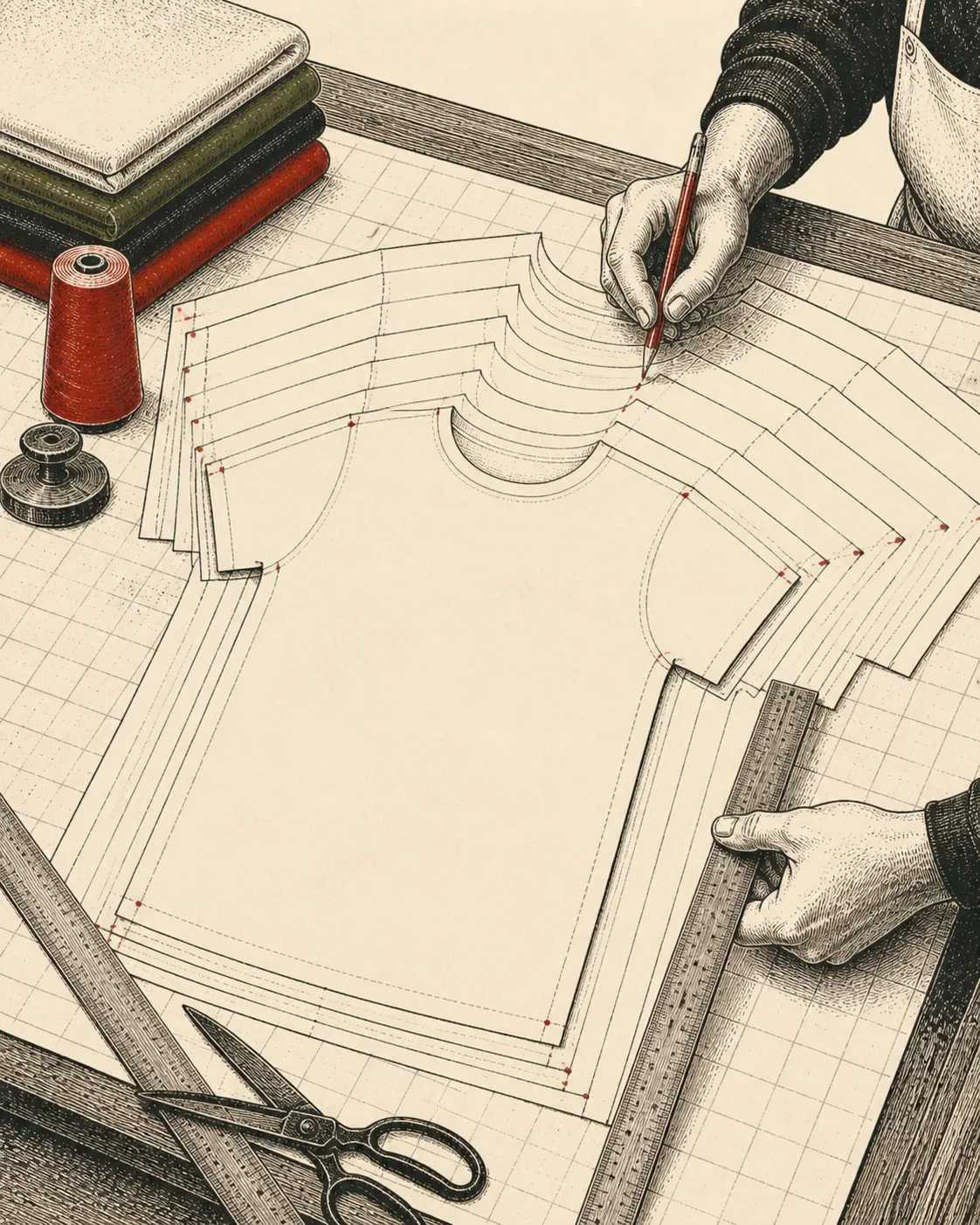
A pattern gets made once. Everything after that is arithmetic.
That’s the part of clothing manufacturing that surprises people who assume every size in a size run was individually drafted and fitted. It wasn’t. A patternmaker builds one pattern, at one size, and every other size in that garment’s range is derived from it by adding or subtracting fixed amounts at set points on the pattern pieces. The industry calls this grading, and its own technical description is blunt about the limit built into it: grading, per the summary on Wikipedia’s pattern grading entry, “will not create shape, but will only increase or decrease size of original shape.” The shape is fixed the moment the base pattern is approved. Every size after that is the same shape, larger or smaller.
What the base pattern actually is
The starting point has two names in the trade, base size and sample size, and they mean the same pattern: the one built first, fitted first, and photographed for the lookbook. It’s usually developed and tested on a fit model, a person a brand employs specifically to try garments on so the design team can judge how the cloth moves and sits on an actual body rather than a dress form. Fit models are chosen against a target measurement spec, and in the US that spec commonly lands around a size 4; Australian agencies size their fit models to roughly a size 10 at about 170 centimeters, according to the reference entry on fit models. Whichever number a given brand lands on, the practical consequence is the same: one body, near one end of the eventual size range, is the only body the garment was actually tried on before grading began.
Before any of this was standardized, there was no base pattern to speak of, because there was no size run. A tailor cut for one client at a time, took that client’s own measurements, and recorded them on a strip of parchment or paper kept as a trade secret, sometimes passed to an apprentice when the tailor died. Grading as a repeatable system arrives with the German mathematician Henry Wampen, whose anthropometric tailoring method was published in 1834 and republished in an Americanized translation in 1842. Ebenezer Butterick took the idea further in 1863, mass-producing tissue-paper patterns cut to multiple sizes rather than one client at a time, which is the moment graded sizing stops being a tailor’s private method and becomes an industry. Even then, a shopper bought one size in one envelope; the multi-size envelope covering a run of sizes in a single package didn’t become the retail standard until the 1970s.
Grade rules, grade points, and what actually moves
A grade rule is the fixed amount a given point on the pattern moves for each step up or down in size. A grade point is where that rule gets applied: a shoulder seam, a side seam, an armhole notch, a hem. Every pattern piece for a garment carries a set of these points, and every point carries its own rule, because a shoulder doesn’t need to widen by the same amount a hem needs to drop. Stack every size’s version of every piece on top of each other, aligned at a common reference point, and you get what patternmakers call the nest: the whole size run visible at once, each outline sitting just outside or inside the last like a set of measuring cups.
Three methods do this work, oldest to newest. Cut and spread is exactly what it sounds like: slice the pattern at the grade points and physically spread the pieces apart to enlarge, or overlap them to reduce, using nothing more than a ruler, a pencil, and scissors. Pattern shifting moves the whole pattern a fixed distance and redraws the outline from the new position. Computer grading, the newest of the three, digitizes the base pattern and lets software apply the grade rules mathematically, which is faster and more precise but is still running the same underlying logic a patternmaker was running by hand with scissors in the nineteenth century. None of the three methods reshapes anything. They all move the same lines the same fixed distances, and that fixed distance is the limitation the whole system runs on.
Why the far end of the size run fits differently
This is where the compromise built into grading actually lands on a customer. A grade rule is one number applied uniformly across a size step, but a human body does not grow uniformly between a size small and a size extra-large. Torso length, shoulder slope, and arm circumference don’t scale at the same rate a chest measurement does, so a rule tuned to look right one size away from the base pattern accumulates error the farther a size sits from it. The base size, remember, was fitted on one body, and that body was usually close to the smaller end of the range a brand sells. Everything above it is extrapolation, and extrapolation compounds. A size two steps from the base inherits twice the accumulated assumption a size one step away does; a size four or five steps out, common in a men’s run that spans small through 2XL, is carrying a shape that was tested on a body nowhere near its own.
None of this is a flaw a brand is hiding. It’s the arithmetic working exactly as designed, and the honest fix costs money most size runs don’t get: a second fit model at the larger end of the range, and a second round of fitting rather than a single extrapolated grade rule for the whole run. Some brands do exactly that, grading in two directions from two tested points instead of one. Most don’t, because it doubles the sample and fitting cost for a size that sells in smaller volume than the middle of the curve. That’s a business decision with a real customer cost attached to it, not a secret.
What this means for buying anything off a size chart
A size chart tells you the finished measurements grading produced, not how faithfully those measurements track an actual body at that size. Reading the chart is still the right move, since it’s the only number that reflects what was actually cut. But it’s worth knowing that the chart’s smallest and largest entries carry more uncertainty than the middle ones, for the specific reason above: the middle sizes sit closest to whatever body the pattern was built and tested on, and the far ends are further along a line that was never re-checked against a person wearing the result.
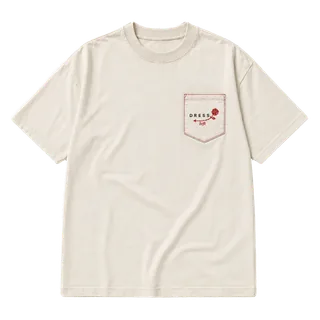
Our own tees run S through 2XL from one base pattern, boxy through the shoulder and straight through the hem by design, made to order after you choose a size rather than pulled from a pre-cut floor stock. That doesn’t exempt the largest or smallest size from the same grading math every other brand runs. It just means the pattern gets checked against the chart before it goes out, not assumed.