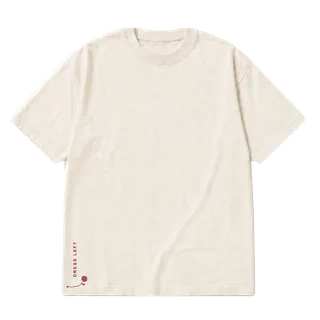
Every screen print begins as a fight with the art file. A design that looks like one image is really a stack of colors, and screen printing needs them apart: one stencil per ink. Our rose is a two-color job, red mark and ink-black text, so the file splits into two separations, each printed as an opaque black positive on clear film. The computer’s job largely ends there. Everything after is hands.
The screen itself is a frame stretched with fine polyester mesh, coated in a darkroom with a light-sensitive emulsion and dried. The film positive gets sandwiched against the coated mesh and blasted with light. Wherever light hits, the emulsion hardens; wherever the film’s black art blocked it, the emulsion stays soft and washes out under a spray, leaving open mesh in the exact shape of the design. What comes out of the washout booth is a stencil that can survive thousands of impressions.
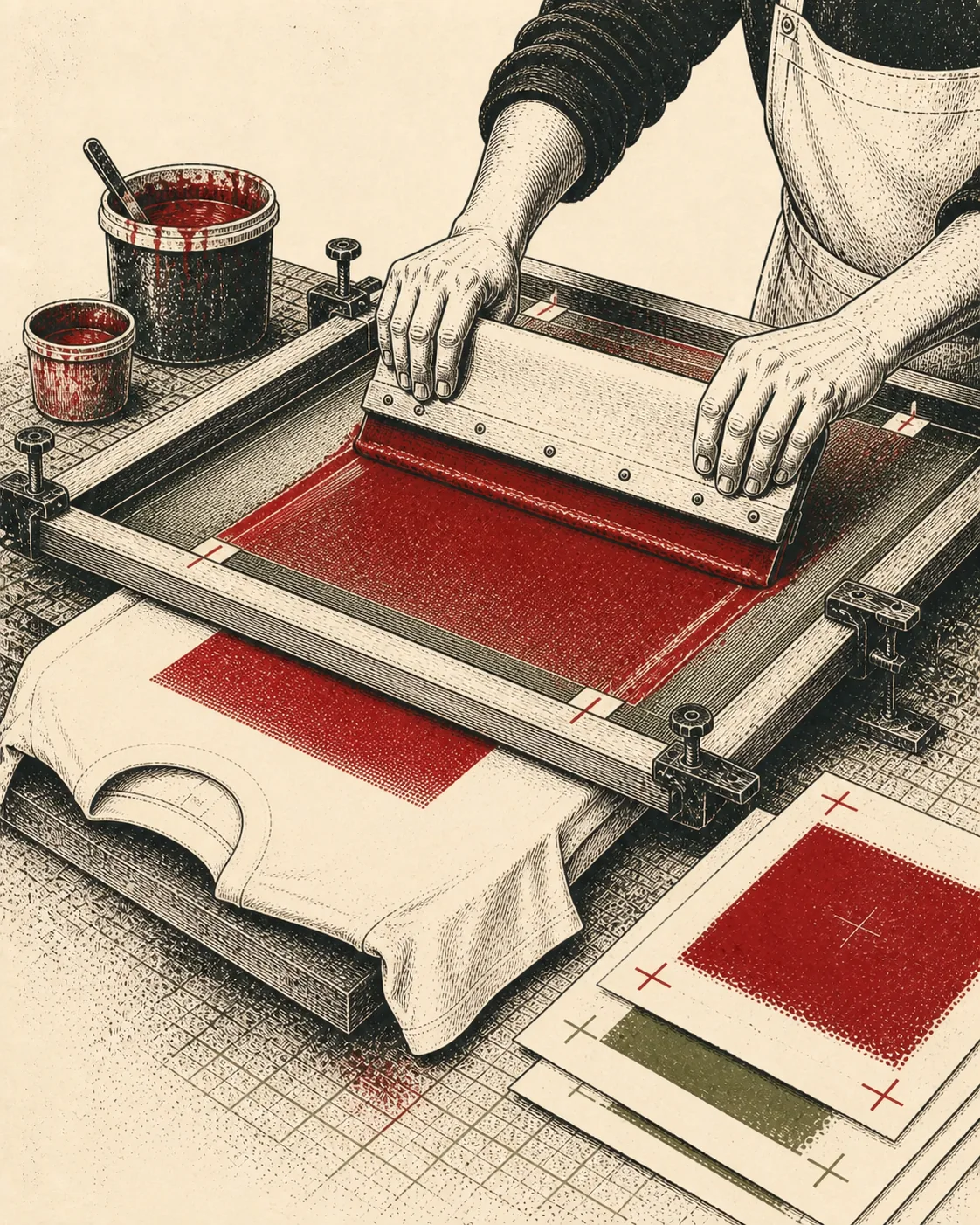
On press, each color’s screen clamps into its own arm above a rotating carousel of platens, the flat boards each shirt gets loaded onto. Registration is the fussy art of aligning every screen to the same coordinates so the red rose lands exactly where the black outline expects it; a sixteenth of an inch of drift reads as a printing error from across a room. Printers register with micro-adjusting clamps and test prints on scrap, and a good registration is the difference between crisp and carnival.
The pull is the part everyone pictures: ink flooded across the screen, then driven through the open mesh with a squeegee at an angle and pressure that printers argue about the way bakers argue about hydration. Dark garments usually take a white underbase first, flash-dried in seconds, so top colors sit bright instead of sinking into the dye. Our cream tees skip the underbase; the ink colors sit dense on the light ground.
Then the step nobody sees and every wash reveals: the cure. Plastisol ink doesn’t dry, it fuses, and only when the entire ink film reaches curing temperature, around 300 degrees Fahrenheit for standard formulas, on its trip through the conveyor dryer. Under-cure by twenty degrees and the print looks perfect at the folding table, then cracks apart by wash five. Good shops verify with temperature strips and wash tests rather than trusting the dial. It’s exactly the kind of invisible diligence that union scale tends to pay for, and exactly why a print’s durability tells you about the shop that made it.
From art to cure, a two-color run involves maybe eight judgment calls that never appear on the invoice. The shirt remembers all of them.