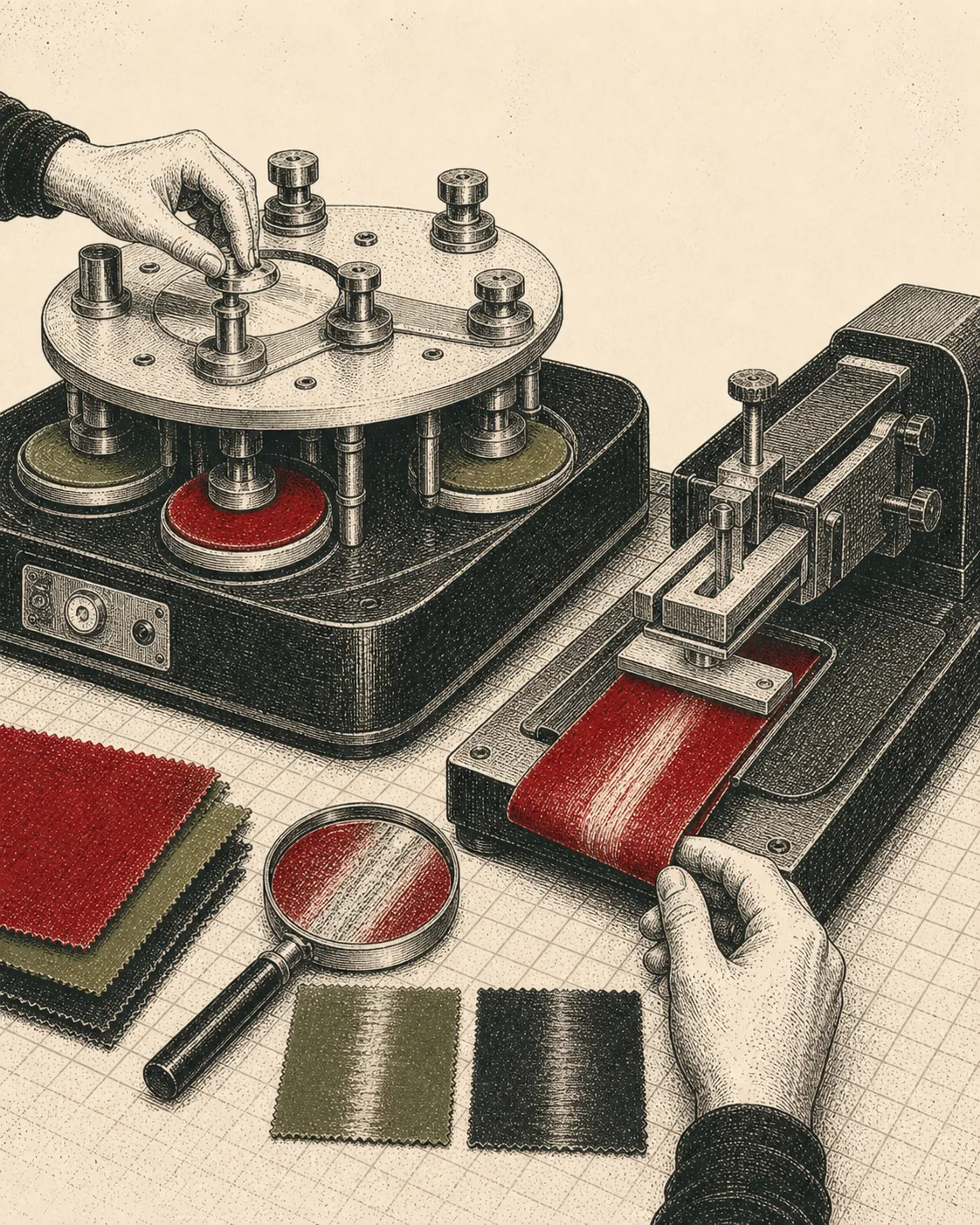
ASTM D4966 runs to eleven pages. It specifies a circular clamp, a figure-eight motion, a piece of worsted wool as the abradant, and a pressure of 12 kilopascals against the sample. It has existed in some form since the 1980s, most recently reissued in 2022, and it produces one number: how many cycles a fabric survives before it visibly breaks down. Any lab with a Martindale tester can run it in an afternoon. Almost no apparel brand ever publishes the result.
What the Martindale test measures
The Martindale method, standardized as ASTM D4966 in the United States and as the ISO 12947 series internationally, mounts a round fabric sample flat and abrades it in a small figure-eight against worsted wool cloth under fixed pressure. A technician checks the sample at set intervals and stops the test once a defined amount of visible damage appears, typically two yarns broken in a woven fabric or a hole in a knit. The result is a cycle count: 20,000 cycles, 40,000 cycles, whatever number the sample reached before it failed. ISO splits the method across several parts, one covering the testing apparatus itself, one for judging when a specimen has broken down, one for measuring mass loss, and one for judging surface appearance change, but the abrading motion at the center of all of them is the same figure-eight against wool.
ASTM’s own documentation for D4966 includes a caution worth repeating here: the method is explicitly not considered satisfactory for acceptance testing of commercial fabric shipments, because between-laboratory results vary and a cycle count from one lab does not automatically transfer to real-world wear without a separate correlation study. That caveat does not make the test useless. It means the number tells you how one fabric compares to another fabric run on the same machine, not how many days a shirt will survive in a closet.
What the Wyzenbeek test measures
The other standard method goes by the name of the machine that runs it. Wyzenbeek is ASTM D4157, formally titled Abrasion Resistance of Textile Fabrics (Oscillatory Cylinder Method), and it works on a different principle than Martindale entirely. A fabric sample is clamped flat under tension and rubbed back and forth in a straight line by an oscillating cylinder faced with an abradant, usually a heavy cotton duck cloth or a wire mesh screen, depending on what the fabric is meant to survive. One complete back-and-forth pass counts as one double rub, and the test runs until the sample fails a defined visual standard, at which point the double rub count at failure becomes the reported result.
The two tests were built for different fabric behaviors. Martindale’s figure-eight motion and soft wool abradant tend to suit finer wovens, knits, and upholstery meant for indirect contact. Wyzenbeek’s straight-line motion under tension and coarser abradant was built for the kind of hard, directional friction upholstery gets from someone sliding across a chair seat, which is part of why it became the North American standard for commercial furniture fabric specifically.
Why the two numbers don’t convert
A fabric rated at 30,000 Wyzenbeek double rubs is not, by any sanctioned formula, equivalent to a specific Martindale cycle count. Trade articles and fabric wholesalers circulate rough ratios, most commonly something near two Martindale cycles for every one Wyzenbeek double rub, but neither ASTM nor ISO publishes that ratio or endorses it, and it does not hold consistently across fabric types. A heavy woven canvas tends to score relatively better under Wyzenbeek’s linear cotton-duck abradant than it does under Martindale’s wool figure-eight; a soft plush or chenille tends to run the other way. The two tests are measuring the same general property, resistance to surface wear, with different mechanics, different abradants, and different pressures, and a number from one does not translate into a number from the other. Anyone specifying a fabric for a real project should ask which test produced the figure they’re looking at, because the figure alone doesn’t say.
Upholstery publishes this. Apparel doesn’t.
Walk into a fabric showroom that supplies commercial interiors and every bolt on the shelf carries a rub count, because it has to. The Association for Contract Textiles, the trade body that sets performance guidelines for commercial upholstery, publishes minimum thresholds by use category: fabric intended for low-traffic private offices needs to clear a lower Wyzenbeek and Martindale number than fabric going into a hospital waiting room or a hotel lobby. A furniture buyer specifying fabric for a hundred-seat conference room can compare two bolts on the same numeric scale, because the industry built a disclosure requirement around a test that already existed.
ACT’s published guidelines put numbers on that comparison directly. Fabric bound for low-traffic private spaces needs to clear 15,000 Wyzenbeek double rubs or 20,000 Martindale cycles. Fabric bound for high-traffic public spaces, a hotel lobby chair, a hospital waiting room bench, needs to clear 30,000 double rubs or 40,000 cycles. Note that ACT lists both numbers side by side rather than converting one to the other, which is the trade body itself declining to do the math this piece just spent two sections explaining nobody can do.
No comparable requirement touches a t-shirt. The same ASTM and ISO methods apply just as well to garment-weight cotton jersey as they do to upholstery velvet; a Martindale tester does not know or care whether the sample in its clamp is destined for a sofa or a shirt. What’s missing is not a test method. It’s a reason to run it. Upholstery has one, because commercial buyers require the number before they’ll sign a purchase order. Apparel has never developed that requirement, because a shopper buying a shirt off a rack has no equivalent gate to clear, and no retailer has built one for them. The absence of a published durability number in apparel is not a gap in the available science. It’s a choice nobody with market power has ever been forced to make differently.
That gap runs straight through marketing copy, too. “Durable” appears on more hangtags than any comparable technical adjective, attached to garments that were never run through D4966 or D4157 at all. The word costs a brand nothing to print and asks nothing of the fabric behind it, which is exactly why it shows up so often on t-shirts and so rarely on a chair. A furniture buyer who reads “durable” on a bolt without a rub count attached walks away, because the category has trained them to expect the number. A shopper who reads “durable” on a hangtag has no equivalent training, because no apparel brand has ever had to give them one, and so the word does the job a number should be doing.
What we haven’t tested
DRESS has not run Martindale or Wyzenbeek testing on the Logo Tee or on any other garment we sell, and this piece is not the place to start implying otherwise with careful wording. The Logo Tee is cut from 6.1 oz cotton jersey, heavier than the 4 to 5 oz weight common in mass-market fashion tees, and a denser knit has more fiber mass for an abradant to work through before it thins or tears. That’s a real mechanical property of the fabric, and it’s a fair thing to say. It is not a cycle count, and nothing on our site claims one. Saying “made to last” without the number behind it is the exact move this piece is about, and we’d rather name that than pretend the sentence is something more than a description.
If a bolt of the jersey we use ever goes through a Martindale tester, that number belongs on the product page, next to the weight and the fiber content, reported honestly by whichever standard produced it. Until then, the shirt gets described by what’s actually known: the weight, the knit, the cut, and the fact that nobody has clocked how many cycles it takes.