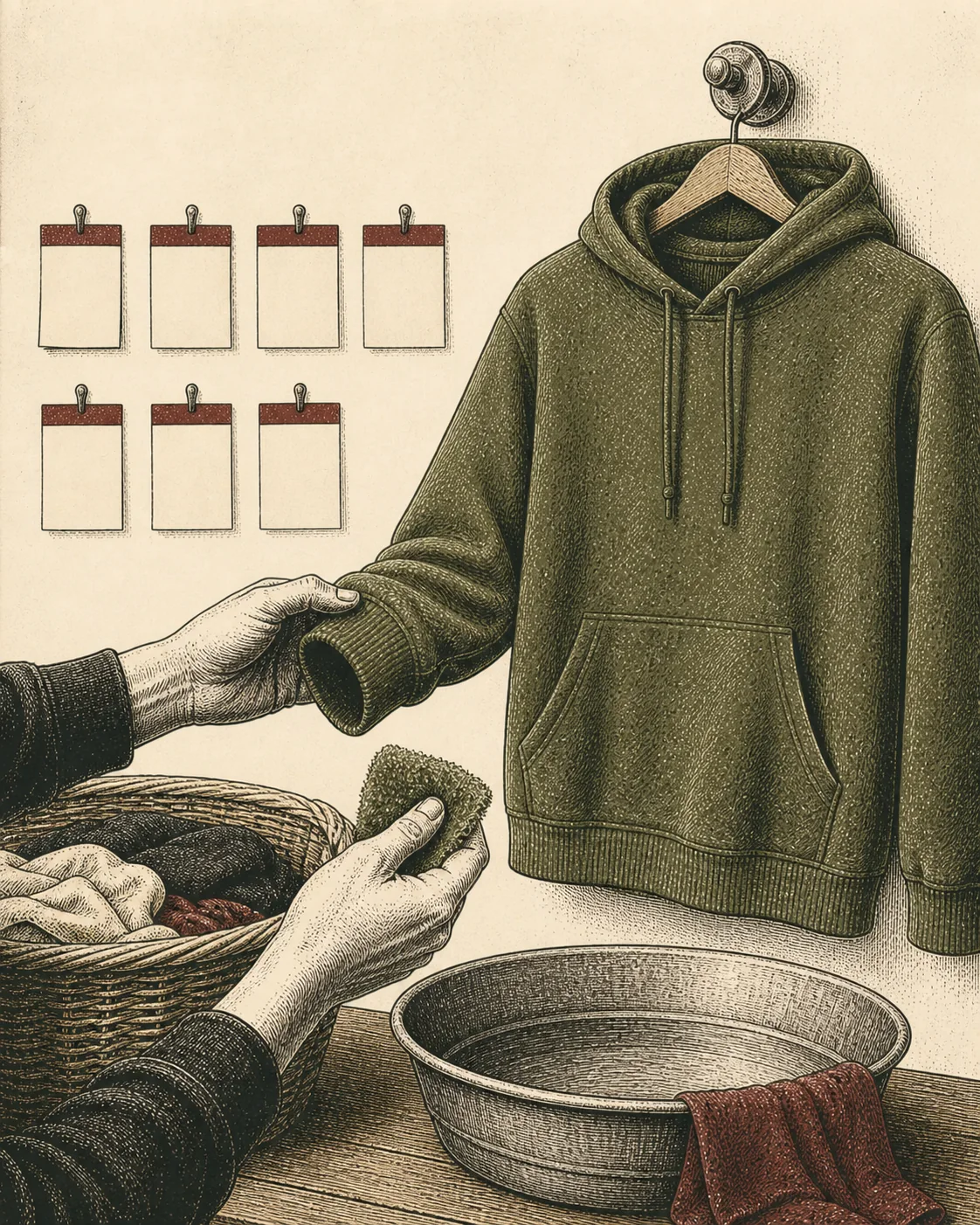
Three to four wears, if the hoodie sits over a shirt. That is the figure the American Cleaning Institute gives for sweaters and sweatshirts, a category a hoodie sits squarely inside, and it is a lower number than most people run their machine on. A t-shirt worn against skin gets washed every time. A hoodie worn over one does not, because the layer underneath is doing the absorbing.
The confusion comes from treating every garment like it touches the same amount of you. It doesn’t. A t-shirt sits against skin for a full day and picks up oil, sweat, and dead skin directly. A hoodie usually sits over that t-shirt, one layer removed from the body, catching ambient odor and the occasional coffee drip rather than a day’s worth of skin contact. Teresa Hunsaker, family and consumer sciences faculty at Utah State University Extension, laid out the American Cleaning Institute’s numbers in a 2021 laundry guide: t-shirts every wear, sweaters and sweatshirts every three to four wears. The gap between those two numbers comes down to skin contact, not habit.
When the three-to-four-wear rule doesn’t apply
The rule assumes ordinary contact. It breaks the moment the hoodie does something a sweater doesn’t: gets worn during a workout, worn against bare skin, or worn until it smells like it. The American Academy of Dermatology’s guidance on exercise-related acne recommends washing workout clothing after every single use, and explains why in plain mechanical terms: exercise causes sweating along with a buildup of oil, dirt, and bacteria against skin, and unwashed clothing keeps that buildup in contact with pores between wears. That is a hygiene floor, not a style preference. If a hoodie served as the top layer on a run, it goes in the wash that day regardless of how many times it’s been worn since the last cycle.
Search the question and a wall of numbers comes back: four to six wears, five to seven, two to five. Almost none of those figures trace to a named laundry scientist or institution; most are apparel retailers restating each other. The American Cleaning Institute’s three-to-four figure is the one with an actual organization behind it, so it’s the number this piece uses, with the honest caveat that fabric, climate, and how hard a person sweats will nudge any of these ranges in either direction. Nobody has run a controlled study measuring the exact wear count at which a hoodie crosses from clean to dirty; the guidance is closer to informed convention than to a lab result, which is also why the American Academy of Dermatology’s every-use rule for workout clothing carries more weight where it applies. That one is tied to a specific, testable mechanism (sweat and bacteria against skin causing breakouts) rather than a general sense of how sweaters behave.
Stains and smell override the count either direction. A hoodie that’s been worn twice but sat too close to a campfire needs a wash. A hoodie that’s been worn six times but never left the couch, never touched a gym, and never got anything spilled on it can keep going a little longer than the guideline suggests. The number is a default, not a rule with an exception clause; it exists because most people default to washing after every wear and that default is wrong for this category of garment.
Washing is the hard part, not wearing
The reason underwashing is the better default has nothing to do with laziness and everything to do with what a washing machine actually does to fiber. A day on a body is gentle: fabric flexes, absorbs a little moisture, gets exposed to light. A wash cycle is not gentle. Agitation rubs fiber against fiber and against the drum, hot or warm water swells and relaxes cotton, and detergent strips oil (including the natural oil in the fiber itself) along with whatever it was meant to remove. Dry heat finishes the job, curling and shortening fibers until they eventually work loose as lint. Every wash cycle is a small amount of permanent wear, spread across the whole garment at once, in a way that a day of sitting on a couch is not. Wash a hoodie every day and the fleece pills, the print starts to crack at its edges, and the color goes flat years before the seams give out. Wash it every three or four wears and the same hoodie ages the way a heavier garment is supposed to: slowly, and mostly through use.
The math is simple once it’s laid out. A hoodie washed after every wear, worn twice a week, goes through the machine roughly 100 times a year. The same hoodie washed on the three-to-four-wear standard goes through it 25 to 35 times, a difference of two to three times fewer cycles over a single year and a much larger gap compounded across a garment meant to last several. Brushed-back fleece is especially exposed to this math, because the brushing that gives it its soft face is short fiber standing up off the surface, and short fiber is exactly what a wash cycle pulls loose first. Fewer cycles means the nap stays raised longer before it packs down flat.
What actually shortens the interval
A few conditions genuinely move the number down, and they are worth separating from the ordinary case because they’re common. Exercise is the clearest one, covered above. Humid climates and heavy natural sweating move the number down even for non-workout wear, since bacteria that cause odor thrive in the same conditions bacteria that irritate skin do. Wearing a hoodie with nothing under it, against bare skin, functions more like a t-shirt than a sweatshirt and should probably be washed on the t-shirt schedule. None of these change the mechanism: skin contact and sweat are what push a garment toward the washer, and the more of either, the sooner it goes.
Washing it right, when it’s time
Cold water, inside out, is the standard care instruction for a cotton-rich fleece hoodie, and it matters more than the interval question. Inside out protects a printed graphic from the friction of the drum. Cold water is slower to set a shrink than hot, and a hoodie that shrinks does it once, mostly in length, the first time it meets real heat. Hang drying avoids that heat altogether; a tumble on low is fine if a little shrink over the garment’s life is an acceptable trade for convenience.
Our Rose Hoodie is 8.5 ounces of cotton-rich brushed-back fleece with a two-color graphic printed the length of the back, and the care line on its product page says exactly this: machine wash cold, inside out, hang dry, or tumble low if a touch of shrink is fine. That instruction exists because the fleece and the print both last longer under it, not because the hoodie is fragile.
The washing machine will eventually be the reason a hoodie wears out, more than the person wearing it ever will.