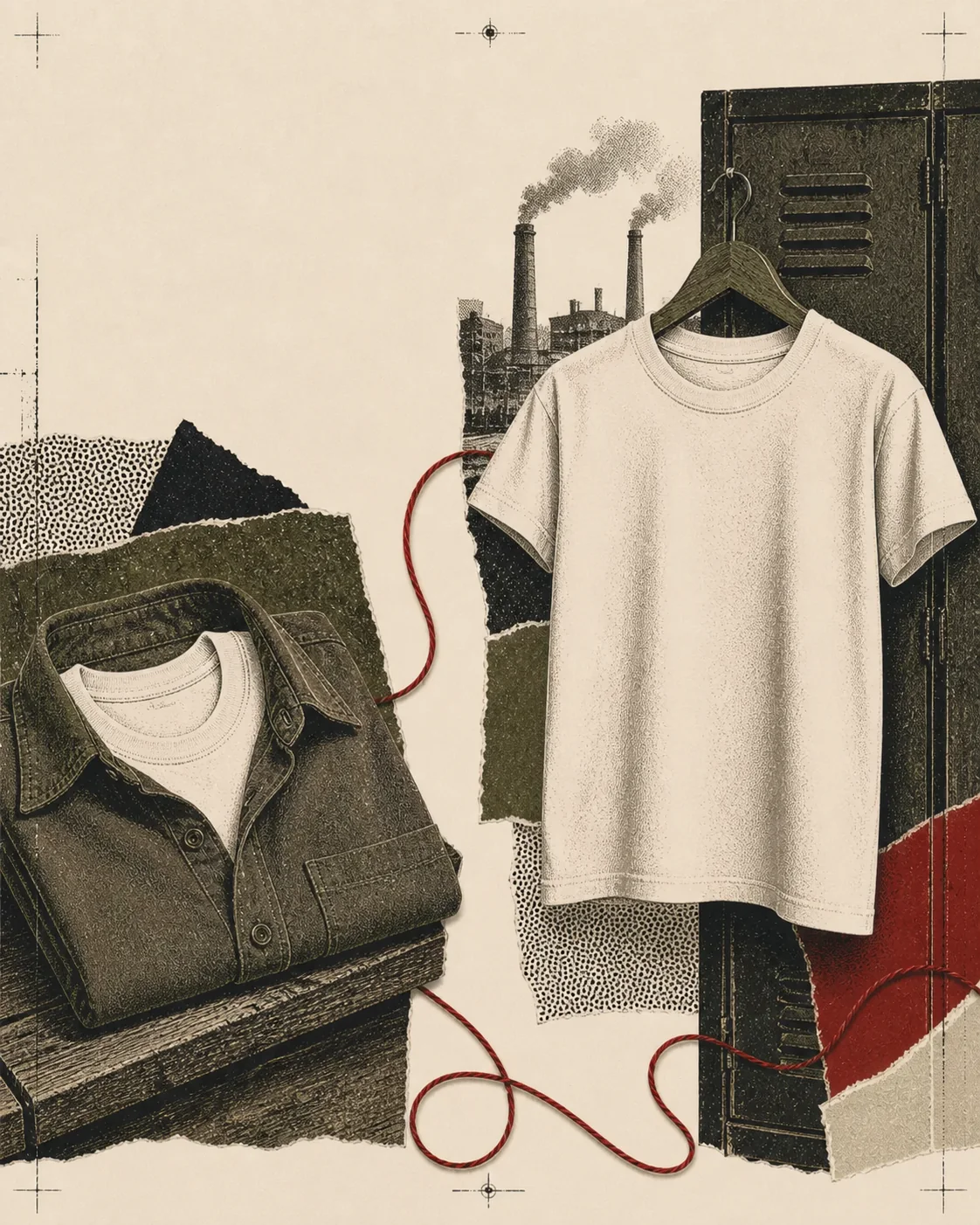
A sailor in 1913 owned three undershirts and never expected anyone to see them. The US Navy’s Uniform Regulations, issued that January by the Navy Department, spelled out the requirement in Article 191: heavy, medium, and light weights, the heavy one knitted of wool and cotton to resist shrinking and bleached white, the light one cut with sleeves barely long enough to cover the armpit. Nothing in the text calls it a t-shirt. Nothing in the text treats it as new. It reads the way an equipment manual reads when it is updating a category that already exists, not announcing one.
That distinction matters, because the story usually told about the t-shirt skips straight from “the Navy invented it in 1913” to “Marlon Brando made it cool in 1951,” and both halves of that sentence do more work than the evidence supports.
What the Navy actually prescribed
The 1913 regulations are specific in a way that is useful precisely because it resists romance. Article 191 lists three undershirt weights available to every enlisted man. Article 192 describes the heavy undershirt: wool and cotton blended to prevent shrinkage, an elastic collarette with no buttons, long sleeves. Article 193 describes the medium weight at about half that mass, sleeves stopping above the elbow. Article 194 describes the light weight, sleeves only long enough to cover the armpit. These are undergarments, drawn from the pay officer, marked with the owner’s name on the inside front, worn under a jumper or overshirt and never alone on deck except when heat made the senior officer signal a modified uniform of the day.
The same document is also explicit that it is not creating a new wardrobe from nothing. Article 39 notes that the jersey, a separate knit item, would cease to be a required article of uniform after July 1, 1913, “except at the Newport and Great Lakes training stations,” language that assumes an established system of garments being adjusted rather than founded. The Naval History and Heritage Command’s own record of Navy uniforms in the years before 1913 covers the same period as one of continuous revision, not a single invention date. The popular shorthand, that the Navy invented the t-shirt in 1913, collapses decades of incremental regulation into a single stroke of a pen that never happened.
A second popular claim complicates the record further, and not in the Navy’s favor. Several accounts credit the Cooper Underwear Company, later Jockey International, with inventing the pullover undershirt in 1904, selling it to men as a “bachelor undershirt” with the slogan “no safety pins, no buttons, no needle, no thread.” Snopes examined the claim in 2018 and found two problems: the ad’s 1904 date has never been independently verified, and even if the ad is genuine, it shows underwear meant to be worn beneath a buttoned shirt rather than a garment anyone was meant to see alone. It is evidence that pullover cotton undershirts existed early in the century, not evidence of a single inventor or a clean origin date, and treating it as one repeats the same tidy-arc problem as the Navy story, just a decade earlier.
The catalog got there before the movie stars
If there is a real inflection point, it shows up in mail order, not in a uniform manual or a film reel. Sears, Roebuck and Co.’s 1938 catalog advertised a garment listed as a “Gob” style all-purpose shirt, gob being contemporary slang for a Navy sailor, and sold it for wear as both an undershirt and a standalone top. That listing, documented in period catalog scans, puts a retailer marketing the t-shirt as outerwear more than a decade before Hollywood is usually given credit for the same shift. Sears was selling twenty-four cents of cotton to a customer who had already decided, on his own, that a plain white shirt was worth wearing in public, no war story or screen idol required.
That decision did not arrive from nowhere. World War II photographs of soldiers and sailors in undershirts alone, working or relaxing in heat that made a full uniform impractical, had already put the garment in front of a civilian public for years before either film in question was shot. By the time Hollywood cast its two most famous t-shirts, the public had spent a decade watching servicemen wear the thing bare, and at least since 1938, a mail-order catalog had been telling customers it was fine to do the same.
Two films, four years apart
The two moments most often cited did happen, and they happened roughly as described, though even here the dates deserve precision instead of a blur. A Streetcar Named Desire premiered in New York on September 19, 1951. Marlon Brando played Stanley Kowalski in a shirt the costume department dyed and washed repeatedly until it shrank tight, then tore at the shoulder for a scene where his character has been scratched. It is costume work, deliberate and specific, not a documentary record of what men wore on the street.
Rebel Without a Cause opened October 27, 1955, a month after James Dean died in a car crash on September 30 of that year. Dean’s Jim Stark wore a plain white crew-neck with jeans and a red jacket, a combination that became, almost immediately, a template for a certain kind of American cool. Undershirt sales had reportedly dropped for a period after Streetcar, on the theory that men no longer wanted to be seen in what suddenly read as underwear in public; sales rose again after Rebel, an odd reversal that undercuts any claim that either film alone settled the question.
Why the tidy version survives anyway
The clean story, Navy origin in 1913, Hollywood breakthrough in the 1950s, survives because it is a good story, with a beginning, a costume change, and a recognizable cast. What the primary sources show instead is a garment moving in fits across four decades: formalized by a military bureaucracy that was already revising an existing item, marketed by mail order as outerwear a decade before the movies got credit for the idea, and pushed back and forth in public opinion by two films that did not agree with each other about whether the shift should stick. None of that fits neatly into a single sentence, which is probably why nobody tells it that way.
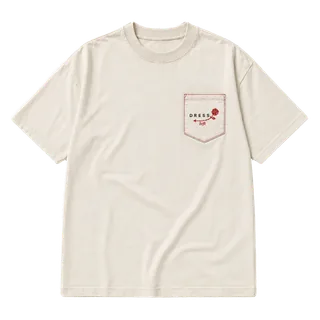
Union floors have been cutting and sewing that same six-ounce cotton for a century now, whichever version of its history you believe. Our own logo tee is 6.1 ounces of heavyweight jersey, cut boxy through the shoulder, made to hang straight rather than cling, because that is still what makes a plain shirt worth wearing alone.