
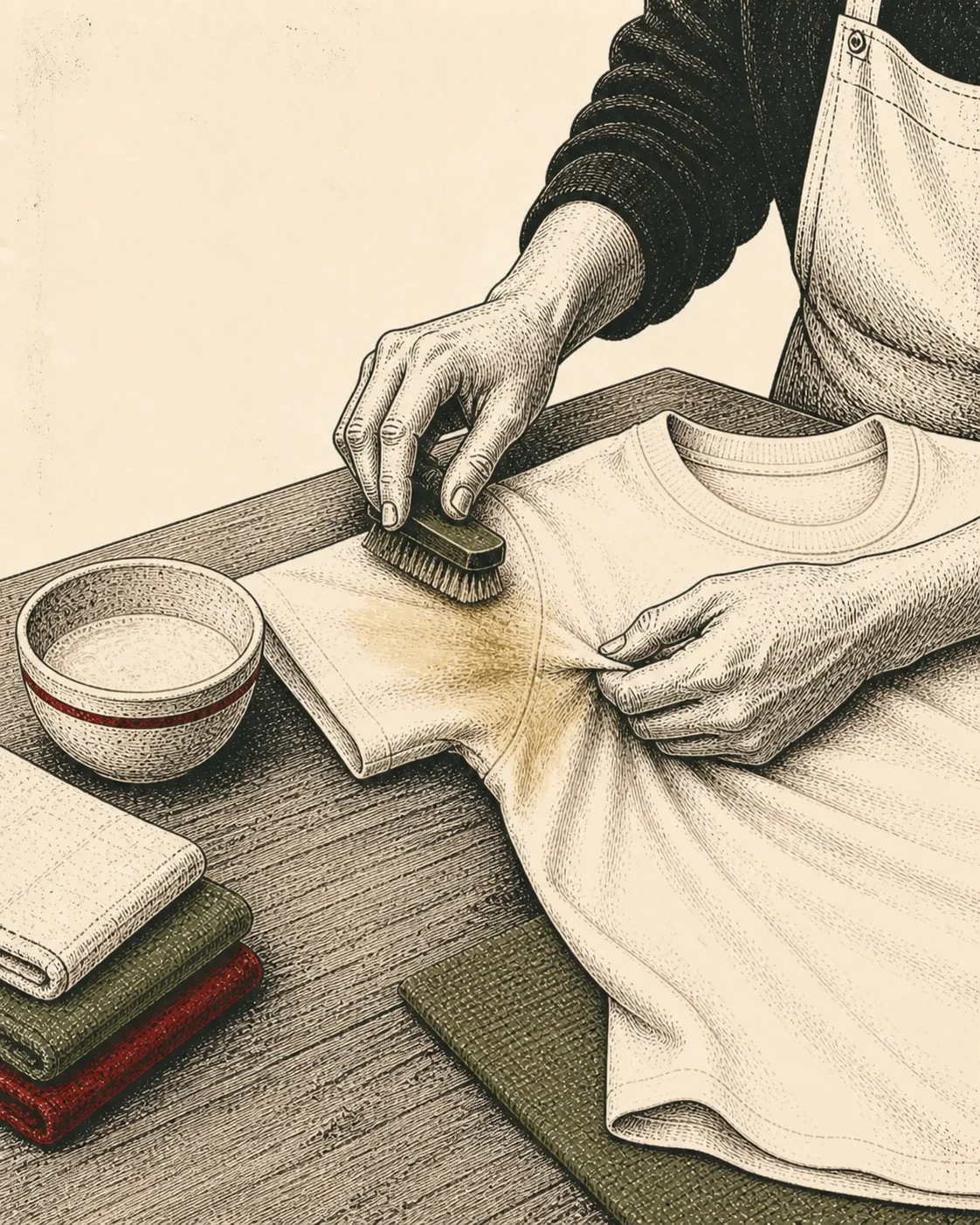
Yellow armpit stains are aluminum, protein, and oxidized skin oil, and sweat alone rarely produces them. A shirt worn without antiperspirant, sweat and all, tends to dry pale or leave nothing at all. The yellow ring comes from the antiperspirant: aluminum salts that plug the sweat duct also bond with the protein in sweat and the oil (sebum) on your skin, and that mixture oxidizes into a stain that gets harder to remove the longer it sits.
What is actually in the stain
A 2011 Colgate-Palmolive patent on antiperspirant formulation, WO2011050044A1, lays out the chemistry plainly: “While aluminum alone does not cause yellowing, the aluminum in combination with sebum and/or sweat contribute to the yellowing.” The aluminum’s job in the stain is structural. It binds sebum and other soils to the cotton fiber, holding them in place through wash cycles that would otherwise rinse them out. Once bound, those soils are oxidizable, and the patent notes that body heat and the higher temperatures of laundering and drying push that oxidation along, with iron traces in tap water or fabric sometimes deepening it further.
Sebum itself is an ordinary mix of triglycerides, wax esters, and squalene, an oil your skin produces constantly and that transfers to any fabric touching it. Xin Chi and S. Kay Obendorf ran the relevant experiment in 1998, soiling cotton with squalene and tracking its color over time: the fabric yellowed as it aged, and adding antioxidants (compounds that block oxidation) measurably slowed the discoloration. That is the same reaction happening in a shirt collar or an underarm seam, minus the lab conditions. Aluminum concentrates the oil and protein in one spot and holds it there; oxidation does the coloring.
This is why a shirt can look clean the day you wear it and turn yellow weeks later. The stain is not deposited yellow. It develops.
Why chlorine bleach is the wrong tool
Chlorine bleach is a strong oxidizer, and oxidation is the exact reaction that produced the yellow color in the first place. Pouring an oxidizer onto an already-oxidizing patch of protein and fat does not reliably reverse the reaction; it can push it further, deepening the stain instead of lifting it, especially once the compound has aged and bonded into the fiber. Chlorine bleach also does nothing to break the aluminum-protein bond that is anchoring the stain to the cotton, so even where it does not visibly worsen the color, it is attacking the wrong part of the problem.
Cornell Cooperative Extension’s home stain-removal guide, a protocol traced back to a 1975 paper in Textile Chemist and Colorist and revised through 2005, treats deodorant and perspiration stains as “water soluble body waste,” a category it works through with detergent and ammonia, then detergent and vinegar, then alcohol, and only reaches for chlorine bleach as a last step to lift final traces, applied for no more than two minutes and flushed immediately. The guide bans chlorine bleach outright on wool, silk, and spandex, and elsewhere in the same document lists chlorine bleach among the agents that can permanently and unrecoverably alter a fabric’s color if misused. Bleach here is a narrow, time-limited tool, not the opening move, and even Cornell’s own sequence does not promise the color will fully lift.
The sequence that works on a fresh stain
Start before the stain sets. Wet the underarm area with cool water, then work in a mild detergent solution with a few drops of ammonia, pressing and blotting rather than rubbing, which spreads the stain instead of lifting it. Follow with a detergent-and-vinegar pass to neutralize residue, then flush thoroughly with water. An enzyme presoak, which is any laundry product labeled “enzyme” or “protein stain remover” on the bottle, does real work here because it breaks down the protein component of the bond directly rather than trying to bleach a color that is chemically anchored to the fiber. Give it the full soak time on the label, not a quick spritz.
For a stain that has already yellowed, an oxygen-based bleach (sodium percarbonate or a diluted hydrogen peroxide solution) in a long, warm soak is the better oxidizer to reach for, since it works on the color without the fiber-weakening and yellowing risk that chlorine carries on cotton over repeated use. Several hours, sometimes overnight, is not unusual for a set stain, and checking progress before running it through a hot dryer matters: heat can lock in whatever color is still there.
What will not come out
Not every yellow stain reverses. Once the aluminum-protein-sebum complex has fully oxidized and cross-linked into the cotton over months of wear and wash cycles, the fiber’s own color has changed, not just its surface. No detergent or bleach undoes a structural color change; that is a different problem from a soil sitting on top of clean fiber, and treating it like a removable stain past a certain point wastes a shirt’s remaining life on a fight it cannot win. The practical fix at that stage is prevention on the next shirt: let antiperspirant dry before dressing, since a wet aluminum gel transfers straight onto cotton, and wash a worn shirt within a day rather than letting the reaction run overnight, several times over, in a hamper.
Heavier, densely woven cotton resists this slightly better than thin jersey, since there is more fiber mass for the oxidation to work through before it reaches visible density, though no weight of cotton is immune to a wet aluminum gel and enough time. DRESS tees run 6.1 oz for exactly the kind of durability that buys a shirt a longer fight against ordinary wear, armpit chemistry included.