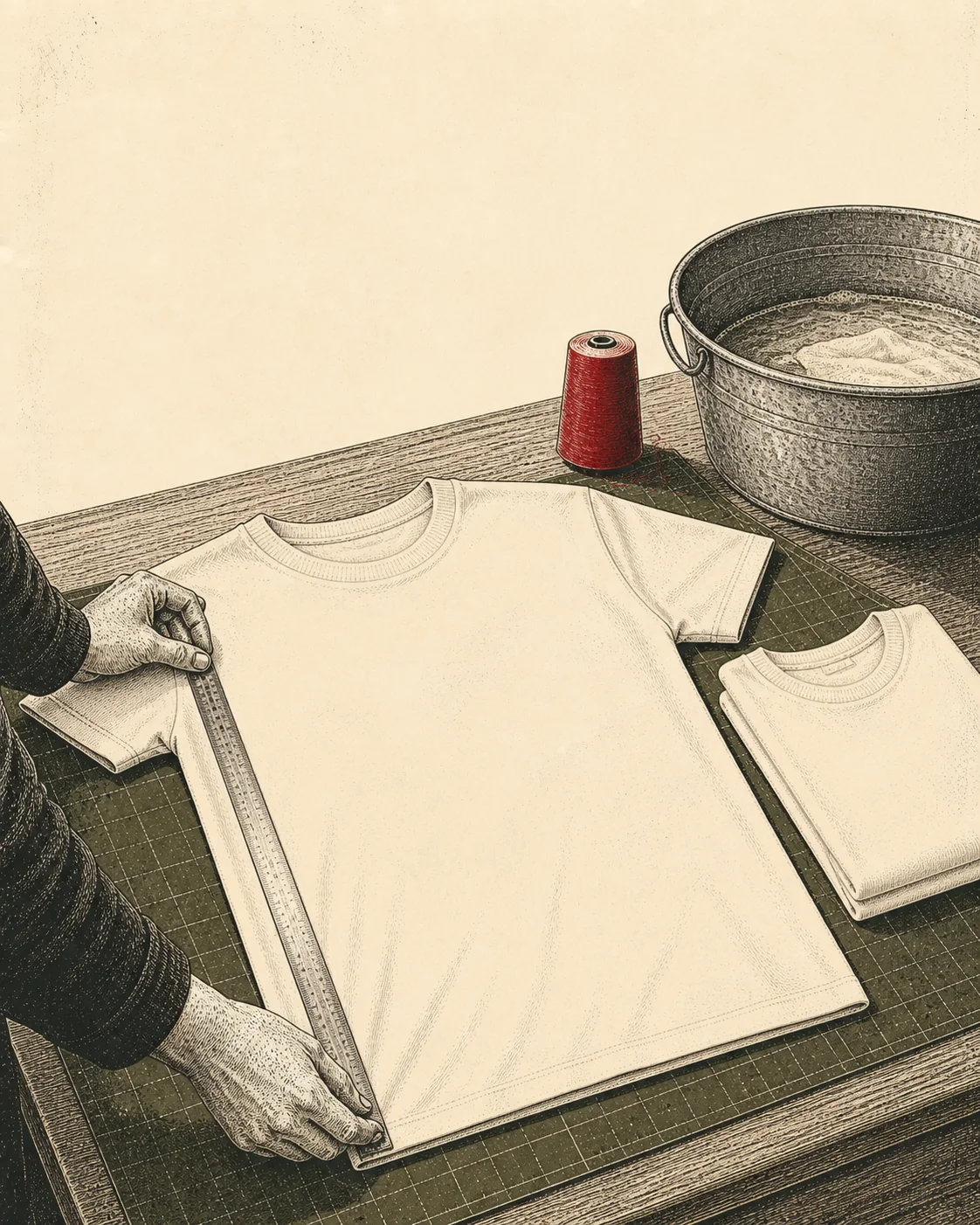
A cotton tee shrinks because the yarn is finally allowed to stop pretending. Every step that makes a t-shirt, from spinning the yarn to knitting the loop to pulling the finished fabric through a dyeing range, stretches the fiber a little past where it wants to sit. Water and tumbling let it go back. That release is called relaxation shrinkage, and it is mostly a one-time event: cotton doesn’t keep shrinking wash after wash the way wool does. Wash cold, skip the hot dryer, and dry flat or on a line, and most of what a shirt has to give simply never happens.
What is actually moving inside the fabric
A knitting machine forms a t-shirt’s fabric out of a single continuous loop of yarn, and the machine holds that loop under tension the whole time it works. Cotton Incorporated’s 2004 technical bulletin on cotton shrinkage lays out what happens next in plain terms: once the fabric gets wet without tension, the loops swell and try to round themselves out, because a round loop is a lower energy state than an elongated one. Rounding a loop shortens it. Multiply that across every loop in a garment and the fabric gets shorter and, often, narrower.
Dyeing and finishing mills call the two main phases of this release elastic shrinkage and drying shrinkage. Elastic shrinkage happens almost immediately, the moment the fiber gets wet and agitated, before any drying starts. Drying shrinkage is the bigger event, and the mill’s own testing found something that runs against the usual advice about heat: tumble-dried samples run at 100°F, 150°F, and 200°F produced nearly identical shrinkage curves. Temperature during drying barely moved the number. What did move it was moisture content. Below about 20 percent moisture, the fiber and yarn “deswell,” the loops finish rounding, and most of the remaining shrinkage happens fast, in a matter of minutes.
The three levers, and what each one is worth
Water temperature during washing turns out to be the weakest of the three levers people reach for. Wetting the fiber is what starts relaxation, and cold water wets it just as thoroughly as hot. The lever that matters is whether the garment ever crosses that low-moisture threshold under mechanical action, which is a description of a tumble dryer, not a washing machine. Line drying or laying a shirt flat removes moisture slowly and without tumbling, so a shirt can sit near bone dry without ever getting the agitation that finishes the shrink. A hot dryer does both at once: it drives moisture down fast and tumbles the fabric the entire time, which is why “I dried it on high” is the sentence that precedes almost every ruined shirt.
Agitation is the lever most people forget, because it is invisible next to a thermostat setting. The same Cotton Incorporated data found that mechanical action alone, with no heat at all, produced shrinkage curves nearly as steep as the heated runs. A dryer’s job, chemically, is to remove water. Its job, mechanically, is to keep tumbling the fabric while it does. Both together are what push a garment to its fully relaxed dimensions. A washing machine’s spin cycle applies some of the same force in miniature, which is one reason an aggressive spin on a delicate fabric can pull a garment slightly out of shape even before it ever sees a dryer.
How much shrinkage a well-finished shirt actually has left
Mills measure this with AATCC Test Method 135, which washes and tumble-dries a marked fabric sample under standardized conditions and records the change in length and width as a percentage. Cotton Incorporated’s published mill data on a 100 percent cotton single jersey shows just how much the finishing step matters to that number. Fabric that went through nothing but a relaxation dryer tested at 7.3 percent shrinkage in length and 3.5 percent in width. The same base fabric, mechanically compacted at the mill, came down to 4.5 by 6.0 percent. Treated with a chemical crosslinking finish instead, it tested at a balanced 5.0 by 5.0 percent. None of those numbers is zero. A shirt labeled pre-shrunk or sanforized has already had most of its available shrink engineered out at the factory; it has not had all of it removed, and the remainder is what a first hot wash and dry will collect.
That first cycle does most of the damage in one pass. The same research found that a single wash and tumble-dry cycle typically removes around 90 percent of a garment’s total available relaxation shrinkage. A shirt that survives its first hot dryer at close to its original size was probably already close to fully relaxed when it arrived; a shirt that loses half an inch in the first wash still had that half inch stored up in the yarn.
Why this isn’t the same thing as felting
Wool shrinks by an entirely different and much less forgiving mechanism. Wool fiber is covered in microscopic scales, and under moisture, heat, and agitation, the scale edge of one fiber locks into the scale gap of its neighbor like a ratchet, according to a 2019 review of shrink-resistance methods by Hassan and Carr in the Journal of Advanced Research. The fibers can only move in one direction as they interlock, so the process never reverses on its own: the same review reports that untreated wool can shrink to roughly 55 percent of its original size after a single laundering. Cotton has no scales. A cotton shirt that has been through a hot dryer is compressed, its loops pulled into their rounded, relaxed shape, not felted. That distinction is also why a badly shrunk cotton tee can sometimes be stretched most of the way back with a soak and some patient reshaping while it dries; a felted wool sweater cannot.
What this means at the washing machine
Cold water, a normal or gentle cycle, and air drying keep a cotton tee close to the dimensions it shipped in, because the fabric never crosses the low-moisture threshold under tumbling that does most of the work. If a dryer is unavoidable, a low-heat setting pulled out while the shirt is still slightly damp cuts the exposure without giving up the convenience entirely. None of this reverses shrinkage that already happened in a previous wash; it only protects what hasn’t happened yet.
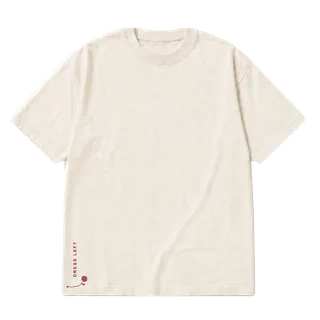
Our tees are 6.1 ounce cotton jersey, finished before the print goes on, and the care instructions on the tag say the same thing this data does: wash cold, hang dry, and the shrink that’s left in the fabric mostly stays where it is.