A tag that reads “100% Cotton, Made in Honduras, RN 12345” is telling you three things the law requires and nothing else. The fiber content, the country where the garment took its final shape, and a number that identifies the company legally responsible for it. Everything else on that scrap of fabric, from “ring spun” to “premium” to a wash icon, is either a separate federal rule with its own logic or a word nobody had to earn the right to print.
The fiber content line is a weight percentage, in order
The Textile Fiber Products Identification Act and its implementing rules at 16 CFR Part 303 require a US garment tag to list every fiber present above 5% of the item’s weight, by its generic name, in order from most to least. A shirt that reads “60% Cotton, 40% Polyester” is telling you cotton makes up more of the fabric by weight, not that it appears first alphabetically or looks better on the label. Anything present at 5% or under can be grouped and named “other fiber” instead of listed individually, which is why a tag sometimes ends with that phrase rather than naming a trace of spandex or nylon.
The word before the percentage matters too. “Cotton” is a generic fiber name defined by the rule. “Ring spun” and “combed” are not fiber names at all; they describe how the yarn was spun and finished, and the FTC does not require, define, or regulate either term. A tag can say “100% Cotton” in full compliance with federal law while telling you nothing about whether that cotton was ring spun, open-end spun, or combed afterward to remove short fibers. When a hangtag leans hard on “ring spun,” that’s a brand volunteering a fact the law didn’t ask for, which makes it worth reading rather than skipping, but it also means nothing stops a brand from printing “ring spun” on a tag with no way for a shopper to check it.
Country of origin is where the garment became a garment
Country of origin under the Textile and Wool Acts is not where the cotton grew or the yarn was spun. It’s where the fabric was cut and sewn into its finished form, the place the FTC calls the point of “substantial transformation.” A shirt cut from cloth woven in one country and sewn together in another gets labeled for the country of assembly. That disclosure has to sit on the front side of the label, and on any garment with a neckline, the standard placement is inside the shirt, centered, midway between the shoulder seams, unless the origin information runs on a separate label kept in close proximity to that spot. The fiber content and the manufacturer’s identity don’t have to share that exact position; they just have to be conspicuous and easy to find, which is why a lot of tags stack all three lines together at the neck even though only one of them is required there.
What the RN number actually identifies
RN stands for Registered Identification Number, a number the FTC issues on request to a US company that manufactures, imports, distributes, or sells textile, wool, or fur products. It is optional. A company can print its full legal business name on the tag instead, and plenty do; the RN exists as a shortcut so a label doesn’t have to carry a long corporate name in six-point type. Either way, the point of the disclosure is accountability: if a shopper, a regulator, or a competitor wants to know who stands behind the garment, the RN or the name on the tag is where that trail starts. A registered number belonging to a private-label reseller does not tell you who cut and sewed the fabric, only who is legally answerable for the product in the US market, which is a narrower fact than shoppers sometimes assume it is.
If any such representation is made, a full and complete fiber content disclosure shall be required.
That line, from the FTC’s own rule on undetermined-fiber products, is a useful reminder of the standard underneath all of this: a tag can decline to make a claim, but it cannot make a partial one and call it done.
Care symbols are a choice, not a single mandated set
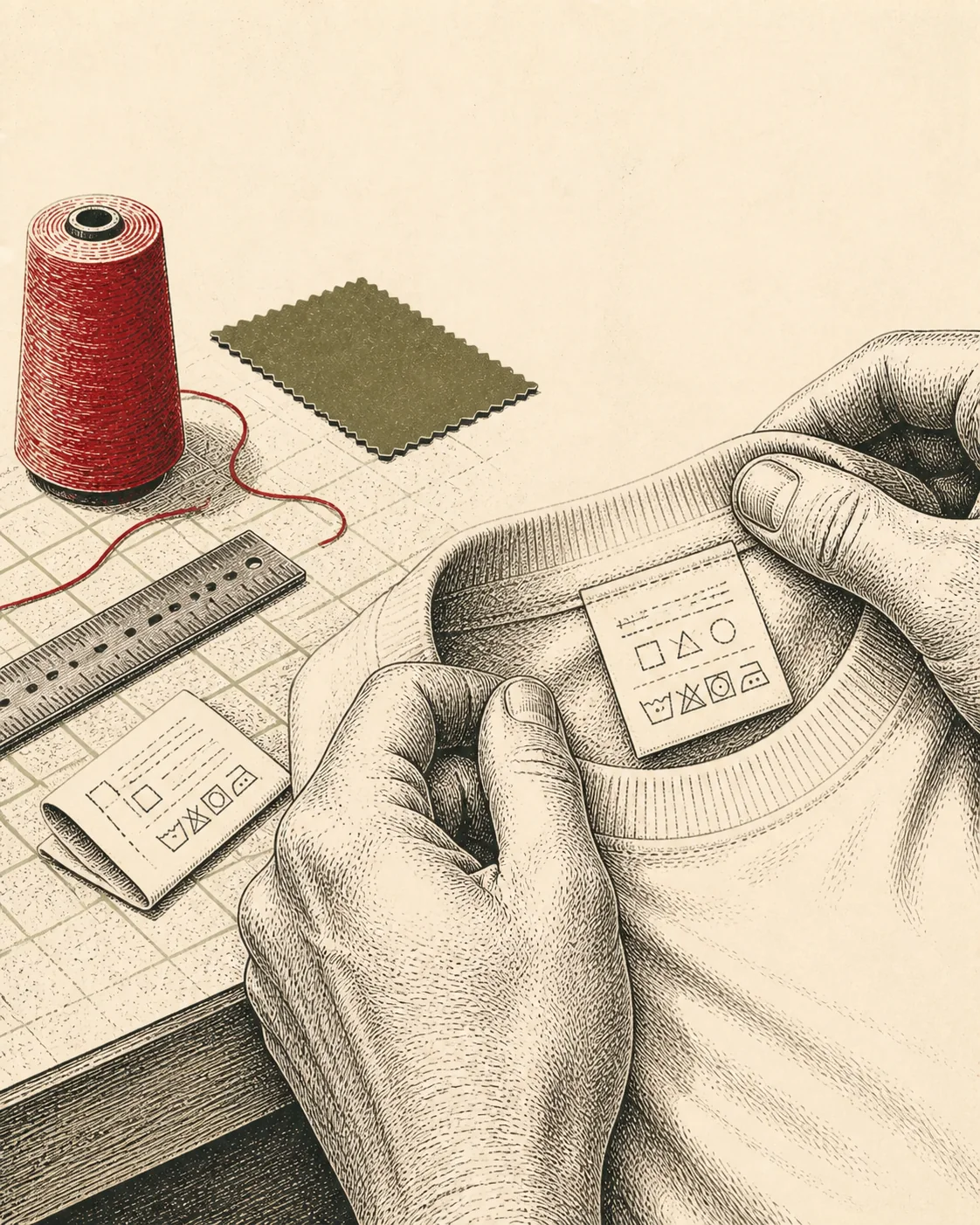
The FTC’s Care Labeling Rule, at 16 CFR Part 423, requires a permanently attached label that addresses washing, bleaching, drying, and ironing, plus a warning if a normal step (machine washing, for instance) would harm the garment. Manufacturers get to choose the format. They can spell it out using the standard terms in the rule’s own glossary (“Machine wash warm,” “Do not bleach”), or they can use the pictograms set out in ASTM D5489, the standard guide built around five base symbols: a washtub, a triangle for bleach, a square for drying, an iron, and a circle for professional textile care. A brand can run words alone, symbols alone, or both together. The familiar international symbols on European-made clothing look almost identical to the American set but are not legally interchangeable with it, which is part of why an imported tag sometimes carries two rows of near-duplicate icons rather than one.
The rule also requires the instructions be one a manufacturer has a documented, reasonable basis for, tested or otherwise substantiated, not a guess printed to cover liability. A tag that just says “dry clean only” on a plain cotton tee, with no technical reason behind it, is the kind of overcautious label the rule was written to discourage as much as it discourages omission.
What a tag never has to tell you
Weight, thread count, and quality of construction are absent from every federal textile disclosure requirement. A tag has no legal obligation to state ounces per square yard, needle count, or whether the shirt was sewn with a single-needle or double-needle hem. Those facts live on spec sheets and product pages, if a brand chooses to publish them, precisely because nothing compels it. That gap is where most of the marketing language on a hangtag lives: “heavyweight,” “premium,” “durable,” words with no regulatory definition sitting a few inches from a fiber content line that has a very specific one. Our own tees carry a weight figure on the product page next to the price, 6.1 ounces per square yard, because that number belongs to us to volunteer, not to the FTC to require.
Next time the tag itches at your collar and you go to cut it out, read it first. Three lines are the law. The rest is the company talking.