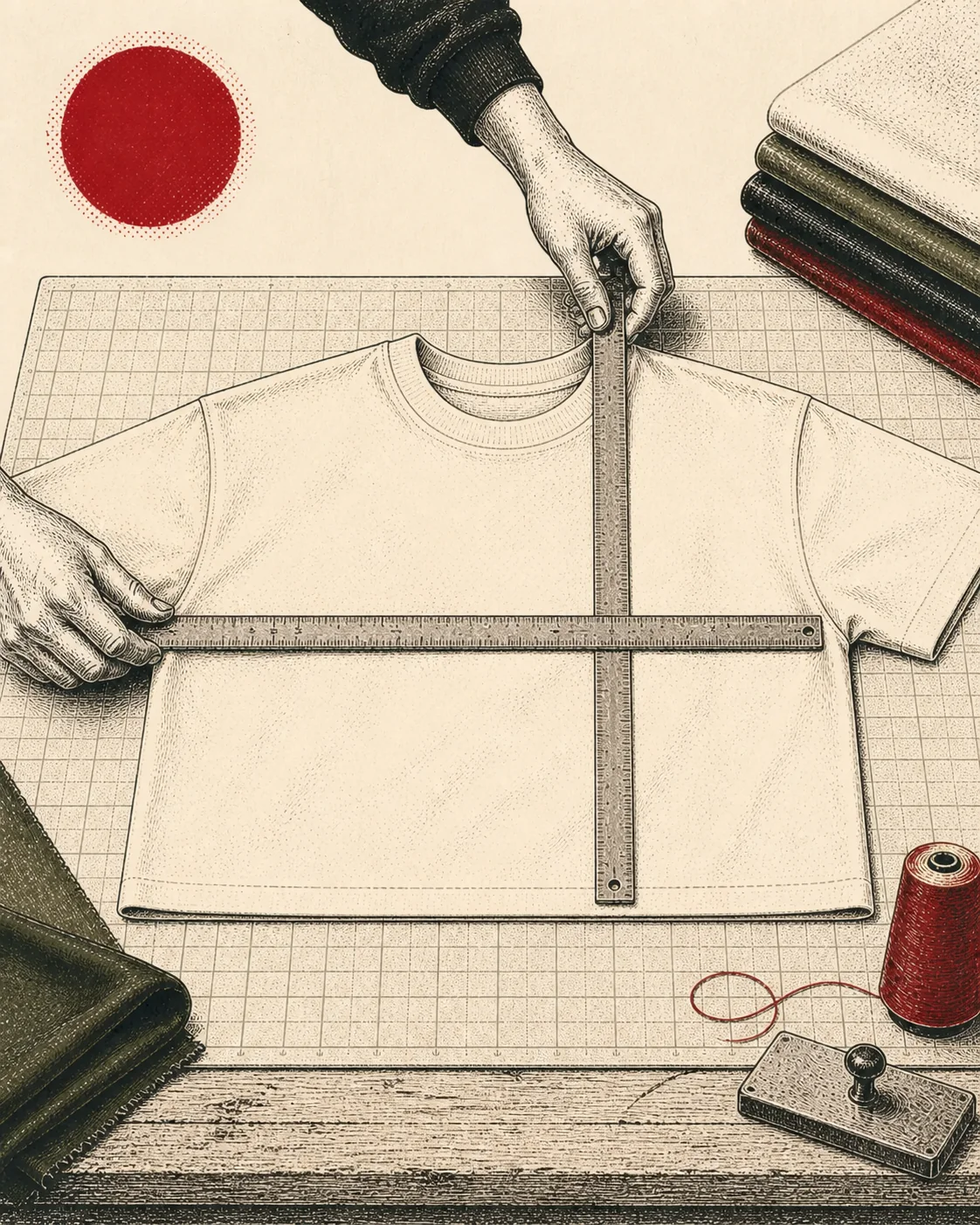
Skip the letter. Find a shirt already in your closet that you like the fit of, lay it flat, and measure two numbers: the width straight across the chest and the length from the top of the shoulder to the hem. Compare those two numbers to a chart that gives the same two measurements for the shirt you’re about to buy. That comparison tells you more about how a boxy tee will fit than any letter ever will.
Why the letter lies
A Medium is not a unit. No regulation ties the word to a chest measurement, so one brand’s Medium can sit two or three inches narrower than another’s, and a single brand can run its fitted tee and its boxy tee on entirely different blocks under the same letter. The tag is a label a company assigns to its own pattern, not a promise about your body. Treat it as a rough sort, not an answer.
What doesn’t drift between brands is a flat measurement in inches. A shirt laid on a table with its chest pinned at 22 inches pit to pit is 22 inches pit to pit no matter whose name is on the neck label. That number is portable. The letter is not.
This matters more on a boxy cut than a fitted one. A fitted tee is built to skim the body, so a size range compresses toward a narrower band of real difference between letters. A boxy tee is built with deliberate extra room through the shoulder and a straight hem that doesn’t taper in at the waist, which means the gap between one size’s chest number and the next can be wider, and guessing off the letter alone gets riskier, not safer.
There’s also a version of this problem inside a single brand. A company that sells both a fitted tee and a boxy tee often cuts them from two different blocks, meaning the pattern itself changes shape between the two, not just its dimensions. A Large in the fitted block and a Large in the boxy block can carry the same letter and a genuinely different chest number, because the letter was assigned to two separate patterns, not one scaled pattern in two fits. Checking the flat measurement sidesteps that entirely; it doesn’t care which pattern the shirt came from.
The two measurements that actually decide fit
Lay the shirt flat on a bed or table, no stretching, sleeves smoothed to the side. Two measurements do the job.
Chest, armpit seam to armpit seam, straight across. This is the flat measurement, so double it if you want the full circumference around the body. It tells you how much room you get across the shoulders and through the torso, which on a boxy cut is most of what defines the silhouette.
Length, from the highest point of the shoulder seam straight down to the hem. This tells you where the shirt ends: hip, low hip, or somewhere closer to a tunic, depending on your height and how long you like a tee to run.
A third number worth checking if the chart gives it: sleeve length, from the center back of the neck to the cuff. It matters less for fit than chest and length, but it catches the case where a shirt looks right on the hanger and then the sleeve hits an odd spot on your arm.
Do this with a shirt you already wear and like, not a shirt you own but never reach for. The comparison only works if the reference garment is one whose fit you’ve already tested against your actual body, your actual posture, and your actual preference for loose versus close. A body measurement chart guesses at all three. A shirt already in rotation has already answered them.
Reading a chest and length chart against a boxy tee
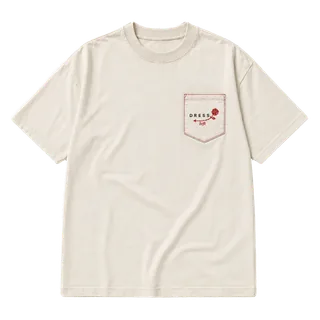
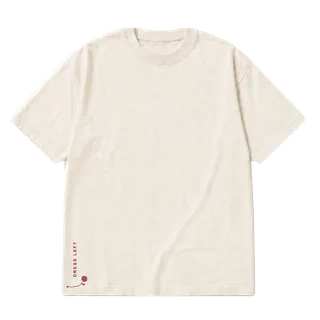
Here is what that comparison looks like using the DRESS tee block, which the Logo Tee and the Direction Tee share, laid flat in inches.
| Size | Chest (armpit to armpit) | Length (shoulder to hem) |
|---|---|---|
| S | 19 | 27.5 |
| M | 20.5 | 28.5 |
| L | 22 | 29.5 |
| XL | 23.5 | 30.5 |
| 2XL | 25 | 31.5 |
The chest measurement climbs about 1.5 inches per size; the length climbs one inch per size. If your reference shirt measures 21 inches across the chest, it sits between Medium and Large on this chart, closer to Large, and you now know something a letter alone couldn’t tell you: whether “true to size” on this particular boxy cut means the same room you’re used to, or more of it.
The cut is boxy through the shoulder with a straight hem by design, meant to hang rather than cling. True to size gets you that relaxed fit. Sizing down by one gets you a closer, less boxy silhouette in the same block, which is the adjustment to make if your reference shirt runs narrower than the chart at your usual letter.
What shrinkage does to those numbers
A flat measurement is only accurate until the fabric meets heat. Heavyweight cotton jersey, the 6.1 oz weight this block is cut from, shrinks predictably once and then holds. Cold water and a hang-dry line keep the shirt close to the numbers on the chart above. A hot tumble dryer is a different story: expect roughly half a size of shrink, concentrated mostly in length, which is the dimension that moves first when heat hits cotton.
That half size matters more on a boxy cut than a fitted one, because a boxy tee’s whole appeal is the drape: fabric hanging straight from the shoulder instead of pulling tight. Shrink the length and you lose some of that drape along with the inch. If you bought at the chart’s true-to-size number specifically for the relaxed hang, drying it hot undercuts the reason you sized that way in the first place.
The fix is upstream of any size chart: wash cold, dry on the line or on low, and the shirt stays at the measurements you compared against when you bought it. This is also why the first wash matters more than the fifth. Once heavyweight cotton has gone through its initial shrink, it tends to hold there through the rest of its life; the damage that costs you a size happens early, or it doesn’t happen at all.
Sleeve length shrinks too, though by less, because there’s less fabric length for heat to act on. If a shirt’s sleeve was already sitting at an odd spot on your arm at the chart’s printed number, a hot dryer will only push it higher, not fix it.
The method, in short
Measure a shirt you already trust. Compare its chest and length to the chart for the shirt you’re considering. Ignore what letter is printed on either tag; it’s a label, not a specification. Wash and dry in a way that keeps the fabric at the size it was cut to. It works on any boxy tee from any maker, not just one chart.
Two shirts with the same letter on the collar can differ by inches. Two shirts with the same flat chest measurement fit the same, regardless of what the tag says.