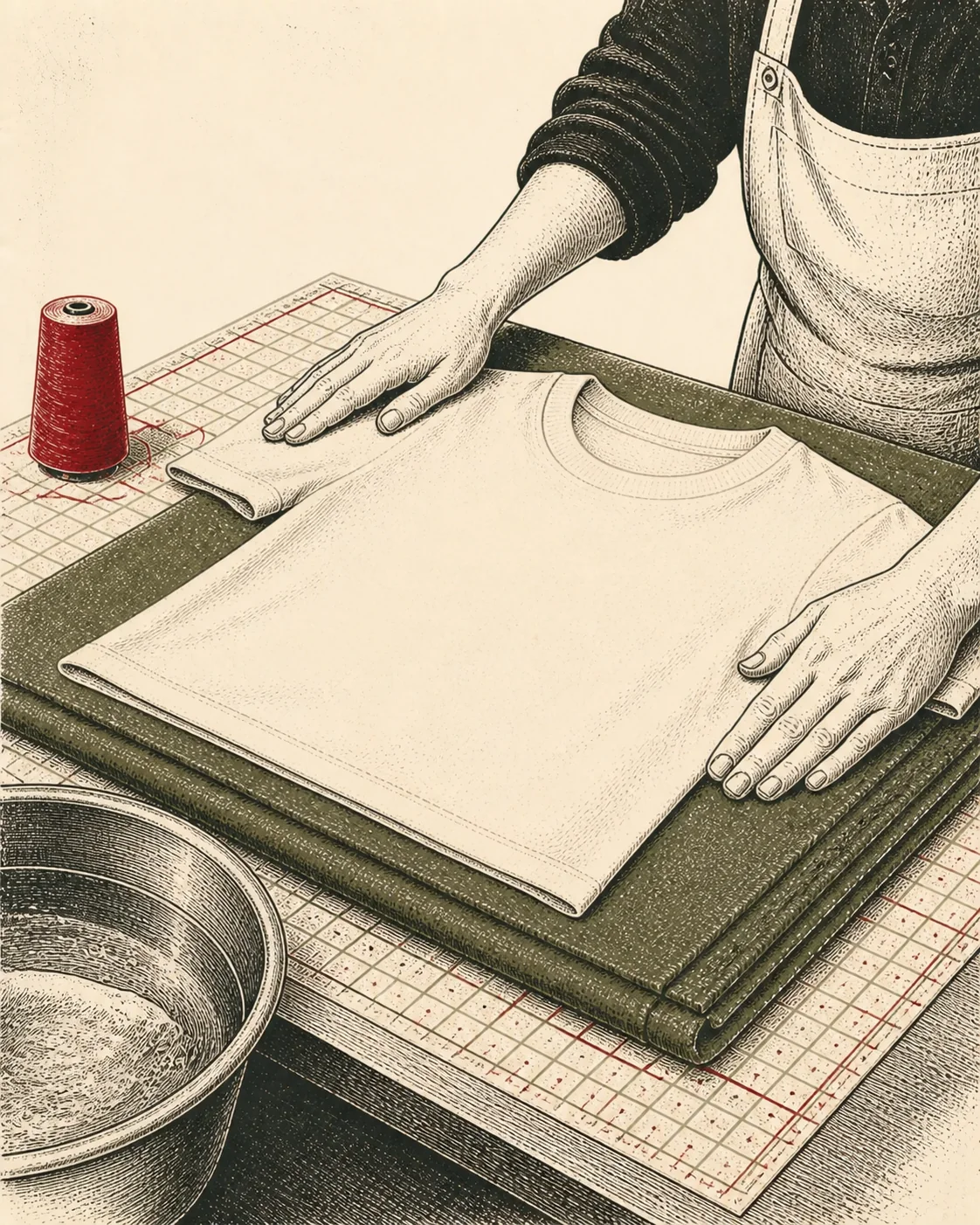
Soak the shirt in lukewarm water with about a tablespoon of hair conditioner or baby shampoo per liter, let it sit for twenty to thirty minutes, then pull it flat to its original dimensions while it is still wet and let it air dry that way. It works on cotton. It gets back most of the lost size, not all of it, and the shirt that spent an hour in a hot dryer will not come all the way home.
Why cotton shrinks in the first place
A cotton fiber grows as a coiled, convoluted strand of cellulose, not a straight rod, and spinning and knitting pull that coil into something straighter so it can be twisted into yarn and looped into fabric. That stretched-out state is under tension the whole time the garment is dry. Hot water and agitation disrupt the hydrogen bonds holding the cellulose chains in their stretched arrangement, and without those bonds locking things in place, the fiber relaxes back toward its natural crimp, according to textile researcher Nisa Salim, writing for The Conversation in 2025. The yarn shortens because the fiber it’s made of just went back to the shape it wanted to be in before a mill straightened it out.
This is called relaxation shrinkage, and it is the reason a heavyweight cotton tee tends to shrink once, in its first hot wash, and then hold steady rather than shrinking a little more every time. Once the fiber has relaxed to its resting crimp, there is nothing left in that fiber to give up. A second hot wash still felt hot to the shirt, but the stretch that hot water could undo was already gone.
What the conditioner is actually doing
The popular explanation, repeated across laundering guides, is that hair conditioner works because it contains cationic surfactants, and those surfactants coat the fiber and lubricate it, letting the cellulose chains slide past each other when you stretch the wet fabric. That is plausible and it is the version most sources give.
It is also not settled science. A 2015 paper in the Journal of Surfactants and Detergents, by Takako Igarashi and coauthors at a Japanese detergent manufacturer, tested the standard friction-reduction theory directly and found it did not hold up the way the industry assumed. Their measurements pointed to a different mechanism: cotton fibers harden as they air-dry because bound water forms hydrogen-bonded bridges between adjacent fibers, and softener works by coating the fiber with a hydrophobic layer that prevents that water-mediated cross-linking, not primarily by reducing friction between fibers. The paper is about fabric softness rather than unshrinking specifically, but the two problems share the same chemistry: cotton cellulose held rigid by hydrogen bonds, and a cationic treatment that interferes with those bonds. Where exactly that interference happens, lubricating the surface or blocking the water bridges between fibers, is the part that is still argued over. What is not argued over is that the shirt has to be wet and warm for either mechanism to have anything to work on. A dry shirt does not respond to conditioner rubbed on the outside.
Why this does nothing for a wool sweater
Wool shrinks by a different route, and the conditioner trick does not touch it. A wool fiber is covered in microscopic scales, the same structure that gives a strand of hair its texture under a microscope. Heat, moisture, and agitation open those scales, and the agitation part is the important one: it drives fibers to migrate and interlock, scale over scale, until a soft yarn becomes a dense, matted felt. That process, felting, is a physical interlocking of thousands of individual fibers, and once the scales have hooked into each other there is no equivalent relaxed state to soak your way back to. Cotton shrinkage is a coiled fiber returning to a shape it already had. Wool felting is fibers building a new, tangled structure that did not exist before. One is reversible in part because it is really just relaxation. The other is closer to matting hair into a dreadlock: soaking a dreadlock in conditioner does not un-tangle it either.
The stretching matters more than the soak
The soak makes the fiber pliable. It does not do the stretching for you. After twenty to thirty minutes in the conditioner bath, lift the shirt out without wringing it, lay it on a towel, and pull it by hand toward its original measurements: shoulder seam to shoulder seam, collar to hem, sleeve to cuff. Roll it in a dry towel to pull out excess water, then lay it flat again on a fresh towel or a mesh rack and keep tension on it, pinning the corners if you have to, until it dries. Fabric that dries without tension goes right back to wherever the fiber’s resting shape wants it, which is the smaller shirt you started with. This part is why the method has a ceiling: you are limited by how far you are willing to pull cotton that is still attached to seams, and a shirt that shrank two full sizes will tear a seam before it stretches that far.
You can do this more than once
Because relaxation shrinkage is fiber returning to a resting shape rather than fiber being damaged, there is no reason a single soak-and-stretch session has to be the only one a shirt gets. If the fabric relaxes to its old crimp again after a later hot wash, the same lukewarm conditioner soak works on it again, with the same partial recovery. This is different from wool felting, where every hot, agitated wash adds another layer of interlocking that a soak cannot remove, or from a heat-set synthetic finish, where the fiber’s shape has been chemically fixed and no amount of soaking will move it. Plain cotton jersey does not accumulate that kind of permanent damage from the shrink-and-stretch cycle itself. What it does accumulate is wear: pulling a damp shirt by hand stresses the seams, and a garment stretched back into shape five times has had five sessions of tension at the shoulder and side seams, which is where a cheaply finished tee will eventually give before a well-sewn one does.
The order of operations matters more than people expect. Stretch a shirt while it is only lightly damp and cotton fiber resists, because there is not enough water in the amorphous regions of the cellulose to let the polymer chains slide against each other. Stretch it while dripping wet and it is easy to overcorrect, pulling a knit panel wider than the original weave can hold once dry, which shows up as a slightly warped, baggy patch instead of the crisp collapse of a shrunken shirt. The middle state, wrung out enough that it holds its own weight without dripping but still saturated through the fabric, is where the fiber is pliable and the shape holds once tension is released onto a flat towel.
What to expect, honestly
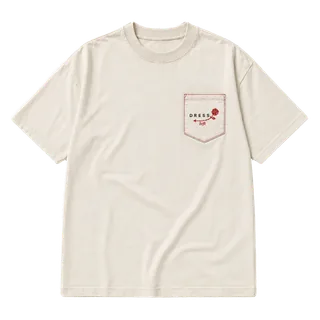
A shirt that lost half a size to one hot wash-and-dry cycle usually comes back close enough that the difference is hard to spot. A shirt that has been through the dryer repeatedly, each cycle adding a little more heat-set shrinkage on top of the last, will only partially recover, and it can shrink right back down the next time it meets a hot dryer, because the treatment did not change the fiber permanently. It just persuaded it to unclench for one session. The fix that actually holds is upstream of all this: wash cold, skip the hot dryer, and hang the shirt to dry. A 6.1 oz cotton tee we make goes through one predictable round of shrink under normal care, mostly in length, and cold water with a clothesline keeps it there.