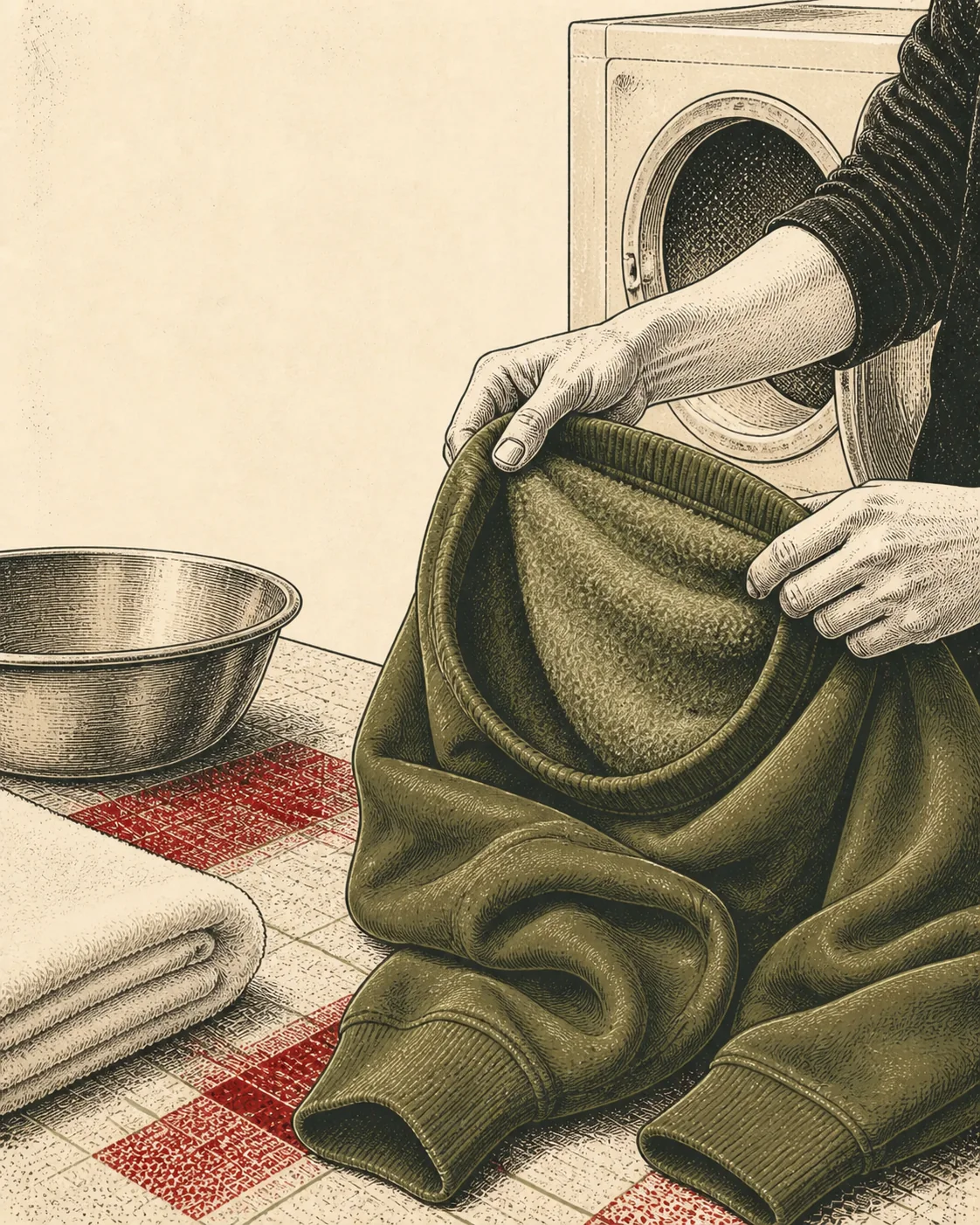
Turn it inside out, wash it cold, and either skip the dryer or run it on low. Four steps, and they work because a hoodie dies two separate ways, one in the fleece and one in the print, and this sequence happens to protect against both at once.
What brushed-back fleece actually is
The soft interior of a hoodie is the same knit as the smooth outside, mechanically altered. After the fleece is knitted, it runs through a napping machine: a drum ringed with dozens of smaller rollers, each wrapped in fine bent wire hooks. Those hooks scrape the surface of the knit and pull loose fiber ends up and out of the yarn, according to a process description from TextileApex. The pile rollers lift fiber in the direction of travel; counter-pile rollers work against it, which tangles the raised fiber into an even, brushed surface instead of a combed one. That raised layer traps air, which is where the warmth comes from, and it is what your hand reads as soft.
The problem is that raised fiber has nowhere to anchor itself except the base knit. It is held up by its own structure, not by tension or elastic recovery. Heat and tumbling press it back down, and cotton fiber does not spring back the way a coil does. Once it is crushed flat, it stays closer to flat, and every hot cycle after that compounds the loss. This is a slow, cumulative failure, not a single catastrophic wash. A hoodie that went through a hot dryer forty times reads noticeably flatter and shinier at the seams and high-friction points than one that air-dried the same forty times, even with identical detergent and identical wear.
What actually cracks a printed graphic
The other failure point is the ink, and here the common wisdom oversells what a home dryer can do. Standard plastisol screen-printing ink cures at 320 to 330 degrees Fahrenheit, held for 45 seconds to a minute, according to McLogan Supply’s guidance for print shops troubleshooting cracked garments. Water-based ink needs a similar ballpark, around 320°F, though it cures in two stages: most of that heat first drives off water, and only the remainder goes toward cross-linking the ink into the fabric, per Permaset’s technical notes for its own water-based line. A home clothes dryer does not get close to either number. GE’s own reference for its dryer thermostats puts the high heat setting at roughly 135°F and low or delicate settings around 125°F. Maytag and Whirlpool publish figures in the same 120 to 160°F range across their lineups. That is a full 160-plus degree gap below the temperature plastisol needs just to finish curing in the first place.
Which means the print that cracks in your wash almost certainly left the shop undercured. Ink that never held full temperature for the full dwell time sets up looking fine and then splits the first time the fabric flexes, no matter how gently you treat it afterward. A home dryer cannot finish a cure that a factory dryer failed to complete, and it also cannot undo one that a factory dryer completed correctly. What a hot home dryer does instead is mechanical: it flexes and abrades a fully cured print thousands of times a cycle, and that repeated flexing is what eventually fatigues even good ink. The fix is the same fix as for the fleece, for an unrelated reason: less heat, less tumbling.
Why the two rules point the same direction
Cold water, inside out, low heat or none. The cold water keeps fiber swelling and dye migration to a minimum on the cotton side and does nothing to threaten a cured print either way. Inside out means the printed panel faces into the garment instead of grinding against the steel drum, other zippers, and other garments’ hardware for the full cycle, which is straightforward abrasion protection that has nothing to do with temperature. Low heat or air drying is the piece doing double duty: it is the only step that separately protects the nap from crushing and the print from unnecessary flex fatigue. None of these steps exists because a hoodie is delicate. They exist because two completely different materials, sewn into the same garment, both happen to prefer the same handling.
Spin speed and how you dry it matter too
The wash cycle itself has a lower-stakes version of the same trade-off. A washing machine’s spin cycle wrings water out by centrifugal force, and the faster that spin runs, the harder it pulls on the fabric doing the wringing. Delicate and knit-friendly cycles typically spin in the 600 to 800 RPM range specifically because a cycle up near 1200 RPM can stretch fibers and distort a knit’s shape, according to Interweave’s knitwear-care guidance. A hoodie is sturdier than a sweater, but it is still a knit, and a slower spin leaves less water-driven torque working against the ribbing at the cuffs and hem.
What happens after the spin, drying flat versus hanging, comes down to the same physics from a different angle. A soaked fleece hoodie holds a substantial amount of water in that brushed nap, and hung from a hanger, all of that weight pulls straight down through two small points at the shoulders for as long as it takes to dry, which for heavier fleece can be most of a day. That sustained load, not any single yank, is what stretches out a shoulder seam or a neckline over repeated washes, per drying guidance published by fleece manufacturer Crescendo Apparel. Laid flat on a rack or towel, the same weight spreads across the whole garment instead of concentrating at the hanger points, which is why “dry flat” outranks “hang dry” for anything heavy enough to sag under its own wet weight. Hanging by the shoulders is the workable second choice when a flat rack isn’t available, not the first one.
The routine, restated
Cold water. Inside out. A slower spin if the machine offers one. Dry flat, or hang if you must, and skip the dryer’s high setting either way. None of it is really about the hoodie being fragile. It is two ordinary materials, brushed cotton fleece and cured plastisol ink, each with one specific way to fail, and it happens that the same four habits guard against both.
Our Rose Hoodie is 8.5 ounce cotton-rich brushed-back fleece with a two-color print run down the back, and the care line on its product page is this same routine: cold, inside out, hang dry, or tumble low if a little shrink doesn’t bother you.