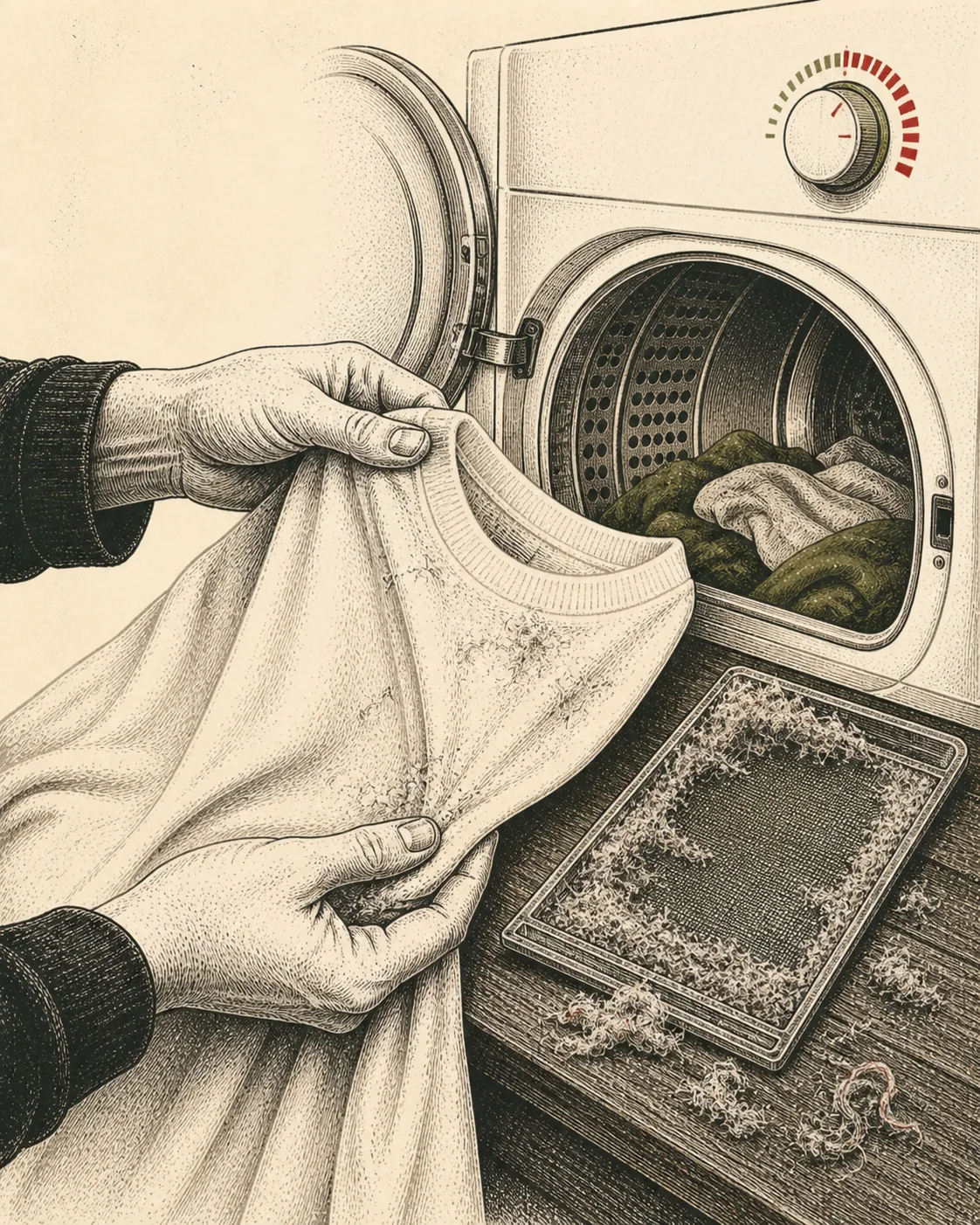
Empty a lint trap and you are holding your shirt. Not dust that settled there between washes, not a mystery byproduct of heat: fiber, physically torn off the fabric by tumbling and abrasion, one wash and dry cycle at a time. A 2000 study in Textile Research Journal put cotton under a scanning electron microscope before and after repeated tumble drying and watched it happen at the fiber level. Cracking, fibrillation, strands sheared clean off the yarn. The lint trap is a collection bin for a process that is otherwise invisible.
What actually damages the fabric
Young-Sook Lee Buisson, a researcher at the USDA’s Southern Regional Research Center in New Orleans, ran an 18-month study on cotton and heat and presented the results in August 1999. Her team found that repeated hot tumble drying could cut a cotton fabric’s breaking strength by 25 percent or more, and that the mechanism split cleanly in two: wet fabric dried with heat took the worst damage, while fabric tumbled dry without heat, or already partly dry when it went in, held up much better. Her own summary of the finding is blunt.
While cotton can be dried at the relatively high temperatures in clothes dryers without immediate catastrophic damage, serious abrasions and cracking damage occur with repeated dryings.
That word “repeated” matters. One trip through a hot dryer will not visibly hurt a shirt. Two hundred trips, at roughly a wash a week for four years, is a different fabric than the one you bought. The Textile Research Journal study backs the mechanism with imaging: dry abrasion inside the drum causes cracking in the fiber wall, while wet abrasion during the wash cycle itself causes a related but distinct kind of fraying called fibrillation. Both end up in the trap, and both are why a heavy tee that started with structure eventually goes thin and soft in exactly the way a worn-in shirt is supposed to, except faster than the wearing alone accounts for.
Cotton is not the only fiber shedding, and it is not shedding alone. A 2022 PLoS One study led by Neil Lant examined what a household lint filter actually catches and found cotton fiber made up 83 to 96 percent of it in a load that was itself less than half cotton by weight. Cotton comes off the dryer more readily than synthetic fiber does, which is one more reason a heavyweight cotton garment loses mass over its life in a way a poly blend does not.
Where the fiber that misses the trap goes
The lint filter does not catch everything. A 2025 study in Environmental Toxicology and Chemistry, run by researchers at the Desert Research Institute with Keep Tahoe Blue, had volunteers fit mesh catchment covers over the outdoor vents on their own dryers for three weeks and log what went into each load through a phone app. Extrapolated across the roughly 82 million electric dryers in US homes, the team estimated 3,543 metric tons of microfiber leave dryer vents into open air every year. Most of it, about 2,728 metric tons, is natural fiber: cotton, wool, the fabrics without a synthetic polymer to blame. The vent exhaust is a second exit for the same abrasion the lint trap only partly intercepts, and the fiber that gets through it does not end up in a landfill or a trap. It ends up airborne, over the neighborhood, the way a factory’s flue does.
The energy arithmetic
Set the fabric question aside and the dryer still costs something to run every time the door closes. The Department of Energy’s baseline figure for a standard electric clothes dryer, as published in ENERGY STAR’s program specification, sits close to 769 kilowatt-hours a year for typical household use. A certified vented model that meets ENERGY STAR’s efficiency bar runs closer to 608 kWh a year; the most efficient heat pump dryers on the market drop into the 125 to 150 kWh range, a fraction of either.
The US Energy Information Administration put the average national residential electricity rate at 18.34 cents per kilowatt-hour in June 2026, up from 17.47 cents the year before. Run the standard baseline against that rate and a dryer costs roughly 141 dollars a year in electricity. The efficient certified model costs about 112 dollars. The gap between them, 29 dollars, buys nothing except heat and abrasion the fabric did not need. A drying rack costs nothing to run at all, and it is the one variable in this whole chain that a person controls without buying anything new.
What changes on a rack instead of a drum
None of this argues for never using a dryer. It argues for using it less on the clothes that are worth keeping. A heavyweight cotton tee, the kind cut from 6-ounce jersey specifically because the yarn holds up, loses the least life when the heat and tumbling are optional rather than habitual. Hang it, and the fiber that would have sheared off in a hot drum stays in the shirt. The shrink that does happen with cold-water washing and air drying tends to be a single, modest, predictable event rather than the compounding kind that comes from months of heat cycles.
Ours are 6.1 ounce cotton, and the care line on every product page says the same thing this research does: wash cold, hang dry to keep the shrink minimal and the print sharp, and treat the dryer as the occasional convenience it should be rather than the default. A fabric researcher reached the same conclusion with a microscope and a strength tester, years before it ended up on a care label.
The lint trap will still fill up a little between now and whenever you next open it. That is fine. It means less of the fiber ended up somewhere invisible instead.