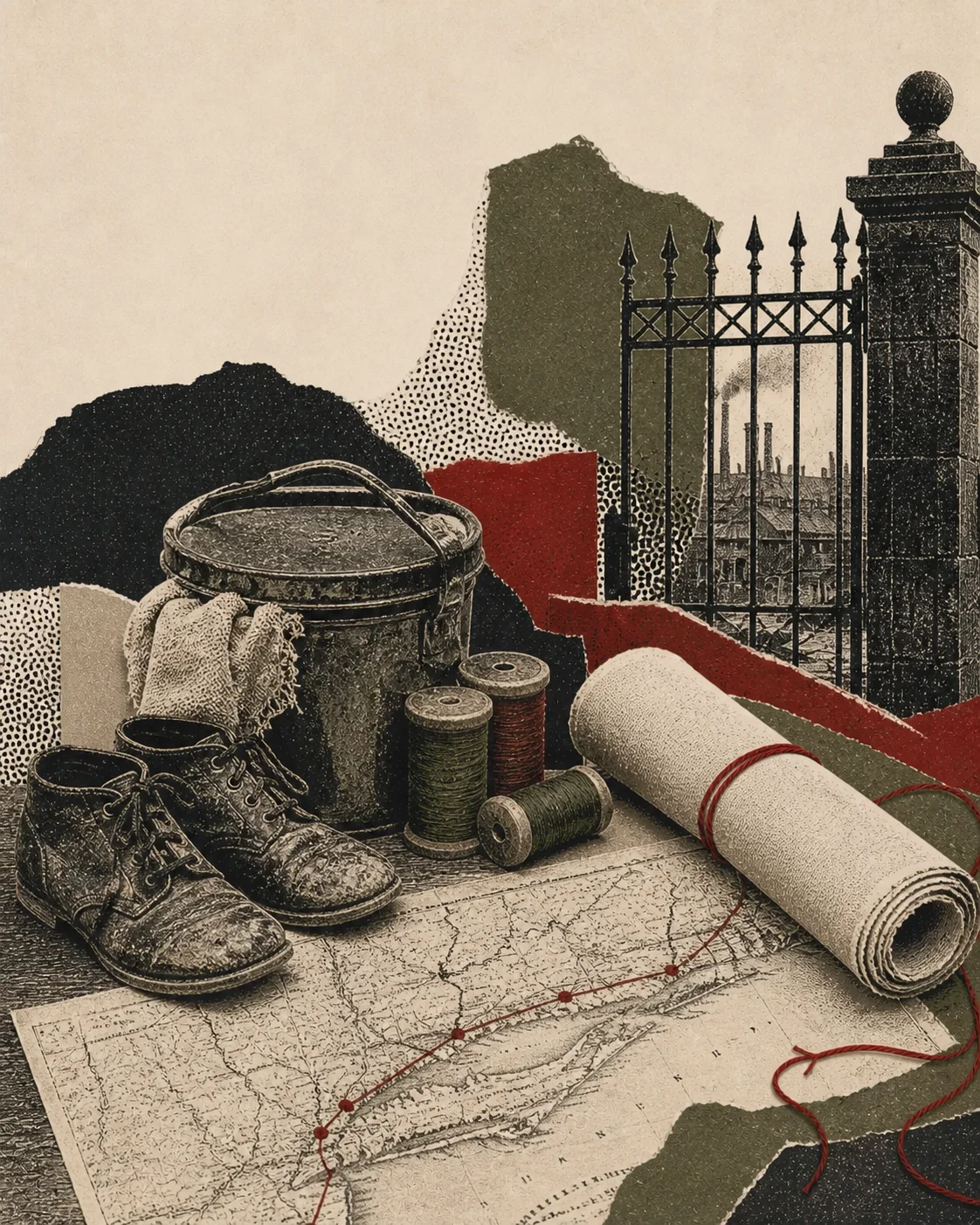
On July 7, 1903, a crowd of striking mill children gathered outside the Kensington Labor Lyceum in Philadelphia, and Mary Harris Jones looked them over before they set off. Some could not close their hands all the way. A machine had taken the top joints of their fingers, or a thumb, and the hand had healed shut around the loss. Jones was sixty-five that summer, a widow who had buried a husband and four children to yellow fever decades earlier and remade herself into the labor movement’s most effective agitator. She had spent weeks in Kensington rallying textile strikers, and she had concluded that a legislature which would not read a report about child labor might still have to look at the children themselves. So she started walking them toward New York, and past it, to the summer home of the President of the United States.
The strike behind the march
The march did not begin as a march. It began as a textile strike in Kensington, the mill district of North Philadelphia, where workers had walked out that spring demanding a fifty-five-hour week and an end to night work for women and children. How large the strike was depends on whose count you use. Historian Gail Friedman, writing for the Encyclopedia of Greater Philadelphia, puts the number at roughly 46,000 workers, calling it the largest strike in the city’s history to that point. Jones’s own autobiography, written more than twenty years later, puts the figure far higher, at seventy-five thousand strikers with at least ten thousand of them children. The discrepancy is worth naming rather than smoothing over: Jones was building a case, not filing a labor statistic, and her number should be read as advocacy rather than a count.
What both versions agree on is the condition of the children themselves. Jones described them at union headquarters as stooped, round-shouldered, and thin for their age, with hands missing fingers and thumbs at the knuckle. Pennsylvania’s own factory law at the time set twelve as the minimum working age for most mill jobs, but enforcement was thin enough that Jones met working children years younger than twelve. The strike itself failed. Wages did not rise and the reduced week was not won, and the children went back to the machines that had already taken pieces of their hands.
Ninety miles, three weeks, no clear plan for what came next
Jones set off from the Kensington Labor Lyceum at 2nd and Cambria Streets with a shrinking, changing group that numbered close to a hundred at points and far fewer by the time it reached New York, historian Elliott Gorn puts the number who actually walked into Manhattan at around sixty. They carried banners rather than slogans built for outrage: signs asking for shorter hours, not for revolution. The route ran through Trenton, Princeton, where the marchers slept on the grounds of former President Grover Cleveland’s estate, New Brunswick, Elizabeth, Newark, Paterson, Passaic, and Jersey City, roughly ninety miles in all, before the group reached New York City on July 23, 1903, three weeks after setting out.
Jones staged the march as a spectacle because a spectacle got newspapers to send reporters where a strike bulletin would not. In New York the marchers appeared at Coney Island, where Jones spoke to a crowd gathered near a menagerie, competing at one point with the roaring of the lions in their cages nearby, a detail contemporaneous press accounts noted because it was, on its own terms, an image nobody had to invent. She meant the animal cages as an argument: children penned in mills, she said, made less of a spectacle to the public than animals penned for entertainment, and she wanted the lions roaring behind her while she said it.
What happened at the gate
The march had one stated destination from the start: Sagamore Hill, Roosevelt’s home on Long Island, where the president was spending the summer. Jones wrote him an open letter asking for an audience to discuss federal child labor legislation, and had it published in newspapers along the route. On July 29, 1903, she and a small delegation of the marching children, boys among them, reached the estate and asked to see him.
They did not get past the gate. Roosevelt’s secretary, Benjamin Barnes, met the group and told Jones the president would not receive them, and that regulating labor inside a factory was a matter for state legislatures rather than Congress, an answer that assumed the very authority question Jones had marched ninety miles to raise. Jones followed up with a letter restating the request. Gorn, whose 2001 biography remains the standard account of Jones’s life, writes that no evidence exists that Roosevelt ever read it. The march that had drawn newspaper coverage the length of New Jersey ended with a closed gate and an aide’s polite refusal, and the children went home the way they had come, on foot and by interurban train, with nothing signed and nothing promised.
The correction
The march of the mill children gets credited, casually and often, with having ended child labor, or at least with having forced the law that did. Neither claim survives a look at the calendar. No federal statute followed from the 1903 march. The first one, restricting the interstate shipment of goods made with child labor, did not pass until 1916, thirteen years later, and the Supreme Court struck it down within two years of its passage on commerce-power grounds that had nothing to do with children and everything to do with how far Congress could reach into a single state’s factories.
Jones’s own account blurs this further. Her autobiography states that Pennsylvania passed a child labor law “not long afterward” that sent thousands of children home from the mills. The actual Pennsylvania reform effort moved on a slower and different track than her sentence implies: a state child labor committee formed in 1904, the year after the march, and the organization that did the sustained legislative work, the Pennsylvania Child Labor Association, was not founded until 1908, five years on, winning its strengthened law in 1915, twelve years after Jones stood outside Sagamore Hill’s gate. She was not lying so much as compressing a decade of committee work into a sentence that reads as immediate cause and effect, because by 1925, when she wrote it down, that was the version worth remembering.
What the march actually did was narrower and, in its way, more durable than a bill. It put a fact in front of the country that a pamphlet could describe but could not make anyone look at: children with missing fingers walking past reporters on a public road, in the same summer a sitting president would not open his gate to them. The National Child Labor Committee, chartered by Congress the following year, in 1904, inherited an argument the march had already made visible: that the injury was not abstract and the people carrying it were not hidden in a mill where a legislator never had to see them. The march changed what could be ignored, even when it could not yet change what was legal.
An old road, an old refusal
Roosevelt spent that same summer in speeches about a strenuous life, about the virtue of hard work honestly done. He never had to square that language with the hands he refused to look at on July 29. The gate stayed shut, the children walked home, and the country kept manufacturing cotton goods with child labor in the mills for another thirty-five years, until the Fair Labor Standards Act finally set an enforceable floor in 1938. DRESS ← prints on union floors now partly because that gate is the older history behind the label: a century of somebody eventually having to answer for what a factory does to the people inside it, whether or not anyone in power wanted to look.