
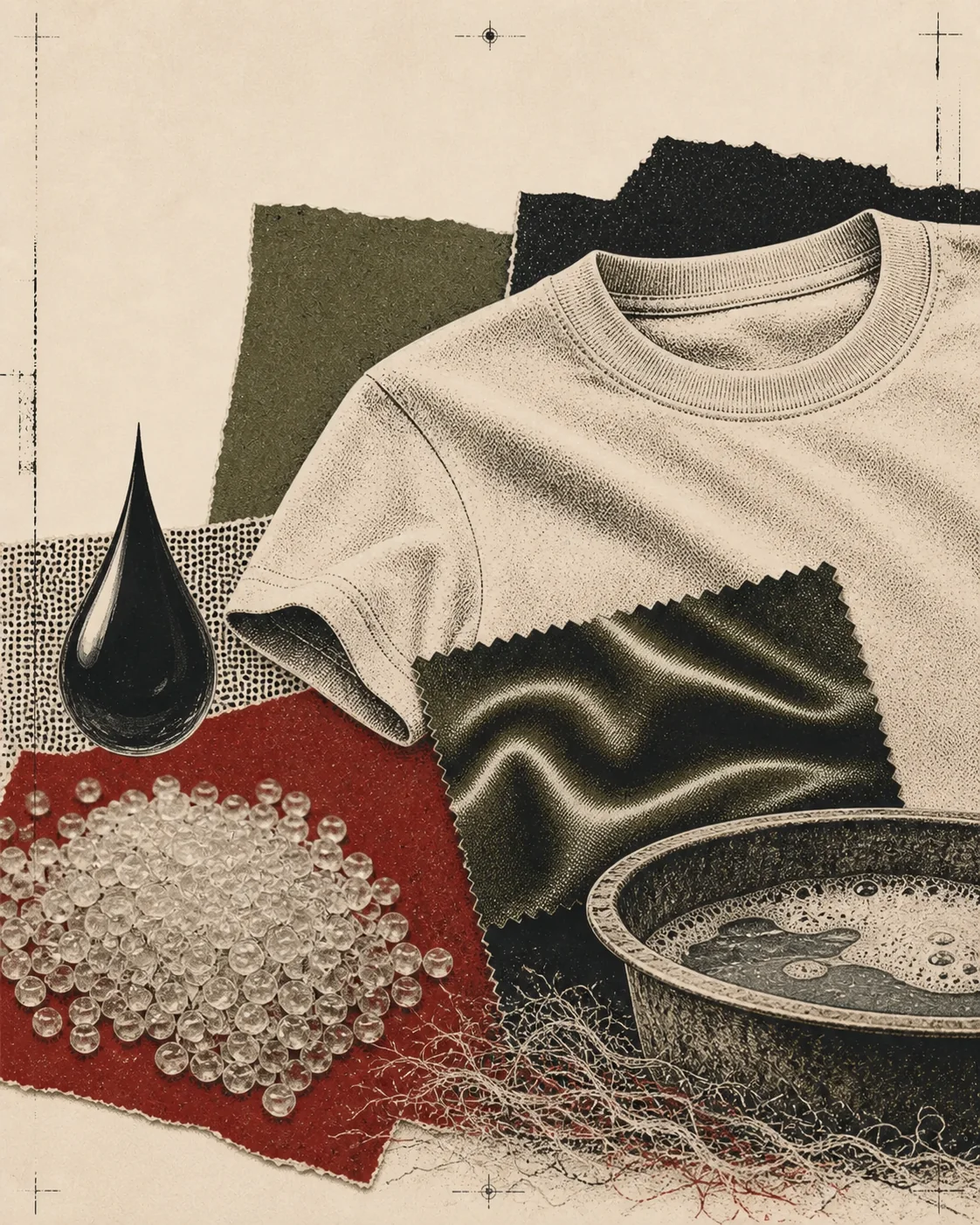
Polyester is plastic. Specifically it is polyethylene terephthalate, the same polymer that makes a soda bottle. The fiber industry calls it polyester and the packaging industry calls it PET, and the molecule does not know the difference. A polyester shirt and a two-liter bottle start from the same reaction, spun into a thread instead of blown into a bottle shape.
The same molecule, two different names
PET is built from two building blocks: terephthalic acid (or its close cousin, dimethyl terephthalate) and ethylene glycol, both derived from petroleum. Cooked together under heat, they undergo polycondensation, a reaction that links the small molecules into a long repeating chain and releases water as a byproduct. The result is a single polymer, PET, with the formula (C10H8O4)n repeating down the chain. Push that molten polymer through a die and stretch the resulting filament, and it becomes fiber. Injection-mold it into a preform and blow it into a mold, and it becomes a bottle. Same plastic, different manufacturing step at the very end.
The fiber version has a real invention date attached to it. John Rex Whinfield and James Tennant Dickson, working at the Calico Printers Association in Manchester, patented PET as a textile fiber in 1941, building on research Wallace Carothers had already done at DuPont on synthetic polymers (Carothers’s own line of work led to nylon, not polyester, before he died in 1937). DuPont bought the American rights to the PET patent from Imperial Chemical Industries in 1946 and brought the fiber to market under the name Dacron. What started as a British wartime patent for cloth became, eight decades later, the material a majority of the world’s clothing is made from.
The majority fiber
That is not an exaggeration. Textile Exchange’s Materials Market Report 2025, covering global fiber production in 2024, puts polyester at 59 percent of everything spun into fabric worldwide, ahead of cotton, wool, nylon, and every other fiber combined. Global polyester output rose from roughly 71 million tonnes in 2023 to roughly 78 million tonnes in 2024, in a single year. Cotton moved the opposite direction over the same stretch, falling from 24.8 million tonnes in the 2022/23 season to 24.5 million tonnes in 2023/24, and its share of the world’s fiber slipped to 19 percent. Of the polyester produced, 88 percent is made from virgin fossil fuel and 12 percent from recycled PET, a recycled share that actually declined slightly from the year before because virgin polyester output grew faster than recycled output could keep pace.
Polyester did not take that position by accident or by marketing. It took it because the chemistry gives it real advantages a natural fiber cannot match on the same terms, and because it costs less to make than the fiber it displaced.
What polyester is genuinely good at
Give it its due. Polyester fiber has high tenacity for its weight, meaning it resists tearing and abrasion better than cotton of a comparable weight. It absorbs very little water, which is why polyester dries fast and why it dominates rain shells, swimwear, and anything meant to survive a workout without soaking through. It resists wrinkling on its own and, blended with cotton, reduces the wrinkling and shrinkage of the cotton alongside it, and that blend is what makes the permanent-press shirt possible at all. It holds color well with disperse dyes, holds its shape wash after wash better than a natural fiber under the same abuse, and it does all of this at a manufacturing cost that undercuts nearly everything else on the market. None of that is spin. It is the direct, honest consequence of weaving a petroleum-derived plastic into thread instead of growing a plant fiber and spinning it.
Where the recycled version actually comes from
The word “recycled” on a polyester hangtag suggests old clothes got a second life as new clothes. Mostly, they did not. Textile Exchange’s own 2025 report states that recycled polyester is still 98 percent sourced from plastic bottles, not from worn-out garments. The industry that put “recycled” on the label is, almost entirely, running bottle collection through a textile mill rather than running old shirts through one.
That distinction matters because a PET bottle and a PET garment do not have the same afterlife, even though they are the same plastic wearing two different shapes. A collected bottle can go into mechanical or chemical recycling and come out as a new bottle, over and over, inside an infrastructure the US EPA has tracked for years specifically because bottle-to-bottle PET recycling is a mature, established process. Once that same plastic becomes a garment, usually blended with elastane or cotton and dyed, it exits into a textile stream where fiber-to-fiber recycling back into new polyester is not standard practice at any real scale yet. The bottle that becomes a shirt has, for practical purposes, taken its one trip through the loop. It does not go back to being a bottle, and it does not yet reliably go back to being a shirt either.
None of this makes polyester a villain fiber or recycled polyester a scam. It makes it exactly what the chemistry says it is: a genuinely useful, genuinely cheap plastic, wearing a soft name, doing the job plastic does well, at a scale that now outproduces every other fiber on earth combined. A running jacket, a tent, a seatbelt webbing, a life vest: all of them ask for exactly what PET is built to give, and cotton was never going to win those jobs.
The honest complaint about polyester was never that it fails at what it is asked to do. It succeeds, reliably, which is precisely why 78 million tonnes of it got made in a single year. The complaint, where one exists, is about what happens after the wearing: a fiber that does not biodegrade on any human timescale, made from a resource that is not renewable, sold at a price point that makes it easy to buy more of it than anyone needs.
We cut our garments from cotton and cotton-canvas, not polyester, which is a fact about our supply chain rather than an argument against anyone else’s rain jacket. A rain jacket has a real reason to want a fiber that sheds water and dries overnight. A t-shirt worn against skin in a Texas August does not, and that is closer to why the choice was made than any position on plastic in the abstract.
Next time a care label reads “100% polyester,” picture the two-liter bottle it started as. The chemistry is literal: the same molecule, still doing what it was cooked to do the first time.