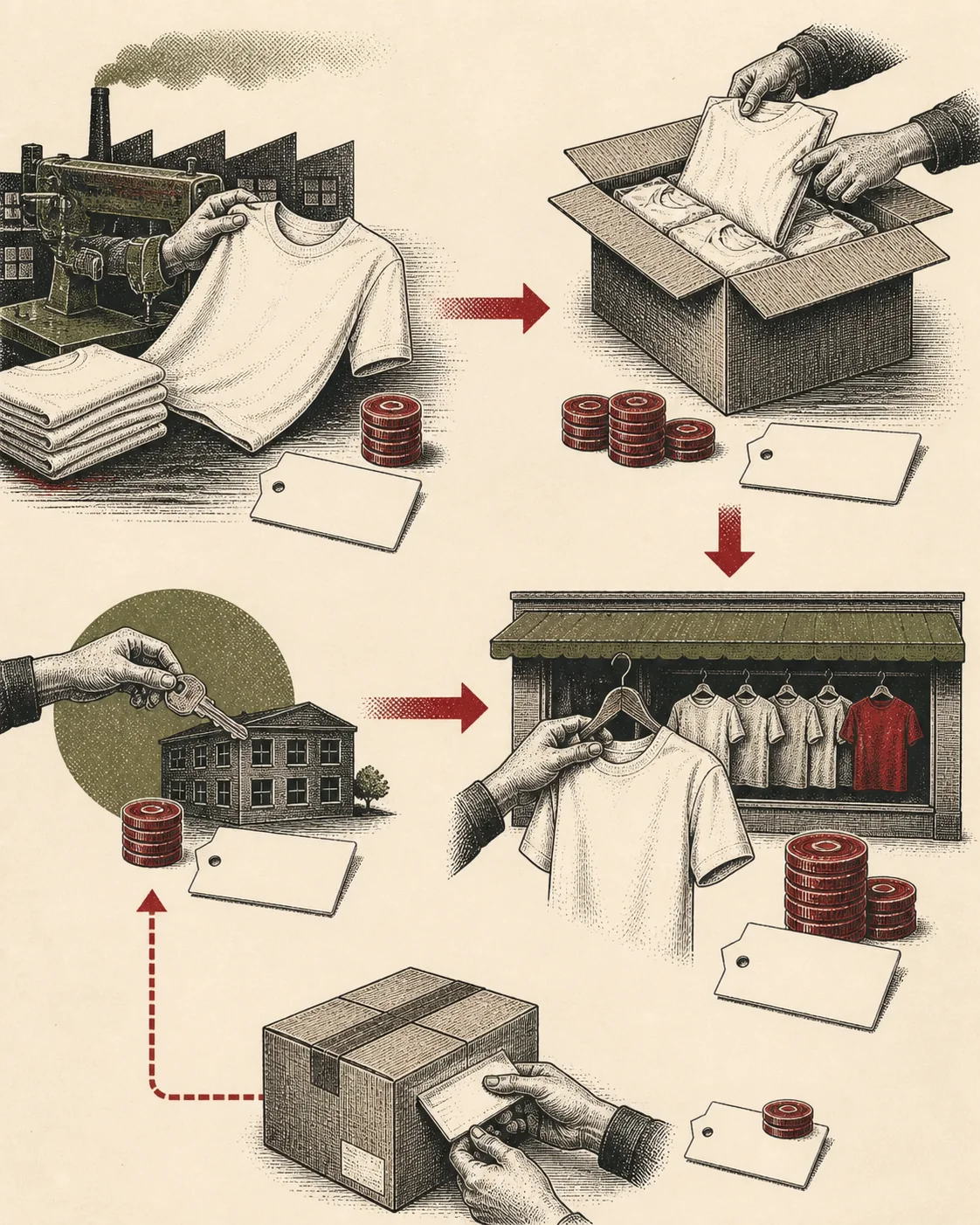
The standard clothing markup is roughly double the wholesale cost, a convention old enough to have its own name, keystone pricing. Cutting out the retailer who applies that markup does not make a shirt’s true cost disappear. It relocates the same money to a different line on a different company’s books, and two public apparel companies just filed the numbers that prove it.
What keystone pricing actually means
Keystone is a hardware-store and jewelry-trade term for pricing an item at twice what it cost the retailer, a 100 percent markup on cost, which comes out to a 50 percent gross margin on the price a customer pays. A shirt that costs a retailer $12 from a wholesaler sells for $24. It survives in apparel because it is fast: a buyer walking a trade show floor with three hundred styles to price does not have time to run a spreadsheet on each one, so the shop doubles the invoice and adjusts up or down from there for a slow mover or a hot one.
The wholesale step usually carries its own markup before keystone even starts. A factory sells a finished garment to a brand or a wholesale distributor at a landed cost, the distributor adds its own margin to cover sourcing, credit terms, and the risk of a retailer returning unsold stock, and only then does the retailer double what it paid. Two markups stack before a shirt reaches a hanger, and a direct-to-consumer brand builds its pitch to the customer on skipping one of them.
The direct-to-consumer promise, and what it leaves out
“Cutting out the middleman” is the sentence that built an entire generation of clothing startups: sell straight from the brand to the customer, skip the wholesale markup, either pocket the difference or pass it on as a lower price. The claim is true as far as it goes. What it leaves out is that the wholesale-to-retail relationship was doing real work, not just taking a cut. A retail store finds the customer, holds inventory on its own shelf, absorbs the ones that don’t sell, runs the checkout, and handles the return. A brand that goes direct has to do all of that itself, and every one of those functions costs money whether a store or the brand is the one paying for it.
Nike’s own filings show this arithmetic in practice, at a scale few brands will ever reach. Nike sells through wholesale partners and through NIKE Direct, its own stores and website, side by side, which makes it one of the few companies where the two channels can be compared inside a single set of books rather than across different companies with different cost structures. In fiscal 2024, NIKE Direct brought in $21.5 billion in revenue against $27.8 billion from wholesale, and the company’s consolidated gross margin was 44.6 percent. The instructive number is not that ratio. It’s that Nike’s own fiscal 2023 annual report describes a period where NIKE Direct margin ran lower than wholesale, not higher, because the company had to run promotional markdowns through its own stores and site to clear inventory that its wholesale partners hadn’t taken. Owning the retail step means owning the retail problem of unsold stock, and that problem does not respect which channel is supposed to be the more profitable one.
A worked model, with its assumptions on the table
Here is a simplified version of the two stacks, built from round numbers chosen to be easy to follow rather than pulled from any one company’s actual costs. Treat every figure as a labeled assumption, not a measurement, and substitute your own numbers if you know a supply chain’s real ones.
Assume a t-shirt costs $8 to cut, sew, and finish, landed at the brand’s door. In the traditional wholesale path, the brand sells that shirt to a wholesale distributor at a modest markup, say $12, to cover the distributor’s sourcing and credit risk. The distributor sells it to a retail store at $16, and the store applies something close to keystone, roughly doubling its own cost, to a $32 shelf price. Three markups, three separate companies, each one covering its own function: sourcing risk, warehousing and terms, and finding the customer.
In the direct-to-consumer path, the brand sells the same $8 shirt straight to the customer, no distributor and no store markup in between. If the brand prices it at $32 to match the shelf price above, the entire $24 gap between cost and price now belongs to one company instead of three, and that company has to fund, out of that $24, every function the distributor and the store used to fund out of theirs: finding the customer (marketing and advertising), holding and shipping the inventory (warehousing and fulfillment, the deeper version of which the queue’s free-shipping piece covers on its own), taking the payment (card processing fees, typically a few percent of the sale), and handling a return. If the brand instead prices it lower, at $24, to actually pass along the wholesale-to-retail gap as savings, it is funding those same functions out of a much thinner $16, and the model stops being generous the moment marketing spend or a return rate gets real.
Neither number in that model is a claim about what any specific brand’s costs are. It’s the shape of the arithmetic, not the arithmetic of a specific company.
What a real direct-to-consumer income statement looks like
Allbirds sells mostly direct, with a much smaller wholesale channel than Nike, which makes its public filings closer to a pure test case for the model above. For fiscal 2024, Allbirds reported a 42.7 percent gross margin, meaning it kept 42.7 cents of every revenue dollar after the cost of the shoe itself, an improvement of about 170 basis points over the prior year. That gross margin, on its own, sounds like healthy keystone-and-better territory. Below that line, selling, general, and administrative expense came to 70.3 percent of net revenue for the year, and in the fourth quarter alone, marketing expense by itself ran to 22.0 percent of net revenue. Allbirds posted a $77.3 million net loss on $152.5 million in revenue for the year. The wholesale-to-retail markup that a traditional store would have taken did not show up as extra profit for the brand. It got spent finding, converting, and serving the customer directly, the same functions a retail partner used to perform for a fee.
Zoom out from any one brand and the picture holds. Aswath Damodaran’s NYU Stern dataset, which aggregates public-company financials by industry and updates monthly, put average gross margin across 35 public apparel companies at 56.88 percent as of January 2026, well above simple keystone. Average net margin for the same sample was 3.85 percent. A gap that wide between what a company keeps at the gross-margin line and what it keeps after everything else is the same story told at industry scale: a healthy-looking markup on the shirt is not the same thing as a healthy-looking bottom line, once every cost the wholesale-to-retail chain used to distribute gets collected onto one company’s books instead.
What actually got cut
“Cutting out the middleman” describes a real transaction that really happened: a step in the chain got removed. It does not describe a savings that appears out of nowhere. Retail’s functions, finding the customer, holding the risk of unsold stock, taking the payment, handling the return, do not disappear when a brand sells directly. They move onto the brand’s own income statement, itemized differently, sometimes cheaper and sometimes not, but never free. A brand that claims otherwise is asking a customer not to notice that the marketing budget and the wholesale markup are doing the same job.
That correction applies here too. DRESS sells its Logo Tee, a 6.1 oz heavyweight cotton jersey shirt, at $34 direct to the customer, with no wholesale step and no retail store markup between the cut-and-sew floor and the person wearing it. That structure removes one set of markups from the chain. It does not remove the cost of running the chain that’s left, and nothing in this piece should be read as a claim that it does.
Double the wholesale cost is a convention old enough to have a name. What a brand does with the markup it removes, and what it has to spend to replace the functions that markup was paying for, is a question no convention answers. Only the income statement does.