
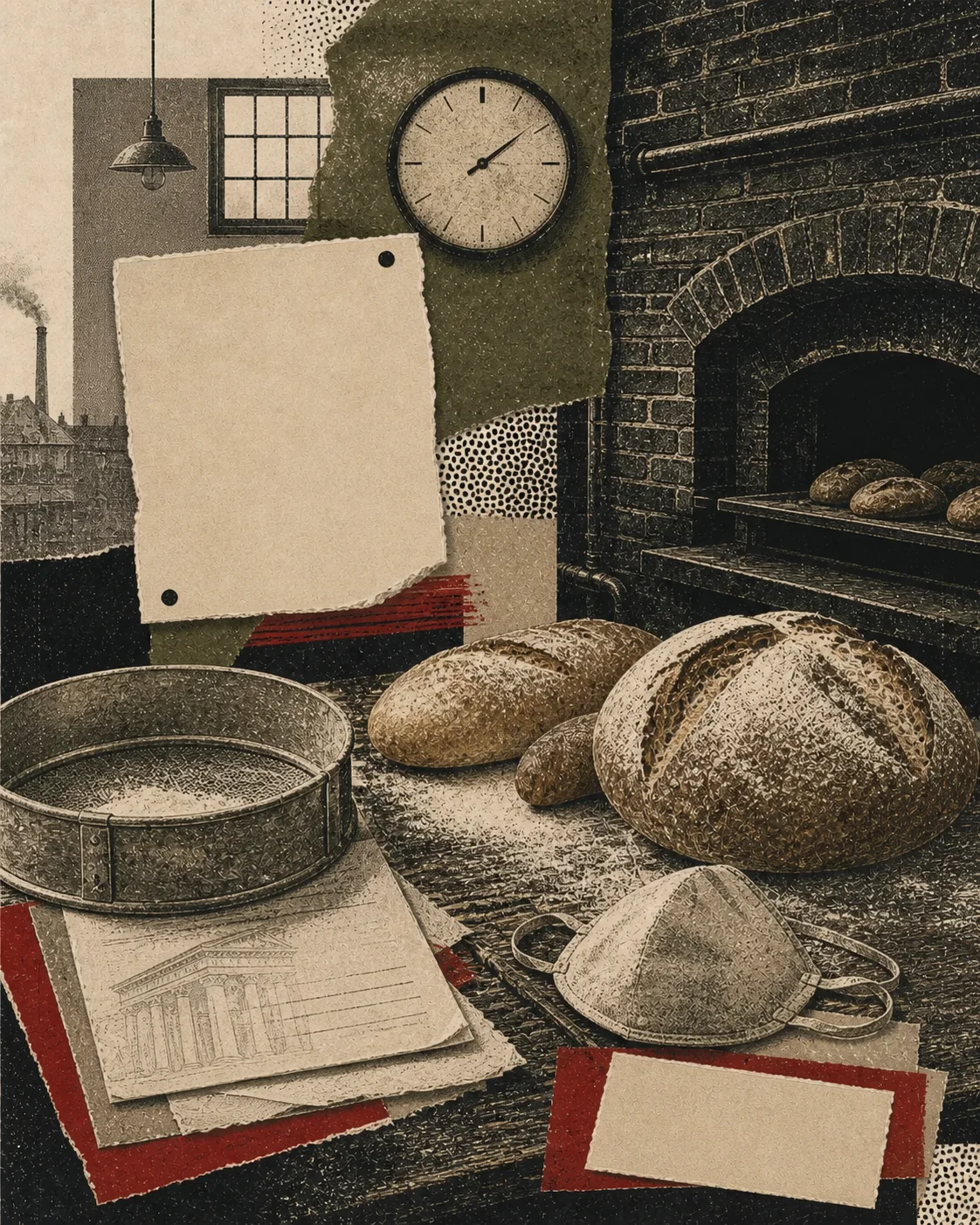
Section 110 of the New York Bakeshop Act reads, in the language the Supreme Court quoted back in 1905: no employee “shall be required or permitted to work in a biscuit, bread, or cake bakery or confectionery establishment more than sixty hours in any one week, or more than ten hours in any one day.” A second section required drainage and plumbing, ventilation, wash rooms kept separate from the bake room, and a ceiling at least eight feet high. The New York legislature passed the whole act unanimously in the spring of 1895. Ten years later, the Supreme Court struck the hours limit down.
The case is Lochner v. New York, and it is usually taught as a pure ideology fight: robed men who believed in laissez-faire economics inventing a constitutional right to overrule a state legislature. That telling skips the part of the record that made the case hard in the first place. New York did not write a sixty-hour cap out of theory. It wrote one because state investigators had counted the bakeries.
What investigators found in the basements
By the mid-1890s, New York City had roughly 1,059 bakeries, and close to all of them, by the state’s own count, operated in tenement basements. The reason was structural, not sinister: a brick oven was heavy, and a cellar’s packed dirt or wood floor could bear the weight where an upper story couldn’t. Rent was also cheaper below ground. The trade-off was a room with a leaking sewer line running through it, no real ventilation, and a ceiling low enough that the air stayed thick with flour dust and the heat of a constantly fired oven. Bakers commonly worked more than seventy hours a week; some worked over a hundred. Many slept in the same cellar, on kneading boards, between shifts.
The New York Press ran an exposé in September 1894, “Bread and Filth Cooked Together,” that put these conditions in front of the public and helped move the legislature. Historian Paul Kens, whose account of the act’s drafting remains the standard one, traces the bill through Henry Weismann, then head of the bakers’ union, who lobbied for both the hours cap and the sanitation rules as a single reform. The vote that followed was unanimous. Nobody in Albany in 1895 was arguing that bakeries were fine as they were.
What the Supreme Court actually said
Ten years and one prosecution later, Joseph Lochner, a bakery owner in Utica convicted a second time of letting an employee work more than sixty hours in a week, was fined fifty dollars with a threatened jail term behind it. He lost at every New York court that heard the appeal before taking the case to the Supreme Court. The majority, five justices to four, ruled his conviction unconstitutional. Justice Rufus Peckham wrote the opinion, and the ruling rested on freedom of contract: the Fourteenth Amendment’s guarantee of liberty, the majority held, includes the liberty of an employer and an employee to agree on hours without the state stepping in, unless the state can show a real link to public health or safety.
Here is the part the ideology-only version of the story leaves out. Peckham did not wave the health question away. He addressed it directly and lost the argument on the merits, in his own view. “We think that there can be no fair doubt,” he wrote, “that the trade of a baker, in and of itself, is not an unhealthy one to that degree which would authorize the legislature to interfere.” He went further: “To the common understanding the trade of a baker has never been regarded as an unhealthy one.” And on the specific claim that fewer hours meant safer bread, he was blunt: “Clean and wholesome bread does not depend upon whether the baker works but ten hours per day or only sixty hours a week.” The connection between hours and health, he concluded, was “too shadowy and thin to build any argument for the interference of the legislature.”
That is a court engaging with an occupational-health record and rejecting it, not a court that never looked. The dispute in Lochner turned on how much evidence should be enough to let a legislature win, with evidence itself never in question.
The dissent that read the same file differently
Justice John Marshall Harlan’s dissent, joined by two other justices, read essentially the same record and reached the opposite conclusion. He cited a medical treatise by a Dr. Hirt describing bakery work as conducted “under conditions injurious to the health of those engaged in it,” in overheated rooms, for unreasonably long hours. He quoted a description of the specific ailments: constant inhalation of flour dust causing “inflammation of the lungs and of the bronchial tubes,” along with rheumatism, cramps, and swollen legs from standing over hot ovens for a full shift. He cited figures claiming bakers were paler and shorter-lived than workers in other trades, seldom living past fifty. New York’s own Eighteenth Annual Report on labor statistics had already flagged baking among the occupations that interfered with normal nutrition and health, and had suggested that shorter hours would improve both.
Harlan’s argument turned on where a court’s job stops, well short of ruling on whether the law was wise. A legislature only needs “a real or substantial relation to the protection of health” to justify a labor law, he wrote, and once that minimal relation exists, whether the law is the best possible policy is a legislative question, not a judicial one. Five justices disagreed about where that minimal bar sat. That disagreement, not a missing record, decided the case.
Holmes, writing past both of them
Justice Oliver Wendell Holmes filed a separate dissent that did not engage the health evidence at all, and that omission was the point. Holmes’s single paragraph has outlasted the rest of the opinions combined, mostly for one line: “The 14th Amendment does not enact Mr. Herbert Spencer’s Social Statics.” Spencer was the Victorian philosopher whose Social Statics argued that state interference with private economic choices, hours laws included, was itself a kind of injustice. Holmes’s point was that the Constitution does not pick a side in that argument. “A Constitution is not intended to embody a particular economic theory, whether of paternalism and the organic relation of the citizen to the state or of laissez faire,” he wrote. His test for whether a law like New York’s should stand asked whether a reasonable legislature could have thought it wise, a much lower bar than Holmes’s own opinion of it, and one Harlan’s tenement-basement record cleared easily.
What the era’s reasoning cost
Lochner did not just decide one baker’s fine. It supplied the reasoning that federal and state courts used for the next three decades to strike down minimum wage laws, child labor limits, and union protections, on the theory that a legislature’s judgment about a workplace was a matter for contracting parties, not statute. Historians now call that run of cases the Lochner era. It ended only in 1937, when the Supreme Court upheld a Washington state minimum wage in West Coast Hotel v. Parrish and stopped applying the freedom-of-contract doctrine the way Peckham had used it. Holmes did not live to see it; he died in 1935. Harlan had died decades earlier, in 1911, having dissented from the doctrine his own colleagues kept extending.
The New York bakers who won their sixty-hour cap in 1895 lost it in 1905, and nobody who worked a cellar oven with a leaking sewer line beside it got a say in the five-to-four vote that took it back. What they had is still legible in the sources: a state report that counted their bakeries, a newspaper that printed what a basement bakeshop looked like, and a law passed by a legislature that did not need convincing. What they lost was decided by a much smaller room, on a narrower question, ten years later.