
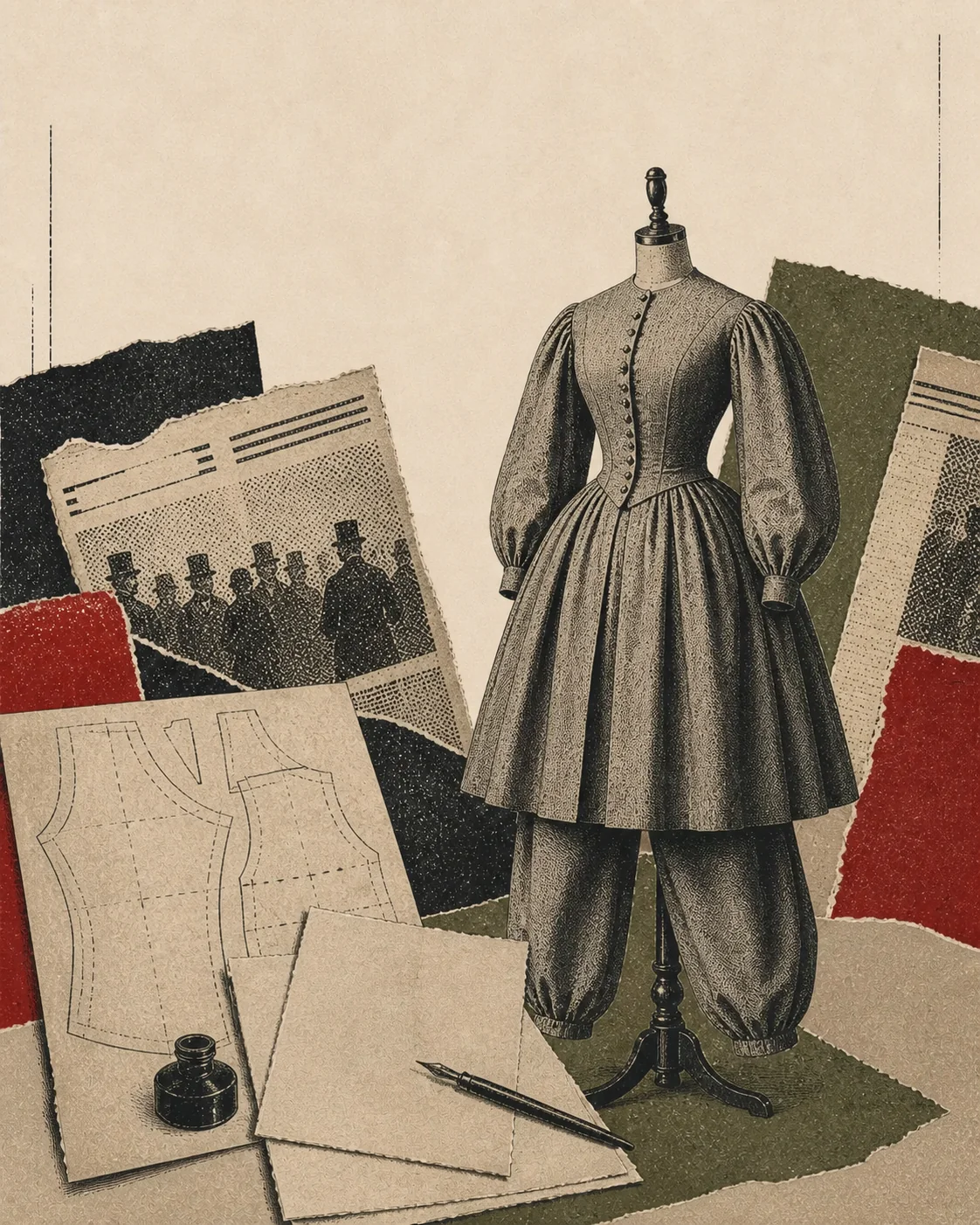
Elizabeth Smith Miller climbed the stairs at her cousin’s house in Seneca Falls with a lamp in one hand and a baby in the other. Elizabeth Cady Stanton, watching from below in her own floor-length skirts, could not have managed the same climb without setting one of them down. Stanton wrote it up herself decades later: her cousin wore “short skirt, full trousers of fine black broadcloth,” cut in a style people were calling Turkish, and moved up the staircase “with ease and grace” while Stanton, hemmed in by her own dress, “pulled myself up with difficulty, lamp and baby out of the question.” Stanton dated the visit to the winter of 1852 in her own memoir, though most historians, working from newspaper coverage, place Miller’s debut in the style on the streets of Seneca Falls in the spring of 1851. Whichever year is right, the argument for the dress was made in a single afternoon on a staircase, not in a pamphlet.
Stanton went and had the same outfit made. So, soon after, did Amelia Bloomer, the Seneca Falls neighbor who edited a temperance paper called The Lily. Bloomer put a drawing of herself in the dress in her paper and wrote about it approvingly. Circulation of The Lily reportedly jumped from around 500 copies a month to roughly 4,000 once readers connected her name to the style, a figure historians draw from the paper’s own later accounts of its growth. Within a few months the short skirt and trousers had a name that had nothing to do with the woman who designed them.
Miller was not, strictly, the first American woman to appear in public dressed this way either. The actress Fanny Kemble and the reformer Lydia Sayer had worn similar Turkish-trouser outfits as early as 1849, two years before Seneca Falls. What Miller did that neither of them had was hand the style directly to two women who were about to make it a national story: her cousin and her cousin’s neighbor with the newspaper.
Amelia Bloomer said, repeatedly, that it was not hers
The costume is called the bloomer to this day, and Amelia Bloomer spent the rest of her life explaining that this was a mistake she had not asked for. In the account she gave her husband, Dexter C. Bloomer, who compiled it into her 1895 biography, she described Miller’s arrival:
Elizabeth Smith Miller, daughter of the Hon. Gerrit Smith, of Peterboro, N. Y., appeared on the streets of our village dressed in short skirts and full Turkish trousers.
Bloomer had been running a debate in The Lily’s pages about women’s dress before Miller ever walked down the street in it. What she had not done was design a garment.
She was explicit about what happened next: newspapers around the country picked up the story, and
“Bloomerism,” “Bloomerites,” and “Bloomers” were the headings of many an article, item and squib; and finally some one, I don’t know to whom I am indebted for the honor, wrote the “Bloomer Costume,” and the name has continued to cling to the short dress in spite of my repeatedly disclaiming all right to it and giving Mrs. Miller’s name as that of the originator or the first to wear such dress in public.
She went further than a disclaimer, writing that the dress would likely never have caught on with the Seneca Falls reformers at all without Miller’s example: “Had she not come to us in that style, it is not probable that either Mrs. Stanton or myself would have donned it.”
A modern retelling did not correct this myth. The credited namesake corrected it herself, in her own compiled writings, while the controversy was still recent enough to explain to her husband in detail. An unnamed newspaper editor coined a word, and the word outlived her correction by more than a century and a half.
What the dress actually cost its wearers
The usual shorthand for why the bloomer costume disappeared is that it went out of fashion, the same way a hemline or a heel height goes out of fashion. That is not the reason the women who wore it gave. Stanton wrote that the freedom the dress offered was real, describing the period she spent in it, free to climb hills and walk through wet weather without gathering yards of fabric in one fist, as bringing her “incredible freedom.” Then she followed that line with the actual verdict:
The physical freedom enjoyed did not compensate for the persistent persecution and petty annoyances suffered at every turn.
The persecution had a shape. Wearers were followed on the street. Crowds gathered to stare at them in towns where they were not already known. Stanton recorded a rhyme that followed the reformers, sung by tormentors who mostly stayed out of sight, behind fences or from upstairs windows:
Heigh! ho! in rain and snow, / The bloomer now is all the go. / Twenty tailors take the stitches, / Twenty women wear the breeches.
A woman who put on the dress to walk to a lecture arrived having already run a gauntlet the lecture itself then had to compete with. The 1881 History of Woman Suffrage, written by Stanton, Susan B. Anthony, and Matilda Joslyn Gage themselves, records the same calculation from the inside: Stanton, Anthony, and Lucy Stone gave up the dress because they “feared the odium attached to the dress might injure the suffrage movement, of which they were prominent representatives.” A new silhouette did not arrive to make the dress look dated and replace it. The argument it was supposed to be serving lost ground to the spectacle, and the dress went down with it.
Not everyone quit at the same pace, and the record does not smooth that over into one tidy retirement date. Stanton put her own run at about two years, which lines up with a return to conventional dress somewhere around 1853. Miller, the woman who had designed the thing, held on considerably longer. Stanton’s own account is specific about it:
The patience of most of us was exhausted in about two years; but our leader, Mrs. Miller, bravely adhered to the costume for nearly seven years, under the most trying circumstances.
Seven years past a debut placed anywhere from 1850 to 1852 puts Miller in the dress into the very end of the decade, wearing it years after the women who had followed her lead had already put their old skirts back on.
A garment reformers judged a tactical loss, not a fashion failure
None of this was really about a skirt length. The short dress and full trousers were meant to demonstrate something specific: that a woman’s clothing, not her constitution, kept her from climbing a staircase with her hands full. Stanton’s own comparison to Miller on those stairs made the case in miniature, years before she wrote a word of it down. A competing style did not arrive to make the demonstration look dated. A woman who wore trousers in 1852 could not walk down a street without becoming the story, and reformers who needed people to listen to an argument about the vote had to weigh what every public appearance in the dress cost them in attention diverted from the vote itself.
That is a different failure than the fashion cycle the popular telling reaches for, and it is the one the women who lived through it actually wrote down. Miller kept wearing the dress for years after her cousin and her neighbor had gone back to full skirts, evidence that the costume itself was never the problem its own designer saw in it. What the others weighed, and what Miller apparently weighed differently for longer, was how much of a public argument a woman could win while also being the argument’s costume.