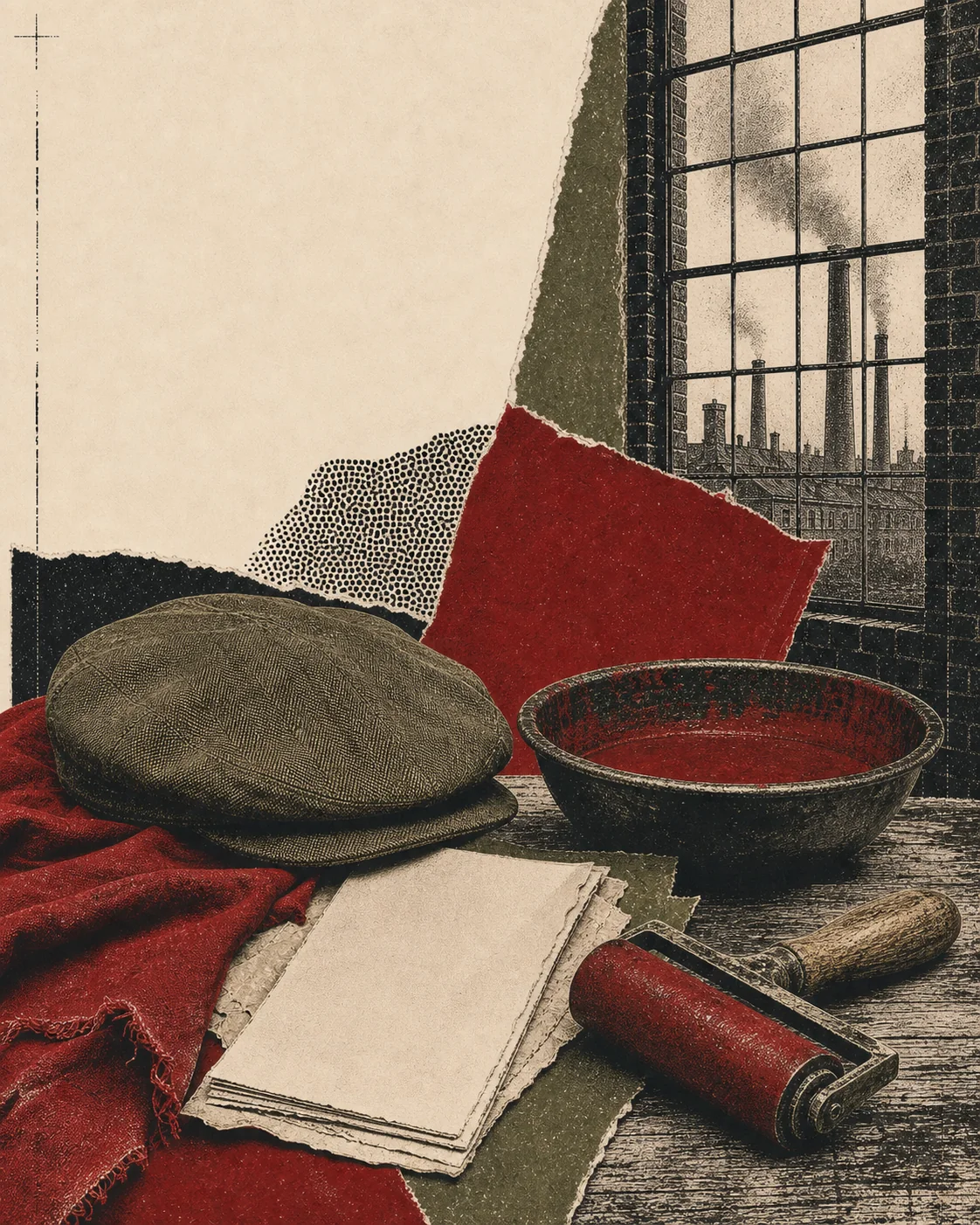
In the spring of 1797, sailors on Royal Navy ships anchored at Spithead and the Nore ran a red flag up the mast. It was not a slogan. In naval signaling of the period, red meant no quarter, the flag a fighting ship flew when it intended to give or receive no mercy. The Spithead and Nore fleets used it to say they would not stand down. Sixteen men were later hanged for the mutinies. Historian Niklas Frykman, in “The Bloody Flag” (2020), places this moment before any political party had claimed the color for anything, in an era of Atlantic-wide naval unrest that ran from the Caribbean to the Dutch fleet. Red was already a warning before it was a cause.
The color existed before the politics did
That order matters, because most retellings run it backward: a movement forms, then picks a color to express its values. Red’s actual path runs the other way. It was first a battle signal, then a riot color, then a party emblem, and only afterward did writers explain what it had “always” meant. Distinguishing between what people did with the flag at the time and what later observers said it meant is most of the historical work here.
The first documented British use of red as a workers’ banner sits in south Wales in 1831. That May, ironworkers and miners around Merthyr Tydfil marched on the Court of Requests to stop the seizure of a neighbor’s goods over debt. According to historian Gwyn A. Williams’s account in “The Merthyr Rising” (1988), the crowd abandoned a white flag for a red one, and one contemporary description has a young man slaughtering a calf and soaking a banner in its blood before the marchers carried it through the streets. Soldiers of the 93rd Highlanders opened fire on the crowd outside the Castle Inn. More than twenty people were killed. A miner named Richard Lewis, known as Dic Penderyn, was tried and hanged for wounding a soldier during the rising, on evidence his own community insisted was false. He is still remembered by name in Merthyr. The flag at Merthyr belonged to no party. It was a warning raised by people who had run out of other options, in a language of blood and threat their opponents would recognize.
France made it a national argument
Seventeen years later, red became a live political question rather than a local one. During the February 1848 revolution in Paris, crowds carried red flags through the fighting that toppled King Louis-Philippe. Alphonse de Lamartine, in his own account of the revolution, describes the scene directly:
A red flag floated amidst the smoke of torches over the foremost ranks of this multitude.
Socialists and radical republicans in the new provisional government wanted to keep the red flag and make it France’s official flag. Lamartine’s government refused, holding to the tricolor and arguing that the red flag represented one uprising’s violence rather than the nation as a whole. The refusal did not settle the argument; it just meant the tricolor stayed official while red kept working as the flag of opposition, the one crowds reached for when they meant to say they were against the government rather than speaking for it.
Paris settled the argument on its own terms twenty-three years later. After France’s defeat by Prussia, Paris formed its own municipal government in March 1871, the Commune, and flew red banners over the Hôtel de Ville for the roughly two months before the French army retook the city and executed thousands of Communards. A sister uprising in Lyon the previous autumn did the same; historian Maurice Moissonnier documented the Lyon Commune’s own red banners in his 1972 study of the First International’s activity there. One surviving banner from the Paris Commune later passed to the French Communist Party, which presented it to the Soviet government in 1921. It is kept today in the mausoleum beside Lenin’s body, a French municipal flag turned into a different country’s relic.
The flag crossed the Atlantic behind the eight-hour day
American labor unions inherited red as an already-loaded color rather than inventing their own. The 1880s eight-hour-day campaign built toward a national strike date of May 1, 1886, set by the Federation of Organized Trades and Labor Unions in 1884. In Chicago, the center of that strike wave, a rally at Haymarket Square on May 4, 1886, turned into a bombing and a police shooting that killed officers and demonstrators. Anarchist organizers who had carried red flags into the square that night were among those tried afterward; four were hanged. The Knights of Labor, which had grown past half a million members on the strength of the eight-hour agitation, distanced itself from the anarchists under Terence Powderly’s leadership rather than defend them.
Haymarket outlived the men executed for it. The Paris Congress of the Second International, meeting in July 1889, set May 1 as an annual international demonstration day in the strike’s memory, which is why May Day is a labor holiday almost everywhere except the United States that produced it. Red flags carried the memory across that gap: a color that had meant no quarter on a mutinous ship in 1797 and blood-warning in a Welsh mining town in 1831 became, by 1890, the flag flown over a hundred cities on the same day for the same demand.
What the myth adds and what it erases
Ask most people why the flag is red and they will say it stands for workers’ blood spilled in struggle, a single clean meaning applied retroactively across a century of separate events. It is not wrong exactly. Blood was real at Merthyr and at Haymarket and outside the Hôtel de Ville. But the sailors at the Nore in 1797 were not mourning anyone; they were threatening. The calf’s blood at Merthyr was theater aimed at frightening a magistrate, staged before any of the marchers had died. The meaning came later, added by movements that inherited the color and needed an explanation worth repeating. Symbols tend to work that way: first a signal for a specific fight, then a memory of every fight that followed, and only at the end a myth clean enough to fit on a badge.
DRESS doesn’t use the red flag. Our mark is a rose, which has its own separate history running through “bread and roses” and the French Socialist Party’s fist-and-rose emblem, and the fabric of the rose hoodie is union made in the United States, cut and sewn through decoration. But the shirt is red for the same reason the flag was, a century and a half before either of us: it was already the color people reached for when they meant business.