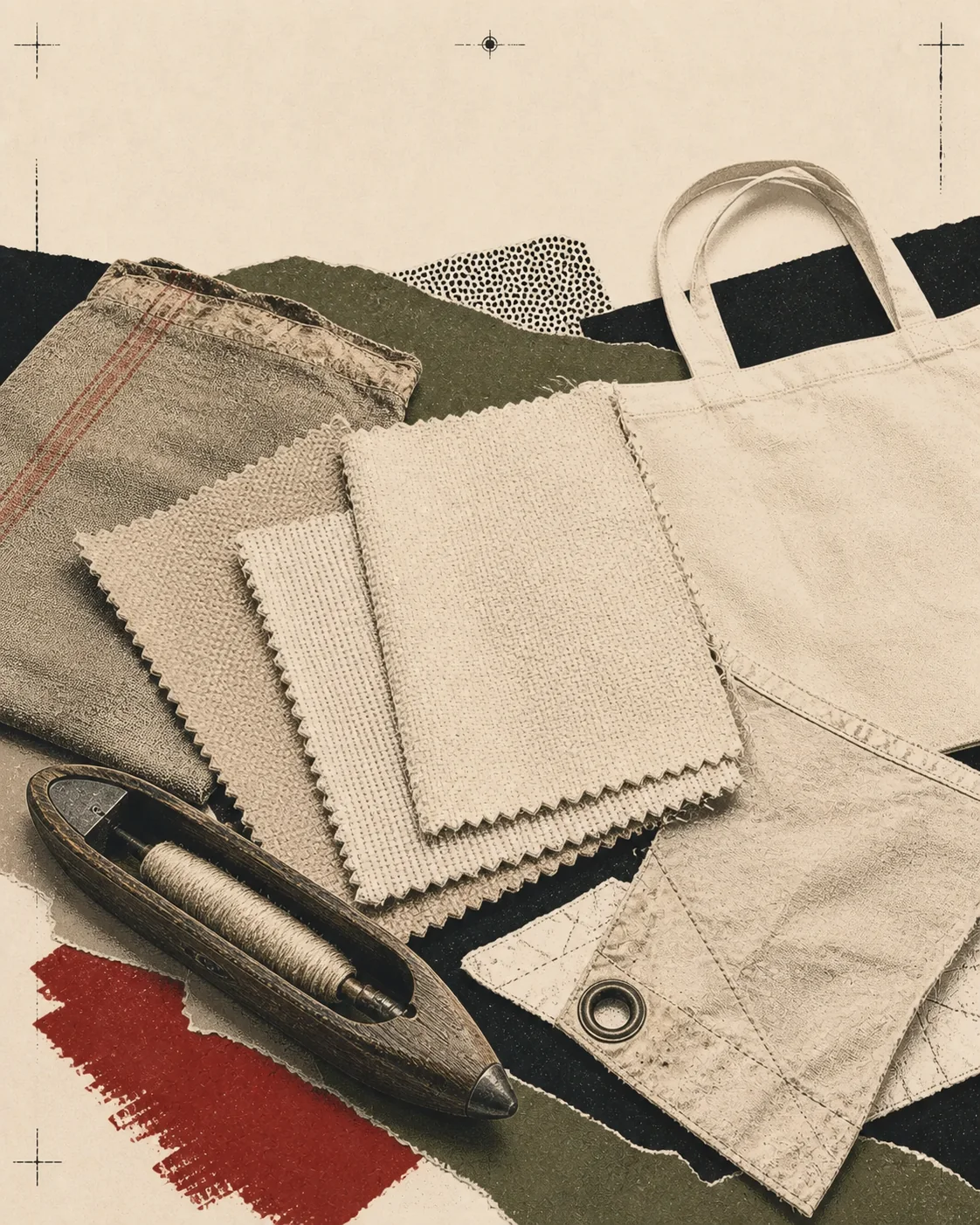
Cotton duck is a plain-weave cotton canvas, and on the scale built to grade it, the smaller number is the heavier cloth. That backward arithmetic was not an accident. The U.S. Bureau of Standards wrote it into a formula in 1924, and the same weave that once went into ship sails and tent panels now shows up, at a fraction of that weight, sewn into grocery totes.
Where the name comes from
“Duck” has nothing to do with the bird. The word traces to the Dutch doeck, meaning cloth, and it entered English trade records early: an English import-duties table from around 1640 lists duck cloth coming in from the Continent, and the Dutch-English dictionaries Henry Hexham published in 1647 and 1648 carry the same word. Holland was Europe’s sailcloth supplier for a long stretch of the seventeenth century, trading flax and hemp into ports across the continent, and the fabric kept the name of the language it arrived in. English mills started weaving their own duck later, and American mills after that, but the word never got translated.
What made the fabric worth naming in the first place was the weave itself: plain, tight, and filled with heavy plied yarn rather than the finer single yarn of ordinary cotton cloth. That density is what let a sail hold wind without stretching out of shape, and it is the same property, four centuries later, that keeps a canvas tote from sagging around a bag of groceries.
The numbers run backward on purpose
By the early twentieth century, American mills were selling “numbered duck” with no agreement on what the numbers meant, and the U.S. government was buying enough of it, for tents, tarpaulins, and ship gear, that the inconsistency became a real cost. The Cotton Duck Association asked the Bureau of Standards to fix it. Physicist Charles W. Schoffstall and technologist Russell T. Fisher published the result in September 1924, in Technologic Papers of the Bureau of Standards No. 264, and the formula they set is still the one anyone citing “numbered duck” is quoting, whether they know it or not:
Number of duck = 19 − (Weight per linear yard 22 inches wide in ounces)
Subtract the weight from a fixed constant and the arithmetic runs in reverse. A lighter yard produces a bigger number; a heavier yard produces a smaller one. Grade 1 duck sits at the top of the weight range. Grade 12 sits at the bottom. Anything heavier than the scale’s zero point got a fraction instead of running past it: a yard weighing 20 ounces became “2/0,” 21 ounces became “3/0,” and so on. The paper also splits numbered duck into soft, medium, and hard texture, based on how many filling threads are packed into each inch, hard being the densest of the three. Schoffstall and Fisher’s own test samples ran from grade 2/0 down to grade 6 for medium texture and from 2/0 down to grade 12 for hard texture, which is why the hard-texture column is the one still quoted when a supplier lists a full 1-through-12 range today. Across both texture classes, the 1924 survey covered ducks running from about 11 to 49 ounces per square yard, which the paper also expresses as 7 to 30 ounces on a linear yard of 22-inch cloth, the two figures related by the width conversion the Bureau used throughout the specification.
Sails, tents, and clothes bags
The Bureau’s 1924 paper lists the government jobs numbered duck was doing at the time, and it is a useful map of what “heavy” and “light” duck were actually for: pontoon covers, tarpaulins, cots, tent flaps and ventilators, wind sails, canopies, winch covers, and hammocks sat at the heavier end. Coaling bags, clothes bags, and awnings sat toward the lighter end of the same numbered range. Sailcloth is the use that gave the fabric its reputation, but the government’s own list already had duck doing bag duty a century ago, just at weights closer to a boat cover than a shopping bag.
Where a twelve-ounce canvas sits
Most canvas totes on the market today, ours included, run in the 10-to-14-ounce range, quoted the way modern mills quote it: ounces per square yard, printed straight on the spec sheet rather than converted through a linear-yard formula. Run that weight through the Bureau’s 1924 arithmetic and it lands near the lightest end of the numbered scale, close to grade 12, the smallest number the government’s survey ever assigned. Retailers selling numbered duck today put grade 12 at roughly 11.5 ounces per square yard, though mills vary enough on the heavier grades that no two supplier charts agree past grade 6 or so; the weight-to-number relationship stays exact only inside the original 1924 formula, not in the marketing copy that borrowed its name.
That placement tells you something practical about what a bag-weight duck is for. A number 1 or 2 duck, at 20-plus ounces, is built to survive wind loading and salt water without stretching. A 12-ounce canvas is built to survive a set of keys, a laptop, and a few years of the same shoulder. It is the same weave family and the same fiber, carrying a fraction of the load the government’s tarpaulin grades were designed for, which is exactly the weight a bag needs and no more.
Duck’s other, stickier legacy
The fabric left one more mark on the language before adhesive tape existed. An 1899 fashion notice in the New Orleans Daily Picayune mentions “pique and duck tape” for washable summer suits, describing plain strips of the cloth itself, sewn as trim, with no adhesive involved. Military engineers were still using the same non-sticky sense of the phrase decades later, calling the cloth strips they laid out on the ground “duck tape” when they used them to mark the edges of minefields during the Second World War. That non-sticky “duck tape” predates the gray sticky roll by more than half a century; newspaper advertising for adhesive “duct tape,” sealing furnace ductwork, doesn’t turn up until the mid-1950s, and the “Duck Tape” brand name belongs to a company that started selling it in the 1970s. The cloth came first, by seventy years, and the tape trademark borrowed its name the same way English borrowed the fabric’s name from Dutch: because the word was already sitting there, attached to something durable.
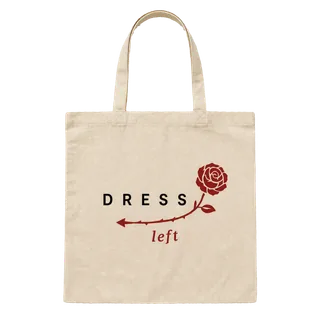
Ours is a 12-ounce natural cotton duck, doubled at the seams the weight actually pulls on, printed on one face and left blank on the other. It sits, by the arithmetic above, close to the lightest weight a canvas has ever been assigned a number for, cut for a shoulder instead of a mast.