
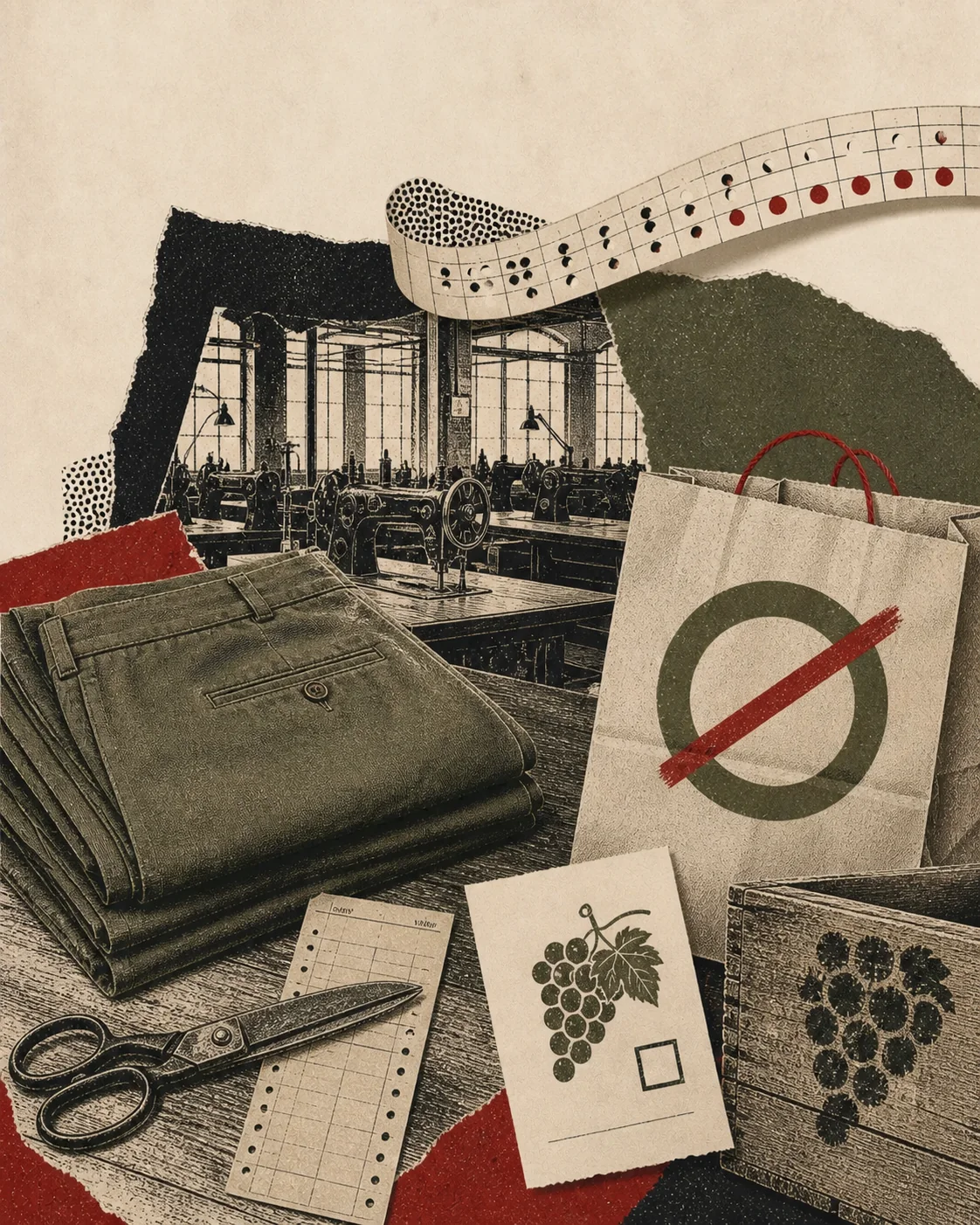
On the morning of May 9, 1972, about 500 workers walked off the cutting-room and sewing floors at Farah Manufacturing’s plant in San Antonio. Within days, workers at the company’s much larger El Paso plants followed them out, and the walkout grew to roughly 4,000 people. They made men’s dress slacks, the kind sold in department stores across the country under the Farah label, and they had not voted to strike so much as simply stopped showing up, plant by plant, until Farah’s production lines in Texas and New Mexico sat idle. Eighty-five percent of them were women, and the workforce was virtually all Mexican American, a fact confirmed not by a company press release but by the historians who later sat down with the strikers themselves to record what happened.
That strike ran twenty-two months. It ended not with a court order or a labor-board ruling but with a company that could no longer afford to keep losing customers.
Why a slacks factory, and why then
Farah had been organizing resistance inside its own walls for years before the walkout. In 1969, male workers in the cutting rooms voted to affiliate with the Amalgamated Clothing Workers of America, and a follow-up election in October 1970 to extend that representation was later overturned. The grievances were the kind that build slowly and then all at once: production quotas set high enough that missing them meant public humiliation on the floor, a company medical clinic strikers considered incompetent, no maternity leave or pension, and, according to the strikers interviewed by historians Laurie Coyle, Gail Hershatter, and Emily Honig for their 1979 study, an atmosphere of open contempt from Anglo supervisors toward a workforce Farah’s owner, Willie Farah, liked to describe in paternalistic terms in the press. The women who ran the sewing machines, according to those interviews, described supervisors who timed bathroom breaks, who came by the machines shouting when a quota was missed, and who treated a request for a slower line as a personal insult rather than a mechanical fact about the equipment. When the San Antonio plant finally walked, El Paso did not need much persuading to follow, and the strike spread within days to Farah’s Las Cruces, New Mexico plants as well.
None of this happened in a city where a garment worker had many other options. Farah was El Paso’s second-largest employer through the early 1970s, with roughly 10,000 workers on its Texas and New Mexico payrolls combined, in a border economy where a manufacturing wage, however thin, still beat the alternatives. Walking off a job like that for nearly two years, with a family depending on the paycheck, took the only real weapon the strikers had and used it, and it cost most of them everything they owned before it paid off.
The tactic borrowed on purpose
About a month after the walkout began, the ACWA declared a national boycott of Farah slacks, and it did not disguise where the idea came from. The United Farm Workers had settled its own five-year grape strike in July 1970 largely on the strength of a consumer boycott that turned supermarkets into picket lines, and the Farah boycott followed that model deliberately, down to sending organizers into the same kind of city-by-city campaign. Cesar Chavez visited El Paso during the Farah strike to show his support, a direct line between the two campaigns rather than a coincidence of timing. By January 1974, the union had about forty representatives working the boycott in more than sixty cities, asking shoppers by name to skip the Farah label the way UFW organizers had asked them to skip the grape display. The AFL-CIO endorsed the campaign, and a network of student groups, Chicano organizations, and Catholic parishes carried it into places a picket line in El Paso could never reach on its own.
The Catholic Church’s support was not incidental. Father Jesse Munoz opened church facilities to the strikers early on, and Bishop Sidney Metzger publicly endorsed the boycott, giving it a moral standing in a heavily Catholic city that a labor dispute alone would not have carried.
What the pressure actually did
Farah’s numbers tell the plainer version of the story. Company sales fell from roughly $156 million in 1972 to about $126 million in 1974, a drop of nearly a fifth in two years, and Willie Farah’s own stock in the company lost most of its value over the same period. Direct picketing in El Paso had gotten the company nowhere through 1972 and most of 1973, while the boycott, working on customers who never saw a picket line, moved it. Farah recognized the ACWA as the strikers’ bargaining agent on February 23, 1974, and the two sides ratified a three-year contract on March 7. It raised wages by 55 cents an hour over the life of the contract, added company-paid medical insurance, established seniority rights and a formal grievance procedure, and, for the first time, gave the union standing to challenge the production quotas that had driven so much of the original anger.
Not every striker considered the settlement a win. Some who had been on the line for nearly two years felt the union leadership had negotiated a smaller raise than the shop floor wanted and had rushed the contract to a vote without enough explanation of its terms. That dissatisfaction fed a rank-and-file group called Unidad Para Siempre, which had organized independently of the ACWA during the strike itself, distributing its own leaflets and running a relief fund for strikers whose $30-a-week union assistance did not stretch to cover rent and groceries for a family. Rosa Flores became one of the strike’s most visible public faces on the picket line and the boycott speaking tours; Cecilia Rodriguez, who also came up through the strike, went on to found La Mujer Obrera in 1981, an El Paso organization for Mexican American garment workers that outlasted Farah’s own presence in the city by decades.
Returning to the floor after the settlement was its own fight. Strikers came back to find production lines reorganized, quotas set on unfamiliar operations they had not been retrained for, and, according to accounts collected after the strike, an apparent pattern of assigning former strikers to the hardest jobs on the line. Texas was and remains a right-to-work state, which meant union membership stayed voluntary even after recognition, and the antiunion sentiment inside Farah’s management did not disappear with a signature on a contract.
The correction the grape strike alone does not cover
Consumer boycotts as a labor tactic are credited, when they are credited at all, to the grape strike almost exclusively. That strike earned the credit; it is the campaign that proved a supermarket picket line could outlast a field picket line. But Farah is the proof that the tactic generalized. It worked in a different industry, on a different coast, against a company selling a manufactured good rather than a crop, run by a different union entirely. The ACWA did not invent a new tool. It picked up the UFW’s tool, in the middle of the UFW’s own campaign, and used it to win a contract in a garment plant twenty-two months after the walkout began. A tactic that works once in a vineyard is an anecdote. A tactic that gets borrowed on purpose and works again in a trouser factory is a method, and the Farah strike is the case that makes it one.
What the strike could not fix
The contract’s gains did not last the way the strikers who ratified it in March 1974 might have hoped. Farah went through repeated ownership changes, plant closures, and eventually a bankruptcy filing over the following decades, and the company that once employed roughly 10,000 people in El Paso no longer operates there as an independent manufacturer. The strikers won the fight they were fighting. They could not win the one that came after it, the slower one against a garment industry moving its production wherever labor cost least, which is a separate history and a harder one.
DRESS garments are cut, sewn, and finished by organized labor in the United States, and the reason a shop like that still exists in an industry this footloose traces straight back through strikes like this one: a plant full of workers with almost no power inside the building who found it instead at the cash register three thousand miles away.