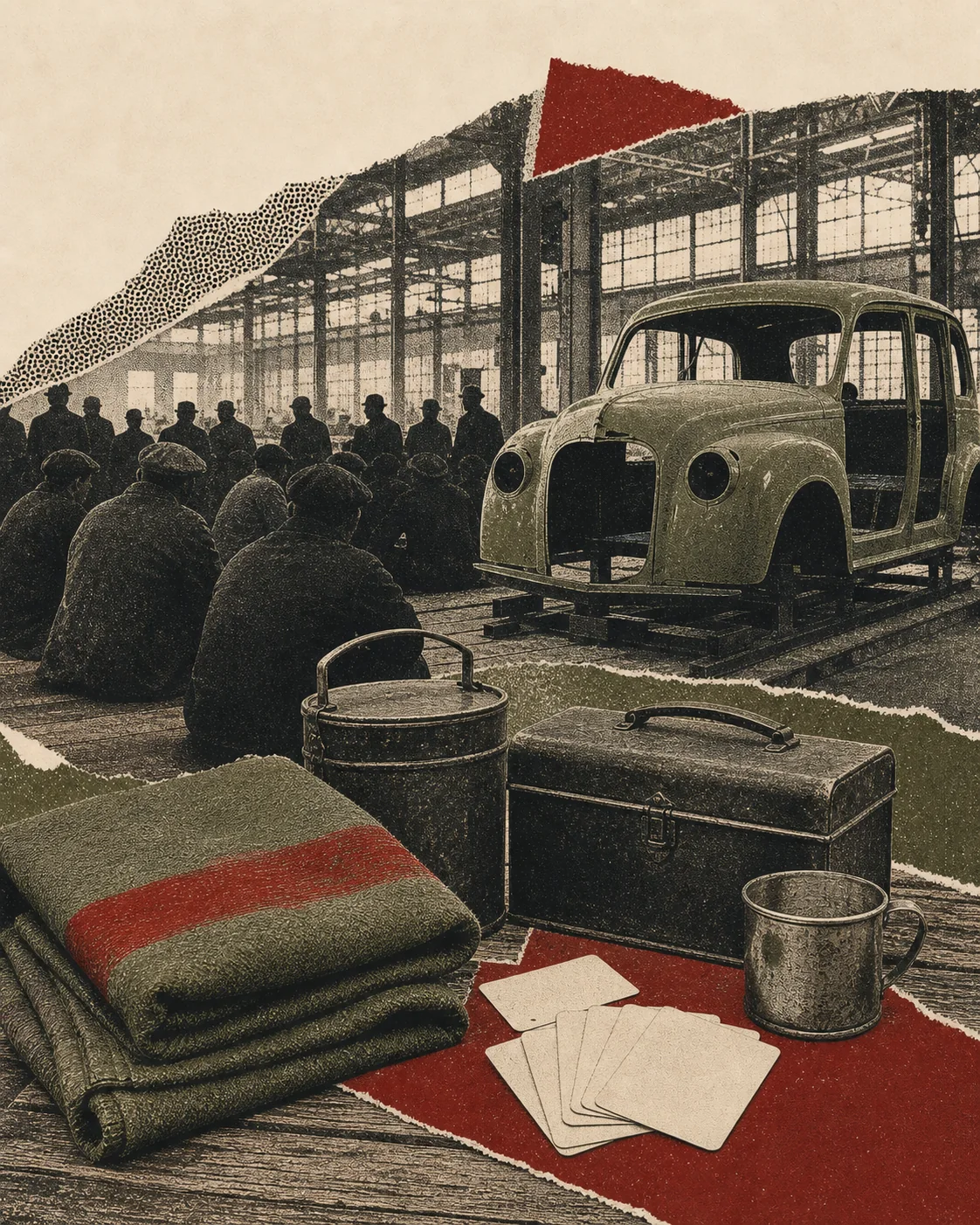
At 8:00 p.m. on December 30, 1936, the machines at Fisher Body Plant One in Flint, Michigan stopped. The workers running them did not walk out the door. They shut off the line, sat down at their stations, and stayed. General Motors owned the building, the tools, and the dies inside it. For the next 44 days, it did not control any of them.
The grievance behind it was the speed of the line itself. GM had steadily raised production quotas through the mid-1930s without adding workers to match, a practice strikers called the speed-up, and it left men too exhausted at the end of a shift to hold a fork steady at dinner. Wages had not kept pace either. Underneath both was the demand GM had refused for two years running: recognize the United Auto Workers as the bargaining agent for its members, rather than negotiate plant by plant with whichever worker committee the company found easiest to ignore.
The tactic was not new to Flint, but Flint is where it broke a company that size. A picket line outside an empty plant can be crossed: replacement workers walk past it, police clear it, and production resumes. A plant full of men who will not leave cannot be run by anyone else, and clearing them out by force means destroying stamping dies and precision tools that took years to build and could not be quickly replaced. The United Auto Workers, barely two years old and unrecognized by GM, understood that the company’s own machinery was the strikers’ best protection.
Why a body inside the plant beat a line outside it
GM’s dies for the 1937 model year sat inside Fisher One and Fisher Two, the two plants under occupation. Smash the windows or send in police with force sufficient to drag out thousands of men, and the same blunt instruments that worked on people would wreck tooling GM needed for the next model year. The company’s own capital became the strikers’ advantage. Bob Travis and the other UAW organizers running the strike understood this specifically enough to plan a second occupation around it: on February 1, 1937, they staged a decoy sit-down announcement at Chevrolet Plant No. 9, timed for 3:20 that afternoon, deliberately in front of known company informants. GM massed its guards at Plant 9. While that diversion held, strikers seized Chevrolet Plant No. 4, the plant that built every engine GM’s Chevrolet division used nationwide. Losing it would have stopped Chevrolet production across the country within days.
The Battle of the Running Bulls
The strike’s worst violence came earlier, on January 11, 1937, at Fisher Body Two. GM cut the heat to the plant in freezing weather and blocked food deliveries to the men inside. When a food run was contested, Flint police arrived and fired tear gas into the crowd and through the plant’s own windows. Strikers responded with the plant’s fire hoses and two-pound door hinges thrown by hand. Police opened fire; more than a dozen strikers were wounded by gunfire, and accounts of the day’s total injuries on both sides run higher still, since strikers and officers alike came away hurt. The confrontation earned its name because it was the police, not the strikers, who eventually ran.
That reversal happened because of the Women’s Emergency Brigade. Genora Johnson Dollinger, then 23, had organized roughly 350 women into the brigade earlier that month, identifiable by red berets and armbands marked EB, Detroit’s counterparts wearing green and Lansing’s white. At the Running Bulls, she reached the scene in a sound truck and called the women forward. “I begged the women to break through those lines of cops and come down here and join with us,” she said in an interview decades later. Police who would fire into a crowd of men hesitated to fire into women walking toward them, and the line broke. Three weeks after, on February 1, brigade members formed a human chain across the gates at Chevrolet Plant 4 to hold off police while the men inside secured the building, the same operation the Plant 9 decoy had made possible.
Two judges, one stock portfolio
GM tried the courts twice. On January 2, 1937, Genesee Circuit Judge Edward Black granted the company a sweeping injunction ordering the strikers out and barring any interference with plant operations. It fell apart almost immediately: the UAW’s lawyers discovered Black held 3,365 shares of GM stock, worth roughly $219,000 at the time, a direct financial interest in the case he was ruling on, and Michigan law barred a judge from hearing a case in which he had a stake. When a sheriff’s deputy read the invalid order to strikers inside the plant, they laughed him out of the building.
A second injunction came from Judge Paul Gadola on February 1, ordering the strikers to evacuate by a set deadline or face steep fines. They ignored this one too, not because it carried the same conflict but because by then the strike no longer depended on a court’s patience. Governor Frank Murphy had already sent the Michigan National Guard into Flint after the Running Bulls, and he used it to keep police and company guards away from the plants rather than to enforce eviction. Murphy spent the following days shuttling between GM’s negotiators and the union, refusing to order troops against men he had chosen to protect.
Murphy never sent the Guard into the plants at all. For six weeks its job was standing between the strikers and everyone else who wanted them out: city police, company guards, and the sheriff’s deputies carrying Gadola’s order.
What GM signed on February 11
The strike ended February 11, 1937, with GM recognizing the UAW as the exclusive bargaining representative for employees who held union membership, a status the agreement extended for the following six months while the union built its membership further. The company agreed to rehire every striker, permit union buttons and talk on the shop floor, raise wages five percent, and stop the practice of secretly diverting work to non-union plants to starve out a strike elsewhere. None of it applied to a union that had, weeks earlier, represented a small fraction of GM’s workforce and had never won a contract with a major automaker.
What the settlement bought other workers is the part that outlasted Flint. Within two years, the UAW’s membership passed 400,000, and the industrial union model the sit-down proved, mass production workers organized regardless of trade or skill level, spread to steel, rubber, and electrical manufacturing over the rest of the decade. None of that required a banner slogan. It required roughly two thousand men who would not leave a building, and 350 women in red berets willing to walk toward armed police so the men inside could stay.