
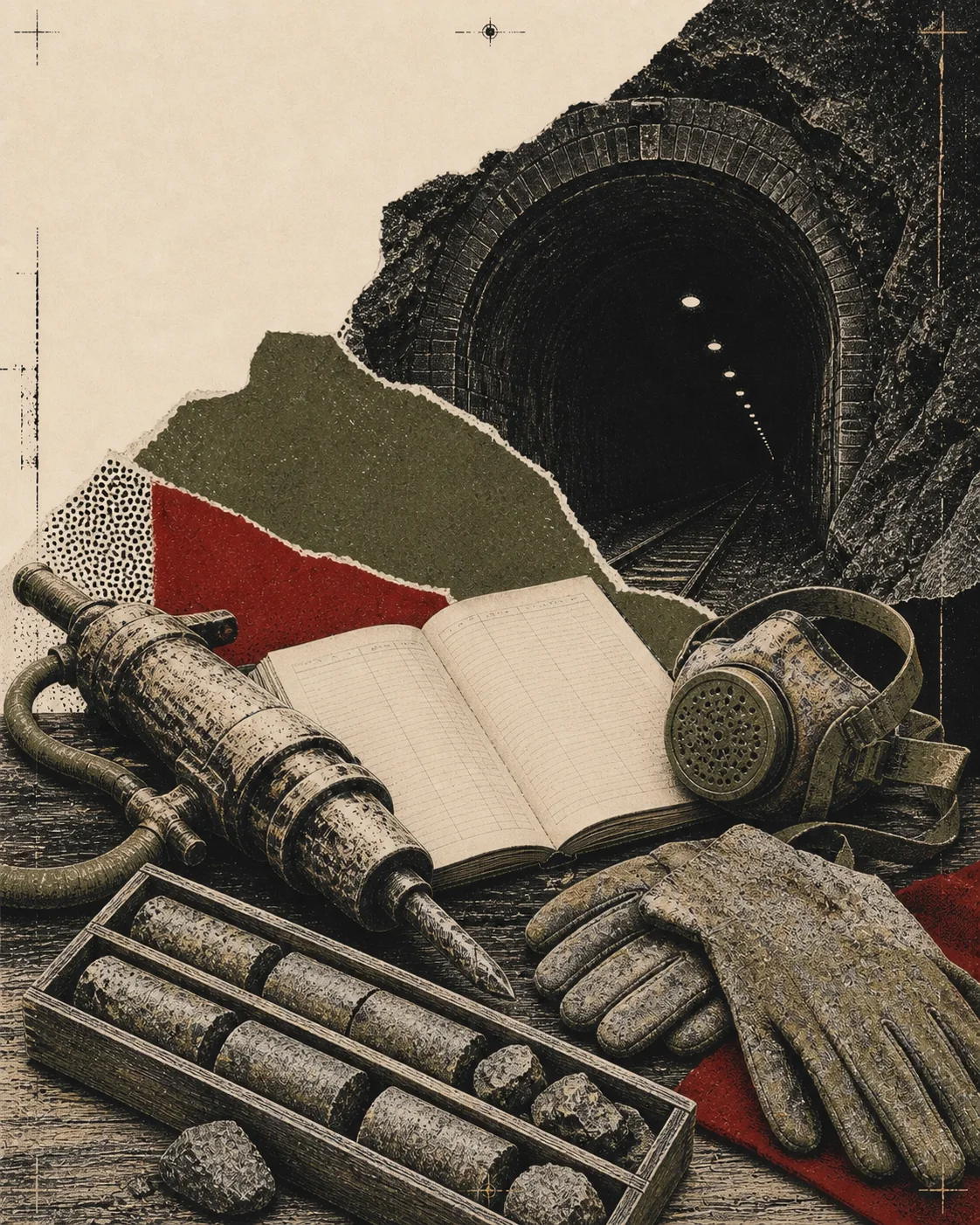
In 1932, a West Virginia woman named Cora Jones filed the first lawsuit over the Hawks Nest Tunnel. She had lost a husband and three sons to it, men who had gone underground healthy and come out coughing within months. Her suit was one of 538 that eventually followed, filed against a contractor and a power company over a tunnel that had been finished for less than a year. By January 1936, when a House subcommittee finally opened hearings in Washington, survivors described what Cora Jones’s family had breathed: dust so thick a man could not see the miner working beside him, a white coating on every worker’s skin and clothes by the end of a shift, and no mask, no water spray on the drill bit, and no way to say no to the job.
What the company built, and how fast
Union Carbide needed a three-mile tunnel to divert the New River through Gauley Mountain and feed a hydroelectric plant that would power a new electrometallurgical furnace nearby. It created a subsidiary, the New Kanawha Power Company, to hold the water rights, and hired Rinehart and Dennis of Charlottesville, Virginia, the low bidder among 35 contractors, to dig it. Core samples taken before construction began in March 1930 already showed what the crews would be drilling through: sandstone running over 90 percent silica, and in some headings as high as 99 percent, nearly pure glass in rock form. The company enlarged roughly a third of the tunnel beyond what the water project required, wide enough to mine the silica itself for the furnace, a detail that came out at the 1936 hearing and that made the extra digging, and the extra deaths inside it, a business decision rather than an engineering necessity.
Most of the drilling was done dry, without the water spray that would have kept the dust down, because dry drilling was faster. Ventilation was minimal for a project that size, and the state archive’s own account of the job describes dust collecting until visibility inside the tunnel dropped to a few feet. Survivors testified that gasoline-powered locomotives hauling out rock added carbon monoxide to air already choked with rock dust, and that foremen pushed sick men back into the tunnel rather than losing a shift’s output. Silicosis normally develops over ten to twenty years of dust exposure. At Hawks Nest, men who started healthy in 1930 were dead of it by 1931, a compression of the disease’s usual timeline that doctors called unprecedented when they testified to the subcommittee five years later.
The exposure itself fell unevenly. Black workers made up roughly three-quarters of the tunnel crews and were the men most often assigned to the deadliest work at the heading, where the drilling happened and the dust was thickest. That assignment pattern, confirmed by later historians reviewing the hearing testimony, is part of why the deaths and the missing records both skewed the way they did.
The hearing, and the number it settled on
The subcommittee of the House Committee on Labor sat for ten days, January 16 through February 4, 1936, taking testimony from surviving workers, company officials who mostly declined to appear, and physicians who had treated the dying. Its published report, running 203 pages, concluded that the tunnel had been built, in the committee’s own language, with grave and inhuman disregard for the health, lives, and futures of the men who dug it. Out of that testimony the committee arrived at a toll of 476 deaths from silicosis tied to the project. That is the number that made newspapers in 1936 and the number still cited as the official congressional figure.
It was never the only number, and it was not even the company’s own number. Union Carbide’s contemporaneous mortality reports, prepared as part of its defense, put the death toll at 109, counting only deaths the company could directly attach to employment records it still had on file. Half a century later, the physician and historian Martin Cherniack reopened the case for his 1986 book The Hawk’s Nest Incident: America’s Worst Industrial Disaster, working from hospital admissions, burial contracts, and the surviving Rinehart and Dennis payroll to reconstruct individual cases rather than accept any single institution’s tally. Cherniack’s count came to 764.
Why the range exists
Three figures, from three sources, none of them wrong exactly, because none of them were counting the same thing. Union Carbide counted men whose deaths it had a payroll record for and chose to report. The 1936 committee counted what its ten days of testimony and subpoenaed records could establish under oath, in a hearing room where the contractor’s own officers mostly declined to appear. Cherniack counted forward from medical and burial evidence the earlier investigations never fully reached, working decades later from records the workers involved could no longer testify to themselves.
The gap between those numbers tracks a gap in who got written down. About three-quarters of the roughly 3,000 to 5,000 men who worked the tunnel were Black migrants, recruited from Virginia, North Carolina, and further south by labor agents who promised tunnel wages during the Depression. Fayette County’s white cemeteries would not take Black burials. Workers who died on site were buried instead on farmland near the camps, in graves that got no headstone and no entry in any county death register, because there was no register that would have them. A man who sickened, quit, and rode a bus home to die in Alabama or Tennessee never appears in a West Virginia count at all, no matter how carefully that county’s own dead were tracked. The dispute over how many died at Hawks Nest is really a record of who the companies and the county considered worth counting while it was happening, and the range between 109 and 764 is the size of that omission made visible.
What followed, and what didn’t
Congress took no action against Union Carbide or Rinehart and Dennis. Cora Jones’s suit and the hundreds that followed it moved slowly through West Virginia and Virginia courts for years; the largest case to reach a jury, in 1933, ended in a mistrial after evidence surfaced of jury tampering. Of the 538 lawsuits eventually filed by workers and families, most were consolidated and settled out of court; accounts of the total differ, with figures running from about 130,000 to 200,000 dollars, and individual payments ranging from 30 dollars to 1,600. Close to half of whatever the total was went to attorneys. No executive, engineer, or foreman was criminally charged. Congress’s one concrete response that year was a requirement that respirators be provided on federal construction contracts where dust exposure was a known hazard, a rule aimed at future tunnels rather than a reckoning for this one.
West Virginia’s own state archive carries an account of the silica readings and the dry-drilling conditions that any mining engineer at the time would have recognized as lethal. The National Park Service now maintains a Hawks Nest Workers Memorial and Grave Site near Summersville, on the open field a funeral parlor identified on Martha White’s farm once local cemeteries stopped taking Black burials. That field, not a courthouse ledger, is where most of the missing names have to be looked for.
In the 1970s, road crews widening a highway near Summersville turned up ground that did not match any cemetery plan on file. Under it were child-sized coffins holding the commingled bones of dozens of men, unrecorded burials from a project that had ended forty years earlier. Nobody working that road crew was looking for them. They were there because Fayette County’s cemeteries would not take the men Hawks Nest killed, and because a company report, a congressional hearing, and a historian’s decades-later reconstruction all had to guess at a number the ground itself was still holding.