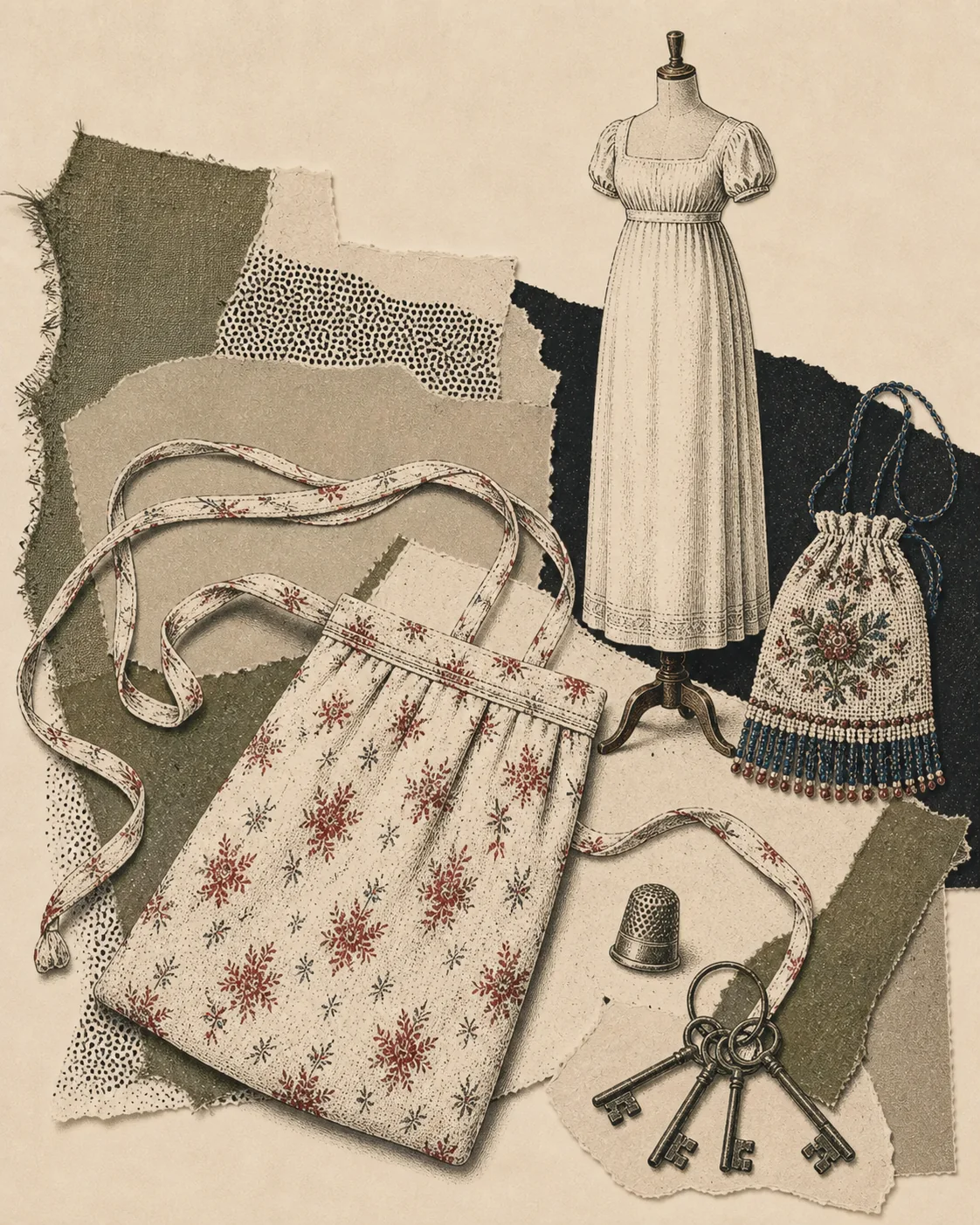
In 1745 a Yorkshire dressmaker cut a slit into the side seam of a woman’s petticoat, not for fit, but for access. Underneath, tied around the waist with a length of tape, sat a separate quilted bag: a pocket, in the original sense of the word, that had nothing to do with the gown above it. A woman put it on in the morning and took it off at night. She could own several and swap between them. She could hide one entirely.
That is the honest starting point for the question people type into a search box: why don’t women’s clothes have pockets? For roughly a century and a half, they did, just not sewn in. What broke the habit was a change of silhouette around 1800, followed by a century and a half of dressmaking that never fully reversed it.
A pocket you could take off and hide
The Victoria and Albert Museum dates common use of the tied-on pocket from about 1650 to the close of the nineteenth century, worn singly, in pairs, or occasionally three at once, accessed through openings cut into the gown and petticoat. Working women wore theirs visibly, over an apron. Women in formal dress kept theirs underneath everything, invisible until needed.
Barbara Burman and Ariane Fennetaux built the fullest account of what these objects actually held. Their 2019 study for Yale University Press examined more than 390 surviving pockets in museum and private collections alongside 572 Old Bailey trial records, since a stolen or lost pocket regularly ended up as courtroom evidence. What turns up: coins, household and cupboard keys, thimbles and bodkins, snuffboxes, penknives, letters, and miniature portraits. A pocket was searchable evidence of a life in a way a woman’s outer dress, borrowed or handed down, often was not.
The V&A’s own framing matters here: pockets and handbags eventually coexisted rather than one cleanly replacing the other. The decline was gradual, and it tracked a specific wardrobe problem rather than a single verdict against women carrying things.
What actually killed the tie-on pocket
The wardrobe problem was the Empire silhouette. Between roughly 1795 and 1820, skirts narrowed, waistlines rose to just under the bust, and fabrics thinned to muslin and lawn. A quilted pocket bulging at the natural waist, which that silhouette no longer had, was no longer physically wearable under the dress. Something had to carry what the pocket used to carry, and the answer was the reticule: a small drawstring bag, first made of netting and later of silk or beadwork, carried openly in the hand.
Contemporaries mocked the reticule as a “ridicule” for its size and its visibility, a private object suddenly made public. But the joke concedes the point: this was a design constraint solved by a new object, not an argument won by anyone. Nobody legislated the pocket away. A dressmaker in 1800 simply had nowhere left to put one.
Skirts widened again through the Victorian decades, crinolines came and went, and sewn-in pockets returned intermittently in working dress and outerwear. A mid-century housemaid’s apron or a walking costume might carry a pocket stitched directly into a side seam, no tape required, because the wider skirts of the 1850s and 1860s had room again. But the return was uneven and class-divided. Formal and fashionable dress, the garments made for display rather than labor, kept routing a woman’s belongings to a bag rather than a seam, and that habit is the one that survived into the twentieth century’s ready-to-wear patterns.
The V&A’s own account is careful on this point: pockets and handbags coexisted for most of the nineteenth century rather than one flatly replacing the other. What changed was which garments got which. A working woman’s dress was more likely to keep a functional pocket than a fashionable one, and pattern-makers designing for the fashionable market simply had less reason to solve a storage problem their customers were already solving with a bag.
Rational dress, not suffrage marketing
By 1881, the missing pocket had become an organized complaint. The Rational Dress Society, founded that year in London under Viscountess Harberton, campaigned against corsets, high heels, and weighted skirts on a platform it stated plainly: freedom of movement, and no more weight than necessary for warmth. Lady Harberton and allies including Mary Eliza Haweis argued for clothing that let a woman walk, cycle, and work without engineering her body around the garment. Pockets, as practical storage that competed for space with a fitted silhouette, sat inside that same argument, though the Society’s own language was about mobility first.
This is the part the popular version compresses. The Rational Dress Society predates the phrase “suffragette suit” by three decades. Dress reform and suffrage politics overlapped and shared members, but they were not one campaign with one product, and no rational-dress pattern from the 1880s was marketed under a suffrage name.
The 1910 suit was a tailor’s invention
The suit itself has a paper trail, and it does not start where the popular telling puts it. The New York Times reported on October 10, 1910, under the headline “Plenty of Pockets in Suffragette Suit,” that the American Ladies’ Tailors’ Association had introduced a divided walking suit carrying seven or eight easily reached pockets. This was a trade association naming a commercial garment after a live political story, the same way a designer today borrows a headline for a collection name. It was not a suit issued, worn as a uniform, or designed by any suffrage organization.
Decades of dress-reform argument, from an 1881 society through Edwardian tailoring trade coverage, get flattened in retelling into a single origin myth: suffragettes demanded pockets and got them. What the record actually shows is longer and less tidy: a garment lost its pocket to a silhouette change around 1800, reformers spent the following century arguing for its return on health and mobility grounds, and a tailoring trade group cashed in the word “suffragette” for a coat with pockets in 1910, three years before militant suffragettes in Britain were being force-fed in prison for the same cause the coat’s name borrowed.
A pattern that outlived its cause
None of this explains why a 2026 dress still ships with pockets too shallow for a phone. The Empire silhouette that started the habit ended two centuries ago. What persisted is the manufacturing default it left behind: a garment costs more to cut and sew with a functional pocket, and decades of pattern-making simply kept omitting one long after the waistline that made it impossible had gone out of fashion. Our Rose Hoodie has a kangaroo pocket cut high enough that a phone stays in it when you stand up, which is a small thing to specify in a garment spec and a real answer to a two-hundred-year-old complaint.