
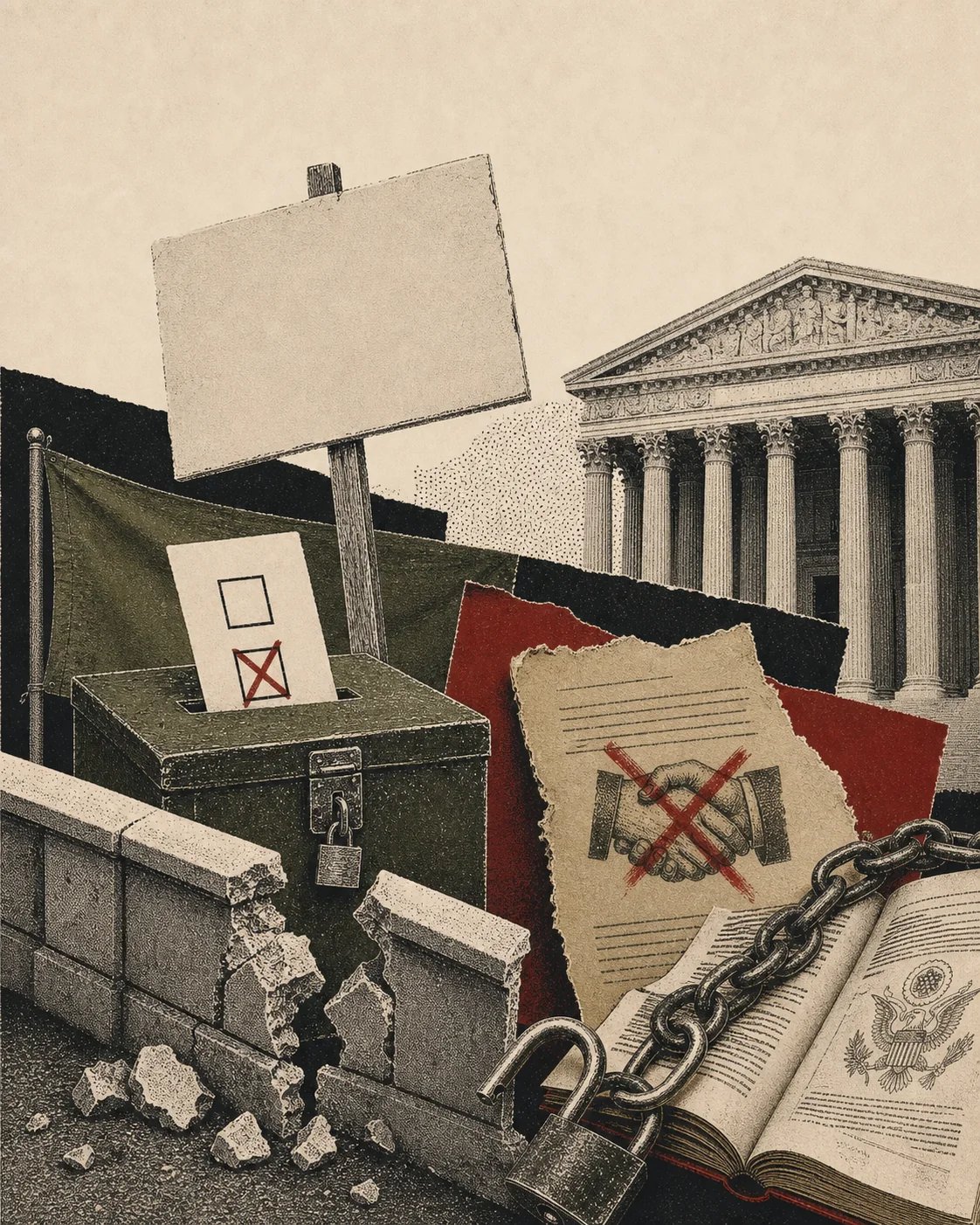
Section 101 of Title 29 of the United States Code opens with a sentence that does not sound like the start of anything. “No court of the United States, as defined in this chapter, shall have jurisdiction to issue any restraining order or temporary or permanent injunction in a case involving or growing out of a labor dispute, except in a strict conformity with the provisions of this chapter.” That single sentence carries the whole structural achievement of the Norris-LaGuardia Act, passed by Congress and signed by Herbert Hoover on March 23, 1932. It does not grant workers a right to organize. It does not create an agency, a hearing process, or a duty to bargain. It takes a tool out of a judge’s hands.
The tool was the labor injunction, and by 1932 it had been the single most effective weapon against strikes in the country for four decades. A struck employer’s lawyer could walk into federal court, describe a strike as a conspiracy in restraint of trade or an interference with property, and walk out an hour later with an order that made picketing, boycotting, or even publicizing a dispute a contempt of court, enforceable by a federal marshal and a jail cell rather than a jury trial. Between the 1890s and the 1930s, courts issued these orders by the thousands. The strike did not have to be violent to be enjoined. It only had to be inconvenient to an employer with a lawyer who knew the right judge.
The Hitchman contract, on paper
The device that did the most damage to organizing before 1932 paired the injunction with a signed piece of paper: the yellow-dog contract. The Hitchman Coal & Coke Company, operating in the Panhandle district of West Virginia, required its miners to sign an employment card that read, in the Supreme Court’s own quotation of it:
I am employed by and work for the Hitchman Coal & Coke Company with the express understanding that I am not a member of the United Mine Workers of America, and will not become so while an employe of the Hitchman Coal & Coke Company.
In Hitchman Coal & Coke Co. v. Mitchell, decided in 1917, the Supreme Court held that this card was a valid, enforceable contract of employment, and that a union organizer who tried to sign up men bound by it was interfering with a legal business relationship. The Court enjoined the United Mine Workers from organizing at Hitchman’s mine at all. The logic ran in a tight circle: the contract made union membership a breach of the employment agreement, and interference with an employment agreement was a tort a court could stop before it happened. A miner did not have to be fired for joining a union. The union itself could be barred from ever reaching him.
That circle is what Norris-LaGuardia was built to break. Section 103 of the Act declares any such undertaking, any agreement, written or oral, express or implied, in which a worker promises not to join a labor organization, “contrary to the public policy of the United States,” unenforceable in federal court, and no basis for injunctive relief. The Hitchman card, if presented to a federal judge after March 1932, was worth exactly nothing. Not voidable. Not disfavored. Void, by the statute’s own word, from the moment it named itself in section 102 as an obstacle to “full freedom of association, self-organization, and designation of representatives” that the individual unorganized worker could not secure for himself against an organized employer.
Section 104 spells out what a federal court could no longer touch, and the list reads like a catalog of everything the pre-1932 injunction had reached: ceasing work, joining a union, paying or withholding strike benefits, publicizing a dispute by advertising, speaking, or patrolling, assembling peaceably to organize, and simply agreeing with other people to do any of the above. Before Norris-LaGuardia, a court could enjoin the agreement itself, the conversation where two workers decided to walk out together, as an unlawful conspiracy. After it, that conversation was named in the statute as protected conduct a federal judge had no jurisdiction to touch.
What the vote looked like
The bill was not a partisan scramble. It passed the Senate 75 to 5 and the House of Representatives 363 to 13, and a Republican president who had spent his career as an engineer and a food administrator signed it three years before Franklin Roosevelt took office. Hoover is remembered, not wrongly, as the president the Depression broke. He is rarely credited with signing the law that took the injunction away from employers, but the record shows his signature on it, and the lopsided vote shows a Congress, in an election year, unwilling to be seen defending the labor injunction any longer. The public mood had turned on the tactic well before it turned on Hoover himself.
What it did not do
New Deal labor law is dated, in most retellings, to 1935 and the National Labor Relations Act, popularly the Wagner Act, which created the right to organize a union, the duty of an employer to bargain with it, and the National Labor Relations Board to enforce both. That dating is accurate but incomplete, and the missing piece hides the harder engineering problem. A right to organize is not worth much if the moment workers exercise it, a court can shut the organizing down before a single card is signed. Norris-LaGuardia did not tell an employer to recognize a union. It told a federal judge that he no longer had the jurisdiction to stop one from forming. The Wagner Act’s affirmative right needed that negative one to already be in place, or it would have been enjoined out of existence in its first year the same way earlier organizing drives were.
The Act also left real limits standing. State courts kept their own injunction power until state legislatures passed their own versions, which many did unevenly over the following decade. Federal courts could still enjoin a strike that involved actual violence or fraud, and the statute’s procedural requirements, a hearing, findings of fact, a bond, were narrower doors than “no injunction at all.” Section 107’s conditions for the rare case where an injunction is still available run for several paragraphs of specific findings a court must make on the record, not a blanket ban with no exceptions. What changed was the default. Before 1932, an employer’s lawyer treated the injunction as the first move. After it, the first move required a judge to make specific, on-the-record findings the statute demanded before jurisdiction attached at all.
Why the less famous law did the structural work
In re Debs, the 1895 decision that let a federal court jail Eugene Debs for organizing during the Pullman boycott, had established that a court could enjoin a strike as a matter of its own equity power, without a jury, on the theory that the strike interfered with interstate commerce and the mail. That precedent stood for thirty-seven years. Norris-LaGuardia did not overrule the case. It could not; only the Supreme Court overrules a Supreme Court case. What Congress could do, and did, was take away the jurisdictional basis the Debs court had relied on, so that the same set of facts, a strike, a boycott, a picket line, no longer gave a federal judge the authority to act the way the Debs court had acted. The doctrine survived on paper while the tool it needed to operate went into a statute in 1932, where it has stayed.
That is the correction worth sitting with. The famous law is the one that gave a right. The consequential one is the law that took a weapon away three years earlier, without the fanfare that let most tellings of New Deal labor history start the clock in 1935 and miss it.