
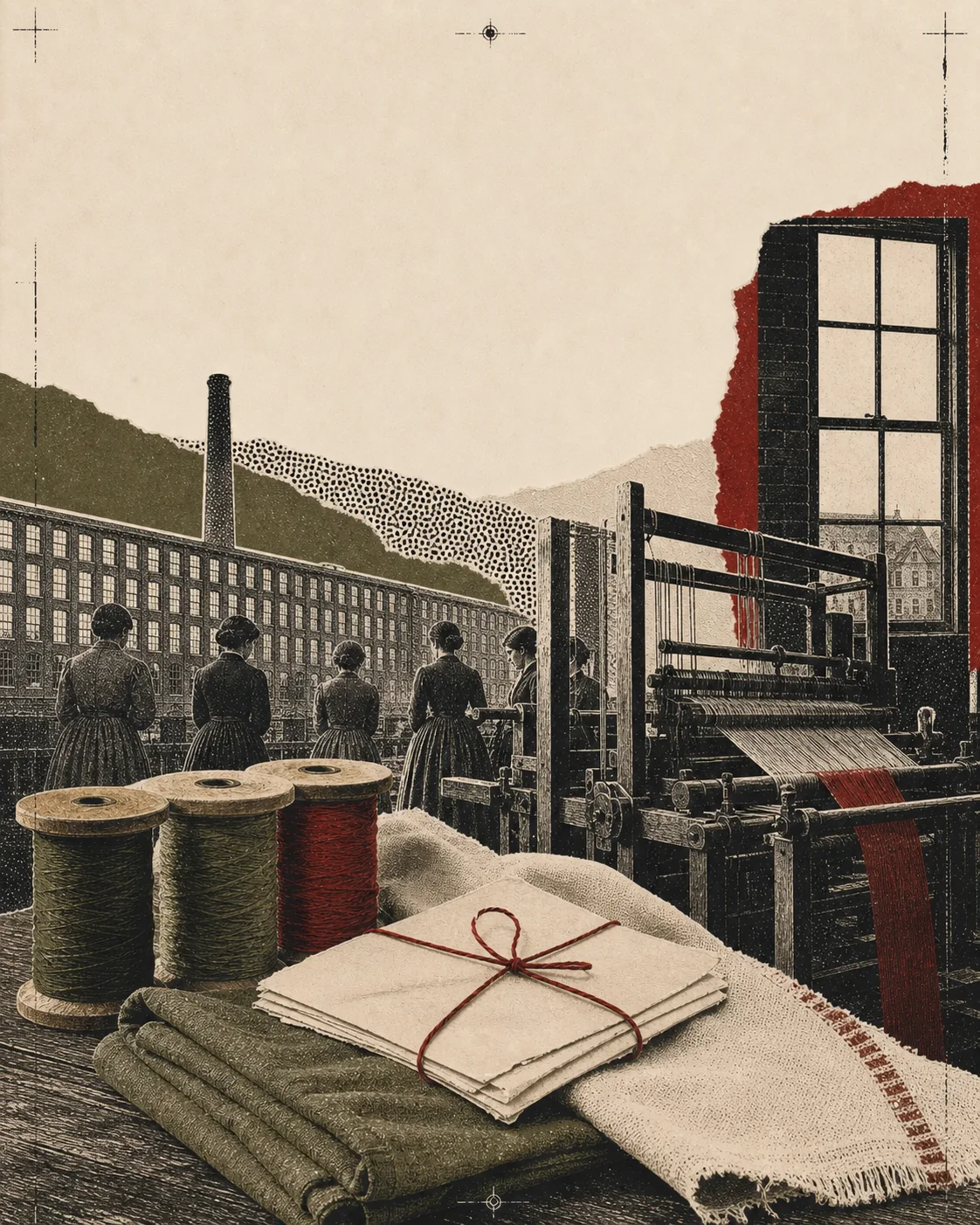
In February 1834, a mill worker named Julia Wilson waved a calash, a folding bonnet, out a window of the Lowell Manufacturing Company. It was a signal to the floor below. Within minutes, roughly 800 women had put down their work and walked into the street. They were protesting a 12.5 percent wage cut, and Wilson had just been fired for organizing against it. The strike did not win. Most of the women went back to their looms within days, or left Lowell entirely. But something had been proven: an entire mill floor could stop on a signal.
Lowell, Massachusetts was built for exactly the labor force that walked out that day. Starting in the 1820s, the Boston Associates who financed the city’s mills recruited young, mostly unmarried women off New England farms to run the new power looms, the first machines in the country to spin raw cotton into finished cloth under one roof. The company housed them in supervised boardinghouses, paid them in cash rather than credit at a company store, and marketed the whole system as a respectable interlude for farmers’ daughters between childhood and marriage. It was also, whatever the marketing said, the first large industrial workforce of women in the United States, and one of the first American workforces of any kind organized around a bell and a machine’s pace rather than a season.
What the 1834 and 1836 turn-outs actually changed
The 1834 strike failed on its own terms, but the mills remembered it, and so did the workers who stayed. Two years later, in October 1836, boardinghouse keepers persuaded the corporations to raise the weekly deduction taken from wages for room and board. It functioned as a pay cut without the word. Between 1,500 and 2,000 workers walked out this time, more than double the 1834 number, and formed the Factory Girls’ Association to hold the line financially through the strike. Among them was an eleven-year-old named Harriet Hanson, who later wrote that watching the older women organize shaped her own path into the labor and suffrage movements. The 1836 turn-out won more than the first: the Hamilton Manufacturing Company dropped its rate increase for daily-paid workers, and the Boott and Merrimack corporations withdrew the increase entirely.
Neither strike produced a lasting union. What they produced was a habit: the demonstrated fact, twice over within three years, that the women running Lowell’s looms would leave the machines rather than accept a cut they hadn’t agreed to. That habit outlasted both individual strikes.
Neither turn-out looks radical by the standards of later American labor conflict. Nobody occupied a mill floor, nobody was killed, and both strikes ended in weeks. What makes 1834 and 1836 worth naming a century and a half later is timing. The Lowell women organized a mass walkout before American railroads were a national network, before the word “strike” had settled into its modern labor meaning, and before most of the men who would later run national unions were born. They were teenagers and women in their twenties, several years off the family farm, working out the mechanics of collective refusal with no template to copy.
Sarah Bagley and the ten-hour campaign
The organization that lasted came eight years later. In December 1844, Sarah Bagley and five other Lowell workers met and founded the Lowell Female Labor Reform Association, built around a single demand: a ten-hour workday, down from the thirteen or more hours the mills then required. Bagley became its president, and membership grew to nearly 600. In 1845, the Association worked with the New England Workingmen’s Association to petition the Massachusetts legislature, gathering 2,139 signatures asking for a ten-hour law.
The legislature did not pass one. It did, however, open the first state investigation into factory labor conditions in American history, a direct result of the Association’s pressure. That investigation went nowhere legislatively either. Massachusetts would not mandate a ten-hour day for years afterward. But the record it produced, testimony from mill workers describing their own hours and conditions under their own names, became a template other labor reform movements would use for the rest of the century.
Bagley did not stop at petitions. She also edited the Voice of Industry, a labor newspaper, and became one of the first women in the United States to serve as a telegraph operator, a job she took up after leaving the mills. The Lowell workers had already been publishing themselves for years by then: the Lowell Offering ran monthly from 1840 to 1845, filled entirely with poetry, fiction, and essays written by the women on the mill floor, under editors Harriet Farley and Harriot Curtis, both mill workers themselves. Readers as far off as Britain took notice of a factory workforce that wrote its own magazine.
Where the cotton came from
The Lowell mills did not grow their own raw material, and the source was never a mystery to the people running the corporations. The cotton came north from plantations in Louisiana and Mississippi, picked by enslaved people who saw none of the wages, however contested, that the Lowell women were striking over. In 1848, Senator Charles Sumner named the arrangement plainly, denouncing what he called the “unhallowed union” between the “lords of the lash” and the “lords of the loom.” Some of what those looms produced went south again as cheap cotton cloth, sold to the same plantations to clothe the enslaved workers who had grown the raw fiber in the first place. Lowell’s reform-minded workforce and Lowell’s anti-slavery meeting halls existed inside a supply chain that ran on the institution many of those same reformers spoke against.
That belongs in the mill girls’ story as the other half of it, not a footnote. The wage the women fought over in 1834 and 1836, the ten-hour day Bagley’s Association petitioned for in 1845, all of it sat on top of a cotton economy that paid nothing at all to the people who grew the raw material. Both facts are true about the same bale of cotton, and neither one cancels the other.
We build DRESS on the idea that a garment’s labor history belongs in the open, not folded into the hem. Every one of our own shirts is union made in the United States, start to finish, which is a fact about today’s supply chain, not a comment on 1836’s.
The women who walked out of Lowell’s mills left behind petitions, a magazine, and a habit other American workers would spend the next century building on. What they never controlled, and what no boardinghouse rule or ten-hour petition could touch, was where the raw cotton in their looms had come from before it reached them.