
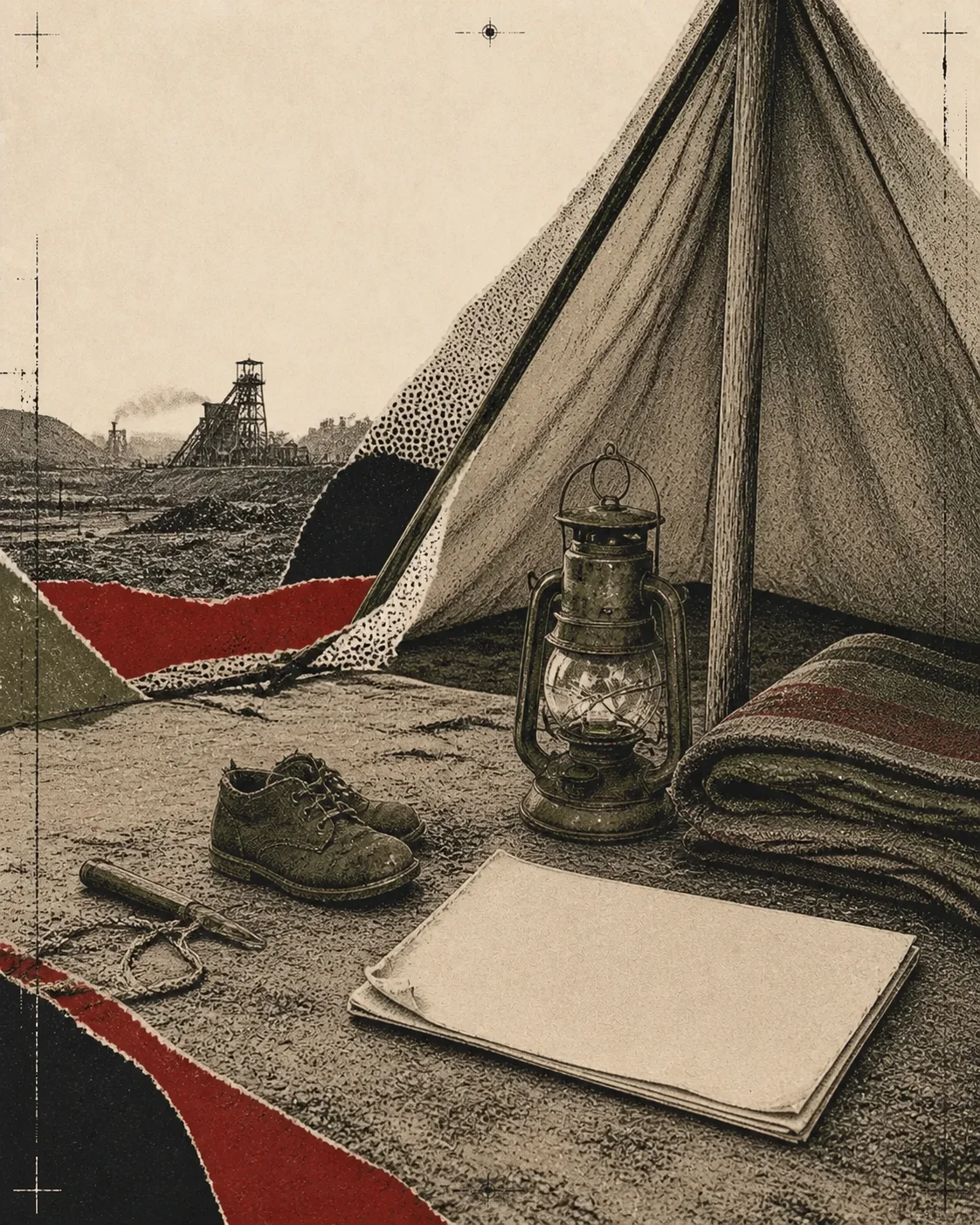
At dawn on April 20, 1914, a machine gun sat on a ridge above a field of canvas tents outside the railroad stop of Ludlow, Colorado. Below it, roughly 1,200 people were waking up in a strikers’ colony they had built themselves the previous autumn, after the Colorado Fuel and Iron Company and other operators evicted them from company-owned housing for walking off the job. By the following morning, the colony was ash, and a militia captain’s own report would later admit what had been found in a cellar dug beneath one tent: the bodies of two women and eleven children.
What the miners were striking for
The United Mine Workers of America called the strike on September 23, 1913, after years of failed organizing in southern Colorado’s coalfields. The demands were not radical by the standard of the day: an eight-hour workday, already law in Colorado but routinely ignored underground; pay by the ton weighed honestly, without the company’s thumb on the scale; the right to shop at a store and see a doctor the company didn’t own; and recognition of the union itself, so a grievance could travel somewhere other than a company foreman’s desk. Colorado Fuel and Iron, in which John D. Rockefeller Jr. held a controlling stake managed from New York, refused all of it. Roughly 11,000 miners walked out, were evicted from company towns, and moved with their families into tent colonies scattered across the coal camps. Ludlow was the largest.
The company hired the Baldwin-Felts detective agency to patrol the colonies, and an armored car nicknamed the Death Special drove past Ludlow more than once, firing into the tents. Strikers dug pits under the canvas floors that winter so their families would have somewhere to go when the shooting started. Those pits, meant as shelter, became the place where the worst of it happened.
The day the tents burned
Governor Elias Ammons had called out the Colorado National Guard the previous October, ostensibly to keep order, though the operators paid part of its costs and its ranks increasingly filled with company mine guards given militia commissions. On the morning of April 20, an argument at the colony’s edge escalated into gunfire from the militia’s machine guns, positioned on the high ground the strikers called Water Tank Hill. Louis Tikas, the Greek immigrant organizer who led the colony, tried to negotiate a ceasefire under a white flag and was shot and beaten to death by militia officers, according to accounts credited by modern historians including the Colorado Encyclopedia. Fighting went on through the day. Toward evening, militia and guards moved through the colony and set the tents on fire, whether by deliberate order or in the chaos of a retreat that scattered burning oil lamps, a dispute that was never resolved to everyone’s satisfaction even at the time.
Most of the colony’s residents fled into the surrounding hills or a nearby arroyo before the fire reached them. Not everyone made it out. The next morning, searchers found the bodies of two women and eleven children in a pit dug beneath one burned tent, killed by smoke and fire rather than gunfire. The youngest was Elvira Valdez, three months old. Contemporary newspaper counts in the days after put the total dead at Ludlow at 20; modern historians, working from fuller records, generally count at least 19 to 21, a range that includes some uncertainty over whether a passing bystander and exactly how many strikers killed in the day’s separate gunfights belong in the Ludlow total as opposed to the broader strike’s toll. The wider Colorado Coalfield War, which ran from the September 1913 walkout through the strike’s collapse that December, killed an estimated 69 to nearly 200 people across all sides by different historians’ counts, a spread that reflects how much of that violence, in the mountains and mining camps of a remote state, was never fully documented at the time.
Ten days of open war
News of the burned colony reached miners across the district within hours, and armed strikers responded by attacking mine after mine for the next ten days, a stretch remembered as the Ten Day War. It was the closest thing to open guerrilla combat the American labor movement ever fought on its own soil: strikers dynamited mine buildings, exchanged fire with guards along a front that ran for roughly forty miles of foothills, and for a few days effectively controlled the coalfield. President Woodrow Wilson, under pressure from the union and from a public reacting to newspaper photographs of the burned colony, ordered federal troops into the district on April 29. The soldiers disarmed both strikers and militia and ended the fighting, though they did not resolve the strike itself.
Who paid for it
Nobody did, in the way the word usually means. Twenty-two National Guardsmen, including Lieutenant Karl Linderfelt, who had led the beating of Tikas, were court-martialed. All were acquitted or received no meaningful penalty. John R. Lawson, a UMWA official charged with murder over a death connected to the strike, was convicted in a Colorado court; the state supreme court later threw the conviction out. The strike itself ended in defeat that December: the union called it off without a contract, without the eight-hour day it hadn’t already had, and without recognition. Rockefeller, questioned by a congressional committee weeks after the massacre, first defended the company’s handling of the strike and later, in testimony before the US Commission on Industrial Relations, said he would rather see Colorado Fuel and Iron’s property destroyed and his own life sacrificed than have the company recognize a union it did not choose.
What the Commission on Industrial Relations produced instead, chaired by the labor lawyer Frank Walsh and running hearings into 1915, was a record: sworn testimony from miners, guards, and Rockefeller himself, laid out in public rather than settled behind closed doors. The commission’s finding that workers had a right to a voice in the terms of their own labor did not free a single miner or convict a single guard. It became part of the argument that Franklin Roosevelt’s administration would win two decades later in the National Labor Relations Act of 1935, the law that finally made union recognition something an employer could be compelled to do rather than something it granted as a favor.
The ground where the tent colony stood is a National Historic Landmark today, and the United Mine Workers of America has worked to preserve and interpret it, down to the pit where searchers found two women and eleven children the morning after the fire.