Pick up a plain cotton tee and run a finger down one side, from the underarm to the hem. On most tees sold today that’s a seam, one line of overlock stitching holding two panels of fabric together. It’s easy to assume that seam is there because someone decided a t-shirt needed two side seams to fit a body correctly, the way a jacket needs darts. It isn’t. That seam exists because of a decision made upstream, at the knitting machine, about how the fabric itself was going to leave the mill.
A cylinder, not a loom
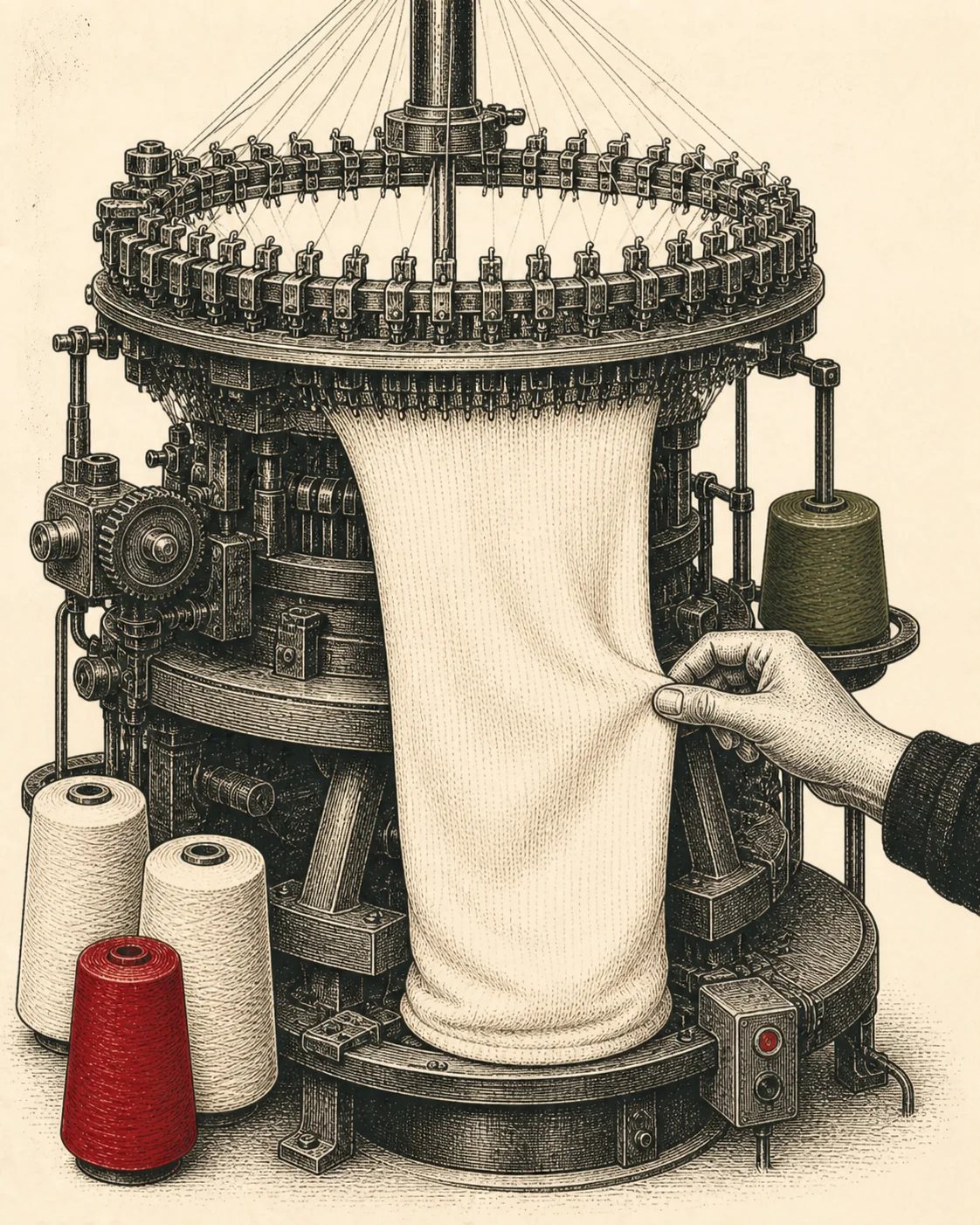
A t-shirt’s jersey almost never starts life as flat cloth. It starts as a tube, knit whole on a circular knitting machine: a horizontal ring of latch needles set into a rotating cylinder, fed continuously by yarn carriers spaced around the circumference called feeders. Every needle around that ring pulls a new loop through the loop below it on every pass a feeder makes, and because the needles sit in a closed circle rather than a straight bar, the fabric that comes off the machine has no edges. It’s a unbroken cylinder of cloth, with no cut edge anywhere in it, produced at whatever diameter the cylinder was built to.
Mayer & Cie, one of the manufacturers whose machines run in commercial knit mills today, lists its Relanit 3.2 S single-jersey machine at a cylinder diameter of 26 to 38 inches, a gauge of 18 to 32 needles per inch, up to 96 feeders on a 30-inch cylinder, and a rated speed of up to 40 revolutions per minute at that diameter. Gauge is what turns into fabric hand: at 24 needles per inch, a 30-inch cylinder carries something on the order of 2,200 needles around its circumference, each one forming and releasing a loop on every single pass. A finer gauge packs more of those loops into the same ring and knits a denser, tighter-faced jersey; a coarser one knits faster and looser. Run the arithmetic on the machine’s own numbers: 96 feeders knitting a course on every one of 40 revolutions a minute means that cylinder is laying down close to four thousand courses of loops a minute, all the way around, simultaneously. A weaving loom has to insert its weft thread across the full width of the cloth one pick at a time. A circular knitting machine forms every needle position on the ring in the same instant, over and over, which is the mechanical reason knit jersey got cheap enough to sell a plain tee for the price of a lunch.
The pattern is downstream of the cylinder
That cylinder diameter isn’t incidental to the finished garment. A 30-inch cylinder produces a tube roughly 30 inches around before it relaxes off the machine, which lands close to a torso’s circumference at a common tee size. Mills run different cylinder diameters to hit different size ranges, and a cutter’s pattern for a tubular tee starts from the tube’s existing width rather than building width in with a seam. The garment’s proportions were partly decided the moment a mill picked a cylinder size, long before a designer touched the collar shape or the hem.
The oldest confirmable version of this logic on record is a 1958 patent, filed by Lawrence L. Mangan for Oneita Knitting Mills of New York, for cutting a t-shirt whole from a section of closed tubular knitted fabric. The patent’s own description is blunt about it: the body of the shirt is formed from a section of tube “such as may be produced in a circular knitting machine,” flattened, cut for the neckline and armholes, then closed only at the shoulders with an overedge chain stitch. No side seams at all. That’s not a stripped-down modern shortcut; it’s the original industrial method, more than sixty years old, for turning a cylinder of jersey into a shirt with the fewest possible stitches.
Why the side seam is actually there
The side seam gets sold, in a lot of apparel marketing, as the mark of a better-made shirt: a construction upgrade over the cheap tubular blank, evidence someone tailored the garment instead of just chopping a tube. That framing skips a step. Most jersey knit today, including jersey that ends up side-seamed, still starts on the same kind of circular machine described above. What changes is what happens to the tube before it gets cut.
Tubular knit fabric develops edge creases as it moves through washing, bleaching, and dyeing under tension, ridges that stay in the cloth permanently once it’s slit open later. A 1965 patent from Samcoe Holding Corp, assigned to fix exactly that problem, describes reorienting the tube so its creases fall away from the eventual cut edges, then steaming the fabric under lateral tension before slitting it into open, flat cloth. The point of the whole process, stated in the patent itself, is fabric that’s “more suitable and desirable for subsequent handling and cutting into garments.” Mills have been slitting tubes open for finishing and dyeing quality, not for fit, for generations. A shirt cut from that open-width cloth needs two seams down the sides simply to become a tube again, because the fabric it’s cut from isn’t one anymore.
That doesn’t make the side seam meaningless. A separately cut panel does let a patternmaker taper the body at the waist in a way a straight tube can’t, and a seam running the length of the body genuinely resists the visible twist that single jersey develops on its own, a defect called spirality. Textile research on spirality, published in the Textile Research Journal in 1997, traces the cause to leftover twist energy in the spun yarn, not to the garment’s construction: yarn with high twist liveliness produces fabric that leans visibly to one side after washing regardless of how the shirt around it was sewn. A side seam is an anchor against a symptom whose cause sits three manufacturing steps upstream, in how the yarn itself was spun.
Manufacturing cost runs the other way, and a 1996 patent for a minimal-seam knit shirt blank says so without hedging: every seaming step, the applicant wrote, increases the manufacturing cost of the shirt, which is the argument for skipping side seams wherever a mill can. Tubular stays cheaper because it has less sewing in it, not because it’s a worse idea; side-seamed stays common because so much jersey passes through open-width finishing anyway, and once it’s open, cutting two panels and closing the sides is the fabric’s default path back into a garment, not a deliberate upgrade layered on top of it.
What this means standing in front of a shirt
None of this is visible from the outside of a folded tee on a shelf, which is exactly why it gets simplified into “tubular is cheap, side-seamed is better,” a claim neither patent nor spec sheet actually supports. What actually happened is three separate decisions tangled together: the machine that made the fabric, the finishing process the fabric went through afterward, and the seam a cutter added because the fabric had already been opened flat. Two of those three decisions were made before anyone drew a pattern.
A buyer standing in a store has no way to see a cylinder or a slitting line, only the two results of them: a tube with shoulder seams, or a panel with side seams. Both can be six-ounce jersey off the same class of machine, both can be well spun or poorly spun, and neither seam tells you which. The gauge on the spec sheet and the twist in the yarn decide more about how a shirt will hold up than the seam count does, and neither one is printed on the hang tag.
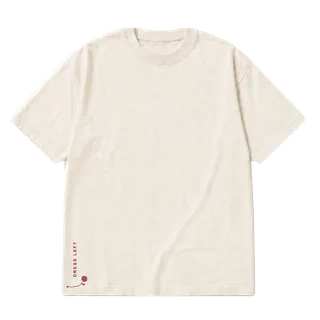
Our own Direction Tee is cut and sewn with a side seam from 6.1 ounce cotton jersey, union made in the United States, the same block whether the fabric started on a 30-inch cylinder or a wider one. Fold it flat and the tube it came from is still legible in the grain, running around the body the same direction it ran around the needles.