“They don’t make them like they used to” is usually said while holding a thirty-year-old t-shirt that is, in fact, still holding together. The shirt is real. The inference drawn from it is not. That shirt is the one that won, out of everything made alongside it that year.
In 1943, the US Army wanted to know where to add armor to bombers, and it had exactly one kind of evidence available: bullet holes on the planes that flew home. The obvious read was to reinforce wherever those returning planes were shot up the worst, wings and fuselage. The statistician Abraham Wald, working for the Statistical Research Group at Columbia University under the National Defense Research Committee, argued the opposite. His memoranda, later reprinted in full by the Center for Naval Analyses in 1980, reasoned that the sections showing the least damage on returning planes were the sections that mattered most, since a plane hit there had not returned to have its damage counted at all. The engines came back almost unmarked, not because they were rarely hit, but because a hit engine usually meant the plane went down. Wald recommended armoring the unmarked spots, not the ones already full of holes. Mangel and Samaniego’s 1984 paper in the Journal of the American Statistical Association gives the formal version of the same reasoning: any inference drawn only from survivors is an inference about survivors, not about the population that produced them.
Wald’s work spanned a series of eight memoranda written for the Statistical Research Group between 1942 and 1944, worked out in enough mathematical detail that the same method got reused to analyze battle damage in Korea and again in Vietnam, according to the Center for Naval Analyses’ introduction to its 1980 reprint. The Army had a full record of the planes that came home. It had almost nothing on the planes that didn’t, and Wald’s contribution was showing that the missing half of the data was recoverable by looking hard at what the surviving half failed to show.
The shirt on the rack already won
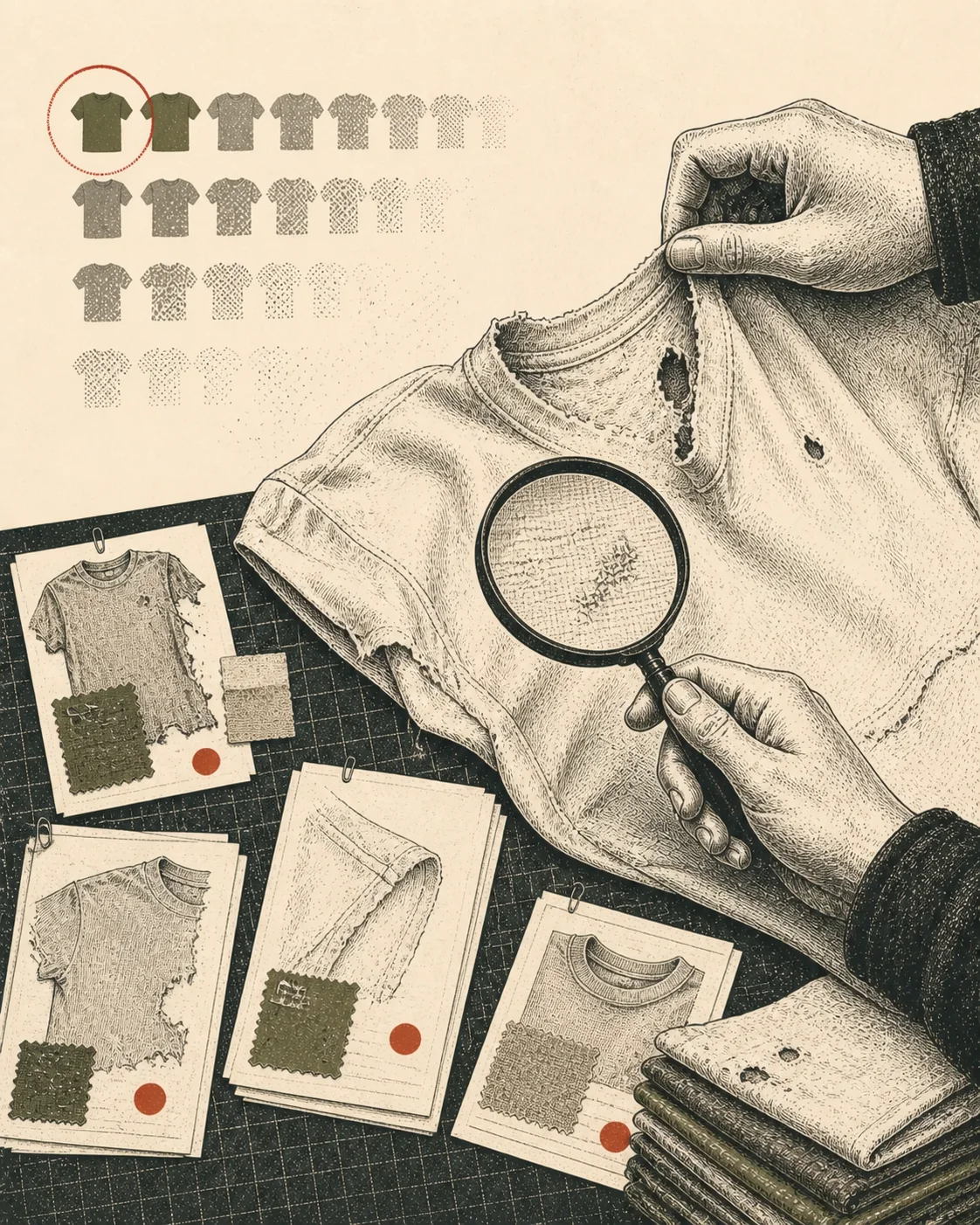
A t-shirt that has lasted thirty years on a hanger or in a dresser drawer went through the same filter Wald’s bombers did. Every shirt made alongside it that pilled after a dozen washes, split at the shoulder seam, shrank two sizes, or simply went out of style and got thrown in a donation bag is gone. It never made it to a resale rack, a closet cleanout, or a nostalgic Instagram post about how things used to be built. The shirt in a shopper’s hand at a vintage store is not a representative unit pulled from 1994’s production run. It is the unit that cleared every filter a T-shirt can fail: fabric, fit, fashion, and simple bad luck with a washing machine. Counting only that shirt and concluding that shirts from 1994 were sturdier is the exact error Wald’s Army officers were about to make with bomber armor, aimed at a t-shirt instead of a fuselage.
This matters more for a brand that sells heavyweight cotton on the promise of longevity than it does for almost anyone else in the conversation. It would be convenient to point at an old shirt and let it do the arguing. It can’t, and pretending otherwise would be the same kind of selective evidence this piece is describing, aimed at our own product instead of someone else’s.
What actually is measurable
None of this means every claim about older construction collapses into nostalgia. Some of it is measurable on the yarn and the fabric themselves, independent of which shirts happened to survive to be tested.
Ring-spun cotton yarn is twisted tighter and from longer fiber staples than open-end spun yarn, and that difference shows up directly in a strength test. Cotton Incorporated’s research, reported by Textile World in a 2023 feature on denim production, found open-end spun yarn averaged 10 to 30 percent weaker than ring-spun yarn of a comparable count. That number came from testing yarn against yarn, not from counting which garments happened to outlast their owners. A twin-needle coverstitch seam, similarly, holds up to seam-pulling tension better than a single-needle seam by the mechanics of the stitch formation itself, a property Trivantage’s technical comparison of the two machine types documents directly, not by tallying which old hems are still intact.
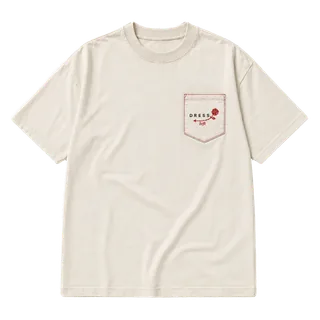
Fabric weight is the same kind of fact. A 6.1 oz cotton jersey has more fiber mass per square yard than a 4 oz jersey, full stop, measurable on a scale before either shirt has been worn once. More mass gives a knit more material to abrade through before it thins, which is a real mechanical reason to expect a heavier fabric to hold up longer under friction. That is a claim about the fabric. It is not, on its own, a claim about how many years or washes a shirt survives, because nobody publishes a wear-count study broken out by fabric weight. DRESS’s Logo Tee runs 6.1 oz, 100 percent cotton jersey, a documented specification. Whether that specific shirt outlasts a lighter one in any one closet is not something this company or anyone else has tested and can honestly claim to know.
The gap between the two kinds of claim
Fiber, spin, weight, and stitch type are properties of a garment you can put a number on today, in a lab or with a scale, without needing thirty years to pass first. Durability across a decade is a different kind of claim entirely, one that requires tracking a cohort of shirts from the day they were sold to the day each one failed or got thrown out for reasons that had nothing to do with failing. No apparel company, government agency, or research group runs that study. It would be expensive, it would take years, and the commercial incentive runs the other way: a company that sells current-year garments has little reason to fund a multi-year study of how long its own shirts last. What exists instead is a construction property, real and measurable, sitting next to a folk belief about which decade made things better, sitting next to a sample of survivors that can speak only for itself.
Collectors already treat this instinctively when they price a shirt by tag style, print method, and stitch count together rather than trusting any single feature alone, because a shirt’s ability to still exist says more about luck than about the factory that made it. The single stitch a shirt happens to carry narrows when it was likely made. It says nothing about how many of its siblings from the same production run are in a landfill.
The same confusion shows up one layer up, at the level of fiber choice rather than a single garment. Global fiber production has shifted heavily toward polyester and other synthetics over the past three decades, a documented industry-wide move rather than a guess about any one shirt’s fabric. A vintage cotton tee surviving decades on a rack does not, by itself, prove cotton outlasts polyester in general use. It proves that one cotton shirt, made when cotton was more common in the first place, made it. The fiber-mix shift is real and separately documented; the survival of any single old cotton shirt is not the evidence for it, even though the two facts get run together constantly in the same sentence.
What this piece can actually claim
Say the two things separately and stop there. Ring-spun yarn tests stronger than open-end. A denser knit has more material to wear through. Those are facts about fiber and construction, confirmed independent of any surviving shirt’s history. What cannot be claimed, by this brand or by a stranger’s grandfather holding up a thirty-year-old concert shirt, is that the existence of a durable old garment proves its era built garments better on average. The shirt that made it to a drawer for three decades is not a witness for its cohort. It is the cohort’s one member still standing, and the interesting question was always about the ones that aren’t in the room to answer.