
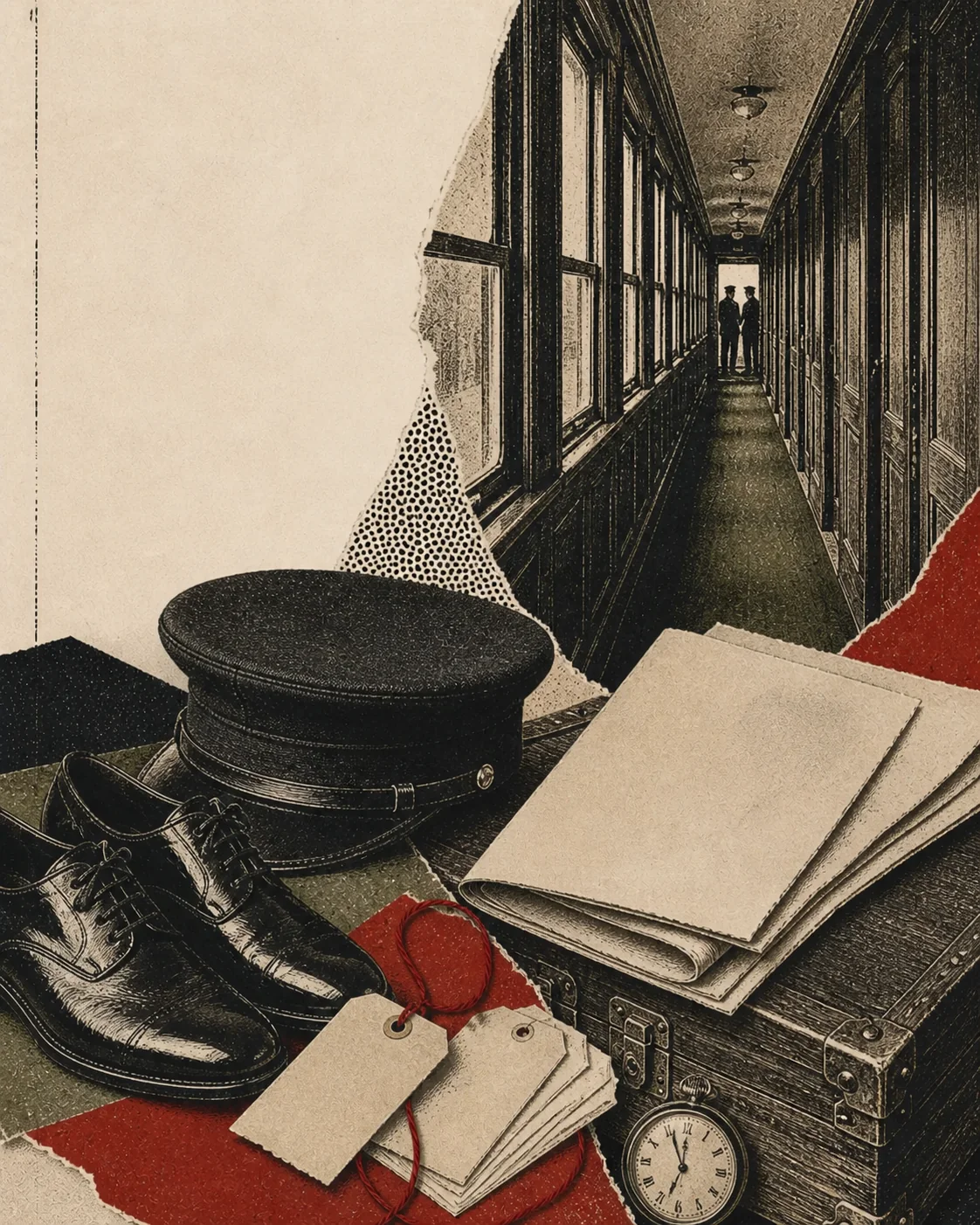
On the evening of August 25, 1925, a group of Pullman porters gathered in a meeting room in Harlem and elected a magazine editor named A. Philip Randolph as president of a union that did not yet have a contract, a treasury, or Pullman Company’s acknowledgment that it existed. Randolph had never worked as a porter, which was the point: a porter organizer named Ashley Totten had gone looking specifically for someone Pullman could not fire, because every porter who had tried to organize before him had been fired, and the company kept a private detective force to find out who was trying. Randolph edited a socialist magazine called The Messenger out of a Harlem office, had no Pullman paycheck to lose, and took the job. Twelve years later, to the day, the Pullman Company signed its first contract with the union Randolph had agreed to lead that night.
Twelve years, not a movement
The Brotherhood of Sleeping Car Porters shows up constantly in civil rights survey courses, usually as a stepping stone: Randolph organized porters, Randolph later threatened a march in 1941, Randolph spoke at the 1963 March on Washington. That sequence is true and it skips the part that actually took twelve years, which was a contract fight against the largest single employer of Black labor in the United States, fought with the ordinary tools of a labor campaign: card counts, mediation board filings, a jurisdictional application to a hostile federation, and a strike vote that collapsed. By spring 1928 the Brotherhood claimed more than six thousand porters had voted to strike, and Randolph set a date, June 8, 1928. AFL president William Green pressed him to call it off, writing that “because of a lack of understanding public opinion has not been crystallized in support of your demands.” Randolph called off the strike. Pullman had already guessed as much, and told the press the porters could easily be replaced. Membership, which had peaked at 4,632 that year, fell to 1,091 by 1931 as the Depression and the failed strike did their work together. The union survived that collapse by continuing to sign up members and file, year after year, for recognition it did not yet have, while Pullman fought back with firings, informants, and a company-run porters’ association built to make an independent union look unnecessary. Sources disagree sharply on how many Black men Pullman employed in the 1920s: one count puts porters and maids at 7,242, while a broader count of all Black rail personnel runs past 20,000. Either way, contemporaries called it the largest single employer of Black labor in the country, and the BSCP outlasted a company that size on organizing discipline, filing and refiling for years with nothing yet to show for it.
The National Mediation Board, created under the amended Railway Labor Act, certified the BSCP in 1935 as the porters’ actual bargaining representative, over the company union Pullman preferred. The American Federation of Labor granted the Brotherhood an international charter that same year, after the union had applied and been held off since 1928 on jurisdictional grounds that had everything to do with which existing AFL unions did not want Black members competing for turf. The certification and the charter did not produce a contract by themselves. Pullman kept negotiating, or refusing to, for two more years. The agreement finally came on August 25, 1937, the same calendar date as the 1925 meeting, cutting the maximum workweek from 400 hours a month to 240 and adding time-and-a-half pay past 260 hours. Historian Preston Valien, writing in the journal Phylon in 1940 while the settlement was still recent, recorded that Pullman itself estimated the wage increases in the new contract would cost the company about $1,500,000 a year, a company’s own number for what it had been extracting from its porters for over a decade.
What the porter actually paid for
The detail that gets flattened into a museum caption is the uniform, usually rendered as a single line about porters buying their own clothes. What the record shows is narrower and worse. Under Pullman’s pre-1937 policy, a new porter paid for his own uniform for his first ten years of employment; only after a decade on the job did the company begin supplying it. The 1937 contract ended that arrangement. Uniforms were not the only required purchase. Randolph, writing in The Messenger in February 1926 while the fight was still young, laid out the shoe-polish rule in his own words:
Porters are required to buy the polish and equipment for shining the passengers’ shoes.
Randolph went on to describe the penalty: a porter who shined shoes and then asked to be paid for it, or who refused to buy his own polish, could be taken off the job for fifteen to thirty days. The porter was not tipped for the shine separately in any reliable way; the polish, the brushes, and the risk of unpaid time off all sat on his side of the ledger, for a job whose whole selling point to Pullman’s white passengers was a hotel’s worth of service delivered by one man on a moving train. Randolph’s own 1926 wage accounting put a starting porter’s base pay at $67.50 a month, climbing to $90 after twenty to thirty years of service, an annual total he set against a Department of Labor figure for a family’s minimum decent income that ran roughly $1,278 higher per year. Tips were expected to close that gap, which is a different thing from a wage closing it, and it is why porters depended on the very passengers whose shoes they were required to buy their own polish to shine.
The march that never happened
Randolph’s name attaches to one more famous fact that is usually told with the causality reversed. In 1941, sixteen years into his union presidency and four years after the Pullman contract, Randolph, working with organizers Bayard Rustin and A.J. Muste, proposed marching Black Americans on Washington to demand an end to hiring discrimination in the booming defense industry, a demand the government could grant without an act of Congress. Randolph made the public call on January 25, 1941. By spring, organizers were talking about 100,000 marchers; by May, Black newspapers were running headlines like the Amsterdam News’s “100,000 in March to Capitol.” The march was set for July 1, 1941. On June 25, six days before that date, President Roosevelt signed Executive Order 8802, barring discrimination in defense industry employment and federal job training and creating a Fair Employment Practice Committee to enforce it. Randolph called off the march the government had never let happen.
The order worked because Randolph had already spent sixteen years proving the threat behind it was real. A union that had out-waited Pullman for twelve years, survived a canceled strike vote, and won recognition from a federal mediation board carried a demonstrated capacity to put a stated number of people in a stated place, because it had already built and rebuilt itself doing exactly that inside railcars and union halls for a decade and a half. Roosevelt’s staff, weighing the political cost of ignoring the demand against the cost of a mass demonstration on the Mall during a wartime buildup, chose the order. The Fair Employment Practice Committee that followed grew directly, years later, into the federal machinery that shaped Title VII of the Civil Rights Act of 1964, a straight administrative line running back through a March that never had to happen to a union whose first win was a workweek cut from 400 hours to 240.
What the twelve years bought
None of this required Randolph or the BSCP to say anything about civil rights in the abstract sense the term carries now. The porters’ demands were a dues checkoff, a shorter month, an end to buying their own polish, and a company signature on a piece of paper. What the contract fight produced, almost as a side effect of doing it right, was an organization that had already solved the two hardest problems any later movement would face: how to sustain a membership through years with no visible win, and how to make a threat that an opposing power actually had to believe. The Brotherhood of Sleeping Car Porters got there by filing, certifying, and negotiating, the unglamorous machinery of a union contract, for twelve years before it had anything to show for it. The civil rights history came after, built on infrastructure a labor fight had already paid for.
The Pullman porter’s uniform, once the company started supplying it, still had to be kept spotless on a moving train with no laundry service between cities. That was never in dispute. What had been in dispute, for twelve years, was who paid for it in the first place.