
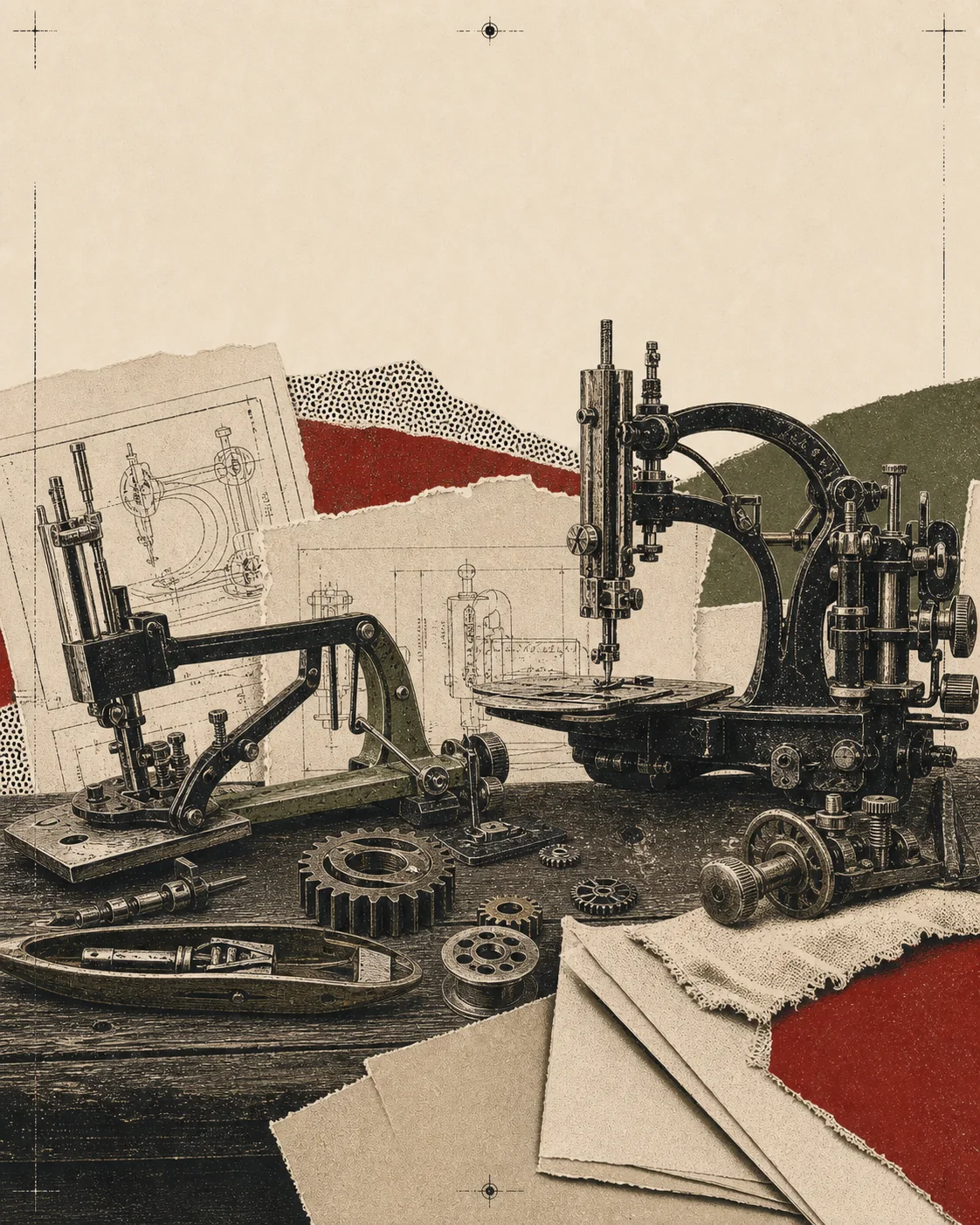
US Patent 4,750 runs about eleven hundred words and five drawings. It was granted to Elias Howe Jr. of Cambridge, Massachusetts, on September 10, 1846, and it does not claim to have invented a machine that sews. It claims something much narrower: a curved, eye-pointed needle carrying one thread, a small shuttle carrying a second thread on a bobbin, and the specific way the two interlock, one loop drawn through another, to form a lockstitch that looks the same from both sides of the cloth. A lifting rod forms the loop. A lever and spring tighten each stitch as the needle pulls back. A pointed plate under the fabric advances it a fixed distance between stitches, so nobody has to baste the seam by hand first. Those five claims are all the patent covers. Read it next to the sewing machine story most people know, in which Howe simply invented the thing, and the gap between the claim and the legend runs through this whole piece.
Howe’s patent didn’t put a machine on the market. It put a mechanism into a decade of litigation, because Howe was not the first person to build one, and he was far from the only person willing to build around him.
Walter Hunt built one first and walked away from it
Sometime between 1832 and 1834, a New York tinkerer named Walter Hunt built a sewing machine in his shop on Amos Street that used an eye-pointed needle and a second thread to lock a stitch, the same basic mechanism Howe would patent a decade later. Hunt held dozens of patents in his lifetime, among them the safety pin, but he never filed one for the sewing machine. His family’s later account, recorded well after the fact, was that he worried a working machine would put seamstresses and tailors out of work, including women in his own daughter’s corset shop. Whatever the exact mix of motives, the practical result was that he let the idea sit.
It sat until 1853, seven years after Howe’s patent issued and after Howe had already begun suing manufacturers for royalties. Hunt applied for a patent on his old machine that year, and the Patent Office examined it and agreed his design predated Howe’s. It denied him the patent anyway. Nearly two decades between building the machine and filing the claim was too long an abandonment under patent law, technicality or not. Hunt got acknowledgment. Howe kept the patent, and with it, the standing to sue.
Howe’s decade in court, and the machine that outsold him
Howe’s own machine sold badly. He spent time in England trying and failing to license it, came home broke, and returned to a country where manufacturers were already building sewing machines that used his needle-and-shuttle method without paying him anything. He spent roughly the next eight years in court establishing that his patent held, and he won the cases that mattered. By the mid-1850s he was collecting a license fee, commonly cited at twenty-five dollars per machine, from manufacturers who wanted to keep building.
One of those manufacturers was Isaac Singer. Singer’s own patent, US 8,294, issued August 12, 1851, claims real engineering: a second forward motion of the shuttle timed against the cloth feed and the needle’s upward stroke, so both threads pull tight at once; a friction pad that controls slack in the needle thread above the fabric instead of at it; and an adjustable arm that lets an operator change loop length without changing how far the needle travels. Singer’s machine ran faster and jammed less than Howe’s. It also used Howe’s eye-pointed needle and shuttle to do it, without a license, which is the correction that matters here: Singer did not out-invent Howe. He built a better machine on top of Howe’s patented mechanism and got sued for it, along with almost everyone else in the business.
Five patents, one deadlock
By the mid-1850s the sewing machine industry had four or five overlapping, mutually blocking patents in circulation. Allen Wilson, of Wheeler & Wilson, patented a rotary hook and stationary bobbin on the same day Singer’s patent issued, August 12, 1851, a mechanism that replaced the shuttle entirely, ran with less vibration, and sewed faster than either Howe’s or Singer’s version. William Grover and William Baker patented a two-thread chainstitch that same year and built a company around it. Each of the four had claimed a genuine, separately valid improvement, and each of the four needed pieces of what the others held to build a machine anyone would want to buy. Building a competitive lockstitch machine meant infringing on somebody’s claim no matter which company you were. Howe sued Singer. Singer’s lawyers tried to use Hunt’s abandoned machine to invalidate Howe’s patent outright, and lost, because abandonment cut against Hunt, not against Howe. Everyone sued everyone else often enough that by 1856 the four largest patent holders were spending more on lawyers than on manufacturing.
The pool that let anyone actually build one
On October 24, 1856, Howe, Singer’s company, Wheeler & Wilson, and Grover & Baker signed what’s known as the Albany Agreement and formed the Sewing Machine Combination, generally counted as the first patent pool in American industry. Instead of continuing to sue, the four parties pooled their patents into a single license, required at least twenty-four manufacturers to take that license, and split the proceeds. Sources disagree on the exact number: the Combination’s own royalty schedule, corroborated independently by ISMACS’s history of the Howe machine and by economists Ryan Lampe and Petra Moser, set Howe’s cut at five dollars per machine sold in the United States and one dollar per machine exported, a steep drop from the twenty-five-dollar figure some manufacturers had been paying him individually before the pool existed. Smithsonian Magazine’s account instead puts the pooled rate at twenty-five dollars per machine; the lower, better-corroborated figure is the one this piece uses. Either way, the effect was the same: a manufacturer no longer had to guess which of four companies might sue next. Outside firms paid roughly fifteen dollars per machine for the bundled license, split among the four holders, and in exchange got freedom from every lawsuit at once. One license covered the mechanism entirely, where four separate ones had covered nothing but litigation.
The Combination ran until its last patent expired in 1877, twenty-one years later. Lampe and Moser, writing in a 2009 paper that measured innovation directly against the machines’ own recorded stitches-per-minute, found something the pool’s defenders would not have predicted: patenting activity and measured performance improvements both slowed for the industry, including the pool’s own members, while the Combination operated, and picked back up once it dissolved. The arrangement that ended the lawsuits also appears to have narrowed the competition that had been driving the machine forward.
What the patents settle and what they don’t
The Combination expired on schedule in 1877, not from another lawsuit but because the last patent in the pool ran out its statutory term. By then the industry had moved on to machines none of the original four had drawn, and the mechanism itself, needle, shuttle or hook, second thread, feed plate, had become common property in a way no single patent could have made it on its own.
None of this makes Howe a fraud or Singer a thief in any simple sense. Howe’s patent describes a mechanism nobody had legally claimed before him, whatever Hunt had built in private. Singer’s patent describes real, separately patentable improvements to a machine that would not run well without them. What the patents settle is narrower and more useful than a single inventor’s name: the sewing machine that reached ordinary sewing rooms in the 1850s existed because five people’s claims got forced into the same room, not because one of them saw it whole. The Combination’s own paperwork, not a company history from either side, is what says so.