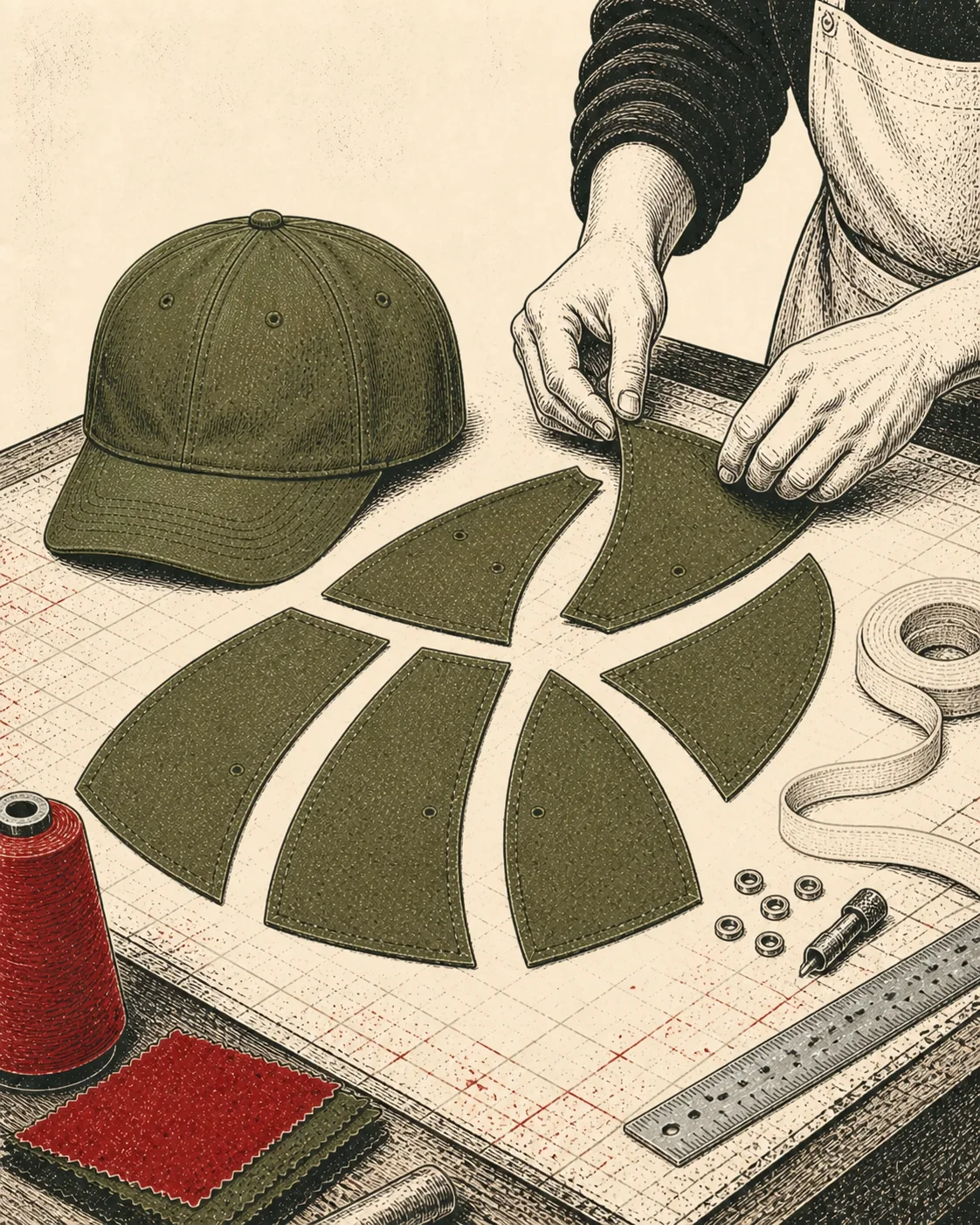
Six panel means six pieces of fabric. Cut a cap’s crown open along its seams and you get six near-identical triangles, curved slightly along their long edges, that were sewn together to turn a flat piece of twill into a dome that fits a round head. Count the seams running up from the brim toward the top of any six-panel cap and you’ll find exactly six, meeting at a small covered button. That button isn’t decoration bolted on afterward. It sits precisely where all six seams converge, because that convergence point is the one spot on the whole crown under the most stress.
Why a cap needs six pieces at all
A head is a sphere, roughly, and a flat piece of cloth is not. Wrap one continuous panel of twill around a curved surface and it either bunches at the crown or gaps at the brim; there’s no way to make flat fabric follow a dome without darts or seams somewhere. Six panels solve the geometry by breaking the dome into six pie-slice pieces small enough that each one can curve gently along its own seams without puckering. Five-panel caps solve the same problem with one fewer seam by merging the two front panels into a single unbroken piece, which is why five-panels sit lower and flatter and read as a skate-shop shape rather than a ballpark one. The six-panel’s extra seam, running straight down the center front above the visor, is the tradeoff: a taller, rounder crown in exchange for one more line the embroiderer has to work around.
That center seam is also why a lockup embroidered dead center on a six-panel cap looks slightly off. A logo that straddles the seam has to jump a small ridge of stitched-over fabric right through its middle, which is why off-center placement, to one side of that seam, is the more common professional layout rather than a stylistic quirk.
Six wasn’t always the number
The panel count settled where it is now through a long series of small corrections, not a single design. The Brooklyn Excelsiors’ 1860 cap, cited by the sportswear historians at Heddels, already had two of the features that define a modern ballcap: a longer brim and a deeper crown that closed at the top with a button. Spalding’s shape by the 1920s had drifted to eight panels, paired with a short brim, ventilation holes, and a leather headband rather than the sweatband inside a cap today. Visors got their own fix earlier still: Spalding’s 1903 Philadelphia-style cap added stitching that reinforced the brim so it held its curve instead of going limp, and stitched visors were standard across the industry by 1910. Panel count kept moving until New Era cut it down to six for the 59Fifty in 1954, and the industry has largely stayed there since; going from eight panels to six means fewer seams doing the same job of turning flat cloth into a dome, at the cost of each remaining seam curving a little more sharply than before.
Structured, unstructured, and the buckram underneath
Nothing about “six panel” says whether a cap stands up on its own or collapses the moment you set it down. That’s a separate decision, made with a stiff backing material called buckram. Fuse buckram to the inside of the two front panels and the crown holds its shape whether it’s on a head or a shelf: that’s a structured cap, the shape built for a logo that has to sit upright and legible. Skip the buckram and the same six panels fold and crease freely, settling into whatever shape the wearer’s head gives them, which is the relaxed, low profile people mean when they say “dad hat.” Unstructured doesn’t mean less constructed; it means one specific layer was left out on purpose.
New Era’s own account of the 59Fifty, the six-panel wool cap it introduced in 1954, describes a version of this same idea from the other direction: rather than stiffening the front, the company fused a stiffener to the back of the crown so the front panels would be pushed consistently forward, keeping a team’s logo facing the camera instead of slumping back. The 59Fifty followed an earlier six-panel wool cap New Era had sold to the Cleveland Indians in 1934, and by 1954 the shape, eyelets, button, and eight rows of visor stitching had settled into close to the form still sold today.
What the small holes and the button actually do
Every classic six-panel crown has a small hole, usually about an eighth of an inch across, punched near the top of each panel. Those are eyelets, and their job is ventilation: they let heat and sweat vapor escape through fabric, typically cotton twill or wool, that doesn’t breathe on its own the way an open weave does. Caps built with mesh back panels frequently drop the eyelets entirely, because the mesh is already doing that job across a much larger area.
The button at the crown has a name in the trade: a squatchee, a bit of headwear slang that made its way into wider use through baseball broadcasters in the 1980s. Functionally, it covers and reinforces the exact point where all six panel seams meet, the single spot on the crown carrying the most structural load in a cap sewn by hand or an older machine. Modern industrial stitching secures that junction well enough that the button is no longer load-bearing in most production; it stays because a bare, exposed seam intersection at the top of a cap looks unfinished, not because the crown would fail without it.
What washing does to a six-panel crown
Buckram and cotton don’t age the same way. A washed, unstructured six-panel crown like a garment-dyed cap starts soft, and every wash after that softens it further, since there’s no stiffened backing resisting the water and the tumbling. The panels crease along the same lines the head puts into them, and after a season the crown carries a shape that’s closer to a memory of the head that’s worn it than to the cone it left the factory as. That’s the appeal of an unstructured cap and also the honest limit of one: it will never again look as crisp as it did in the box, and that’s not a flaw to manage, it’s what unstructured means.
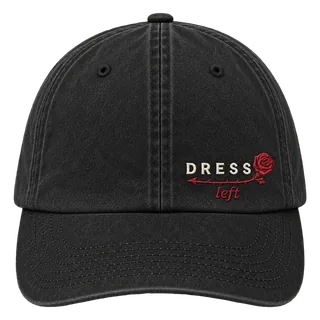
Ours is a washed six-panel twill, unstructured, with the lockup embroidered off to the right of that center front seam rather than straddling it. The wash is uneven across the crown on purpose, which is the same effect a few dozen wears would produce on its own.