
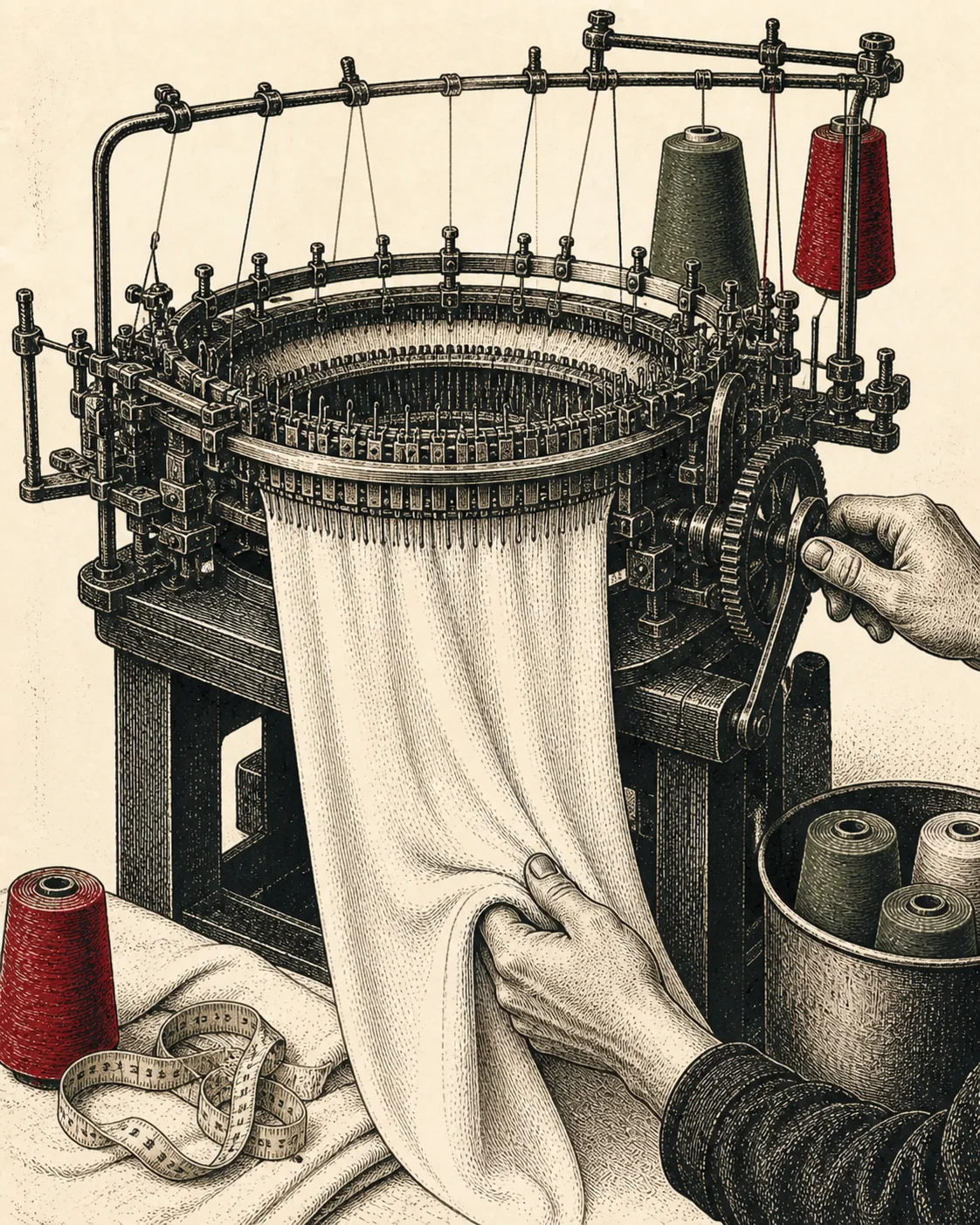
The machine has no fabric roller. That’s the detail that gives it away if you’ve ever stood next to a modern circular knitter, where the finished tube gets gripped and pulled down by a motorized roller the moment it forms. On a loopwheel machine, called a tsuriami-ki in Japanese, the tube of jersey just hangs. It descends through the needle bed under its own weight, gathered by a slow-turning wheel of sinkers instead of being drawn off by force, and the whole machine stands taller than a person to give that hanging tube somewhere to go before it’s wound.
Roughly 200 of these machines are still running, and nearly all of them are in one place: Wakayama Prefecture, on the Kii Peninsula south of Osaka. Two companies operate them. Kanekichi Industries, founded in 1920, is one. Wada Meriyasu Co. is the other. Between them they keep a technology alive that stopped being manufactured decades ago, because nobody builds new loopwheel frames anymore. Every one running today is a survivor.
Where the machines came from, and why so few are left
Circular knitting frames of this design arrived in Japan from Europe in the early twentieth century, brought in to help build a domestic garment industry. LOOPWHEELER, one of the two companies still operating them, describes the count of working machines rising steadily from that point through the 1960s, when faster, higher-tension circular knitters started replacing them on factory floors. That substitution is the same one described from the buyer’s side of the industry: a machine that knits ten times the cloth in the same hour is going to win a factory floor built around output, regardless of what the slower machine’s fabric feels like in the hand. Loopwheel frames didn’t lose an argument about quality. They lost a schedule.
What’s unusual isn’t that the older machines eventually lost that argument. It’s that a corner of one prefecture kept running them anyway, long after the rest of the industry had moved on, and that two companies are still tending frames built for a production rate nobody else in commercial knitting has needed to match in decades.
What “low tension” actually means
Every knitting machine has to solve the same problem: get yarn onto needles, form a loop, pull that loop off cleanly, and move the finished fabric out of the way so the cycle can repeat. Modern circular knitting machines solve the last step with a take-up roller, a motorized cylinder that grips the fabric and pulls it down at a fixed rate synchronized to the needle cycle. That pull has to be firm enough to clear the fabric reliably at speed, and it puts the yarn under a small, constant, mechanical stretch the entire time it’s being formed into loops. Patent literature on modern positive-feed systems is explicit about the goal: deliver yarn to the needles at an exact, controlled rate to keep loop length uniform, because uneven tension produces uneven loops.
A loopwheel machine has no equivalent part. Kanekichi Industries describes its own machines in exactly these terms: the yarn is not stretched or pulled during knitting, so it stays relaxed and air stays folded into the fabric rather than getting pressed flat by tension. The company names the working part directly: a sinker wheel, a slow rotating ring that gathers the fabric as it forms and lets it descend, rather than a motor gripping and hauling the tube away. Gravity does the entire job that a roller does on a modern machine, pulling the hanging tube down at whatever rate its own weight dictates rather than a rate set by a motor. That’s a genuine mechanical difference, not a marketing description of one. It shows up in the finished cloth as a looser, more textured loop structure and a fabric with more give before it settles, because nothing forced the loops tight and even while they were forming.
The comparison only means something next to what a modern machine is built to do instead. Positive-feed systems on today’s circular knitters exist specifically to hold yarn delivery constant, because loop length that drifts even slightly produces visible bands in the finished cloth. Patent filings on these systems describe pulleys and geared tapes driving the yarn at a fixed circumference, adjustable to set the loop length precisely and hold it there for the whole run. That’s the right engineering answer if the goal is consistent fabric at speed across a run of thousands of yards. It is also, by definition, yarn under continuous, deliberate, measured tension from the moment it reaches the needle. A loopwheel machine was never asked to solve that problem, because nobody needed thousands of consistent yards from it in the first place.
A meter an hour, against ten or more
The tradeoff for skipping the roller is speed, and it isn’t a small one. LOOPWHEELER, one of the two operating mills, states its own machines produce about one meter of fabric an hour. A modern sinker-top circular knitting machine of the kind running in most commercial mills produces well over ten meters an hour, feeding dozens of yarns into a cylinder that turns many times faster than a loopwheel frame’s slow revolution. Ten times is the conservative way to state the gap; depending on the specific modern machine and gauge, it can run wider. Either way, a loopwheel machine tended for an eight-hour shift is not competing with a modern one on output. It never was built to.
That production rate explains most of the price on a loopwheel garment, before any claim about how the fabric feels or wears. A machine producing a meter an hour, run by an operator who can tend only a handful of frames at once, costs far more per yard of finished cloth than a bank of modern knitters running unattended for most of a shift. The number belongs in the conversation about price whether or not anyone brings it up.
The claim that has no test behind it
Here is where loopwheel marketing usually goes further than the machine can support. The low-tension mechanism is documented by the people who operate these machines, described the same way by two separate mills, and consistent with basic knitting mechanics: less tension during loop formation should, in principle, leave a fabric with less stored stress in the yarn. That much holds up.
What doesn’t hold up, at least not in anything this research turned up, is the leap from “less tension” to “lasts longer” or “lasts forever,” the claim attached to loopwheel fabric in nearly every piece of writing about it. No manufacturer, mill, or independent lab publishes a controlled comparison of loopwheel jersey against modern jersey under abrasion, wash-cycle, or wear testing. What exists instead is a chain of inference (looser loops, less residual stress, therefore a garment that should hold up better over years) repeated by retailers as settled fact. The inference is reasonable. It is also, as far as this research could confirm, untested. A fabric can be exactly as described mechanically and still have an unproven durability claim riding on its back, and loopwheel jersey is a clean example of both things being true at once.
The two claims hold up only if kept separate. The mechanism is real: no take-up roller, gravity feed, a documented reduction in knitting tension, confirmed by the mills that build the cloth and consistent with how tension is known to affect loop formation on any knitting machine. The lifespan claim is a hypothesis nobody has published a test for. One belongs in a spec sheet. The other belongs in a sentence that says “should,” not “does.”
What’s left running
Two hundred machines, in one prefecture, none of them younger than the mid-twentieth century, producing cloth at a rate that would have looked slow even to the mills that first installed them. Nobody is building a third company to run more of these frames. When the ones in Wakayama stop, the low-tension mechanism they demonstrate doesn’t disappear from the textbooks, but the fabric it makes will have come from the last machines anyone still knows how to run.