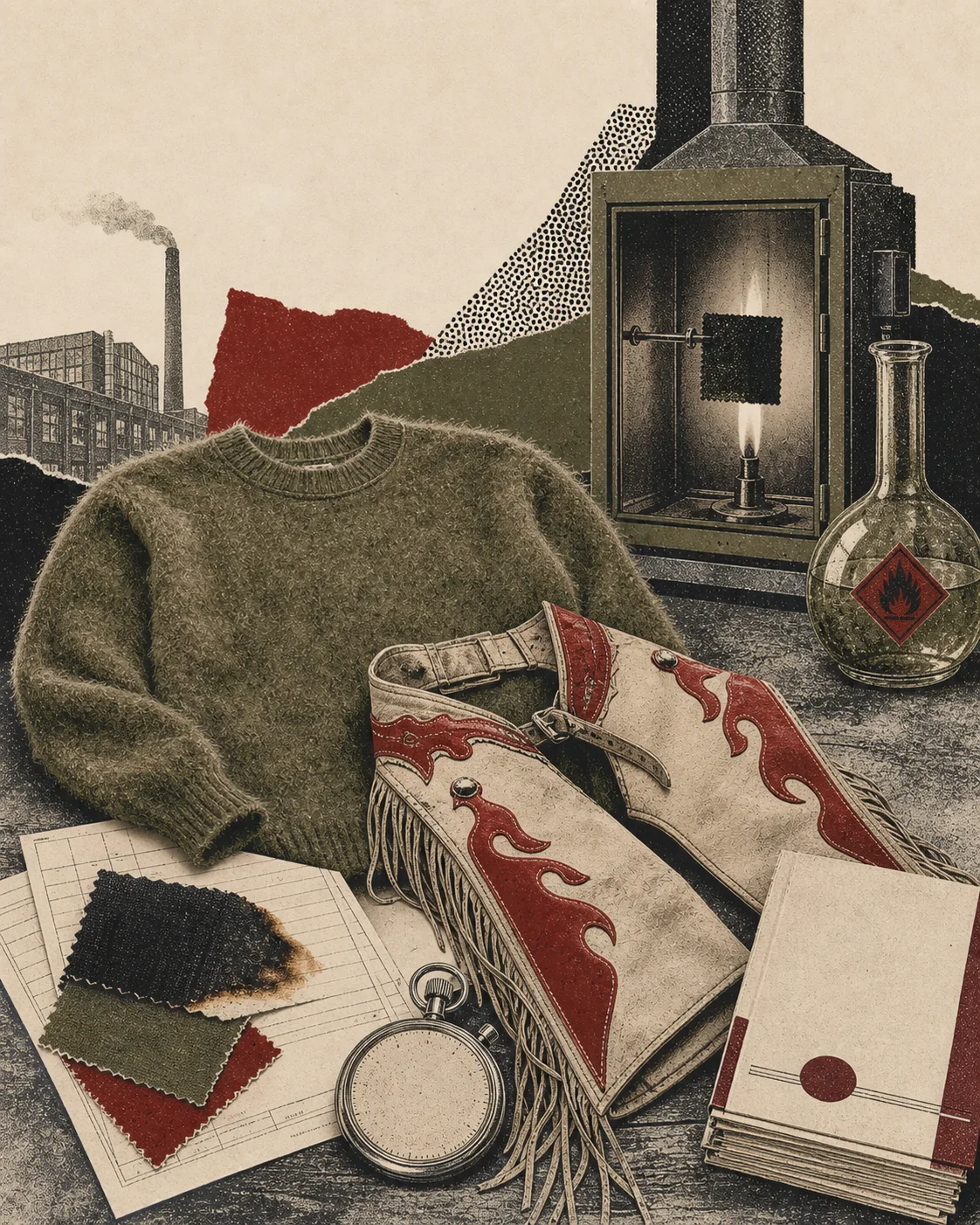
On January 30, 1952, a National Bureau of Standards chemist named Marjorie W. Sandholzer clamped a strip of maroon sweater into a test rig in a federal lab in Washington. The District of Columbia Fire Marshal had sent it over: a sleeveless slip-over and a matching long-sleeved jacket, both knit of brushed rayon, both sold under the label “Genuine Embassy Sportswear,” both caught up in what her report calls “current widespread public concern” about sweaters that burned. She touched a microflame to the fabric for one second and started a stopwatch. The flame crossed a five-inch strip in an average of 1.1 seconds. A fabric was considered dangerously flammable, by the standard textile chemists were using that year, if it burned that same distance in under four seconds. The sweater beat the threshold by nearly four times.
The brushing was the hazard, not the rayon
Sandholzer’s report, filed as NBS Report 1422, is short and precise, and it isolates the mechanism in a way that a headline from the period would not. The sweater fabric was knit of ordinary delustered viscose rayon, nothing unusual in the fiber itself. What made it dangerous was that the outer surface had been brushed into a soft nap, raising thousands of fine loose fibers with air trapped between them. She proved the point with a second test: turned inside out, so the flame met the smooth knit backing instead of the brushed face, the same fabric needed a four-second flame application just to ignite, and then took 22 seconds to burn the same five inches it had crossed in 1.1. Same yarn, same weave, same dye lot. The only variable was which surface faced the match.
Sandholzer ran two other tests on the same fabric, and both agreed with the first. In a horizontal test, where the sample burns flat rather than at an angle, the flame crossed the material at 270 inches a minute, well past the 60-inch threshold the same proposed federal legislation had used to define a highly flammable fabric. In a vertical test that mimics a garment hanging on a body, the flame covered five inches in 0.7 seconds, the fastest result of the three. She also tried to ignite the fabric with a lit cigarette, pressed into the nap and buried in a fold of cloth, and could not get it to sustain a flame either way; the danger was specific to open flame meeting a raised surface, not to a smoldering ember. Three separate testing methods, three separate labs’ worth of accumulated technique, and all of them agreed on the same sweater.
Her report also names the fabric that had already made the danger a public issue before her test began: “long, fine rayon pile (such as the material in the cowboy suit chaps which caused a number of fatal accidents).” That’s a federal chemist, writing in a government file two years before Congress acted, and the sentence names the deaths outright rather than gesturing at them. The historian Barbara Young Welke, in a 2014 Journal of American History article built on the insurance claims and product liability records the tragedy generated, traces the pattern across a full decade: from 1942 to 1952, children in Gene Autry-style cowboy suits made of long rayon pile were burned badly enough, and often enough, to leave a legal record.
What Congress actually wrote
The bill that became the Flammable Fabrics Act moved through the 83rd Congress in a matter of weeks. President Eisenhower signed it on June 30, 1953, and it took effect a year later, giving manufacturers and retailers time to clear existing stock. The statute itself, now at 15 U.S.C. 1191 et seq., does something narrower than ban a list of fabrics: it prohibits selling or shipping in interstate commerce any article of wearing apparel that is “so highly flammable as to be dangerous when worn,” with the specific flammability threshold set by regulation rather than fixed in the statute’s text. That structure, a broad statutory ban paired with a technical standard the agency can update, is why the same law from 1953 still governs clothing sold today; only the regulation underneath it has to change as fabrics and testing methods do.
The original Act also exempted hats, gloves, and footwear from coverage, a gap Congress closed in a 1967 amendment that broadened the definitions and brought those categories in. Enforcement sat with the Federal Trade Commission for the law’s first half century; a 2008 amendment moved it to the Consumer Product Safety Commission, the agency that still administers it. The current test, 16 CFR Part 1610, sorts fabric into three classes by how fast a flame travels across a sample mounted at 45 degrees: Class 1 is normal flammability and ships freely, Class 2 covers raised-surface fabrics that burn a little faster but stay legal, and Class 3, the class that 1952 sweater would have landed in without argument, is barred from clothing outright.
The correction: the sleepwear standard did not end cleanly
The Flammable Fabrics Act is usually told as a straight-line safety story: dangerous fabric identified, law passed, problem solved. The part of the record that gets left out is what happened when the Commission wrote a tighter standard specifically for children’s sleepwear, 16 CFR Parts 1615 and 1616, issued in 1971 and 1974 for sizes 0 through 6X and 7 through 14. That standard did not just ban a fabric surface the way the 1953 Act had. It set a performance bar many ordinary cotton and synthetic weaves could not pass on their own, and manufacturers met it, in large part, by chemically treating the fabric.
The chemical most widely used for that treatment was Tris, formally tris(2,3-dibromopropyl) phosphate. It worked. It also turned out to be the problem the Commission had to solve next. A National Cancer Institute feeding study found that Tris caused cancer in laboratory animals, and the Commission concluded children could absorb it through skin contact or by mouthing treated fabric. On April 8, 1977, the CPSC declared Tris-treated children’s sleepwear a banned hazardous substance, and it spent the following months in federal court enforcing that ban against individual retailers, including a case against Macy’s and one against the F.W. Woolworth Company. A federal appeals court upheld the Commission’s authority to act that way in 1978. The chemical industry’s replacement compound, chlorinated Tris, drew the same suspicion and was pulled from sleepwear voluntarily that same year, before it could be banned outright.
The story’s least-told chapter is the one that follows the ban rather than the chemical. Manufacturers who had stocked Tris-treated garments in good-faith compliance with a federal flammability rule were left holding inventory they could no longer legally sell, and Congress passed a bill authorizing the government to indemnify them for the loss. President Carter vetoed it on November 8, 1978. His memorandum argued that producers, not taxpayers, carry the responsibility for the safety of what they put into commerce, and that some of the same companies had kept selling Tris-treated garments after they had reason to know the material was hazardous. A safety standard that saves children from fire by requiring a fabric treatment that turns out to cause cancer is not a clean win with an asterisk. It is the same regulatory system working twice in a row, once against a fire hazard and once against the fix for it, and the second round left manufacturers, not the government, to absorb the cost of having complied.
The standard that still runs under every hanger
None of this is settled history in the sense of being finished. Every garment sold in the United States today, sleepwear or not, still has to clear 16 CFR Part 1610’s Class 1 or Class 2 threshold before it can legally reach a rack, our own brushed-back fleece hoodie included. What changed since 1952 is not that fabric got safer on its own. A federal chemist measured a sweater burning end to end in about the time it takes to say the word, wrote the number down, and the number is still the reason a brushed surface on a garment sold today behaves nothing like that one did.