
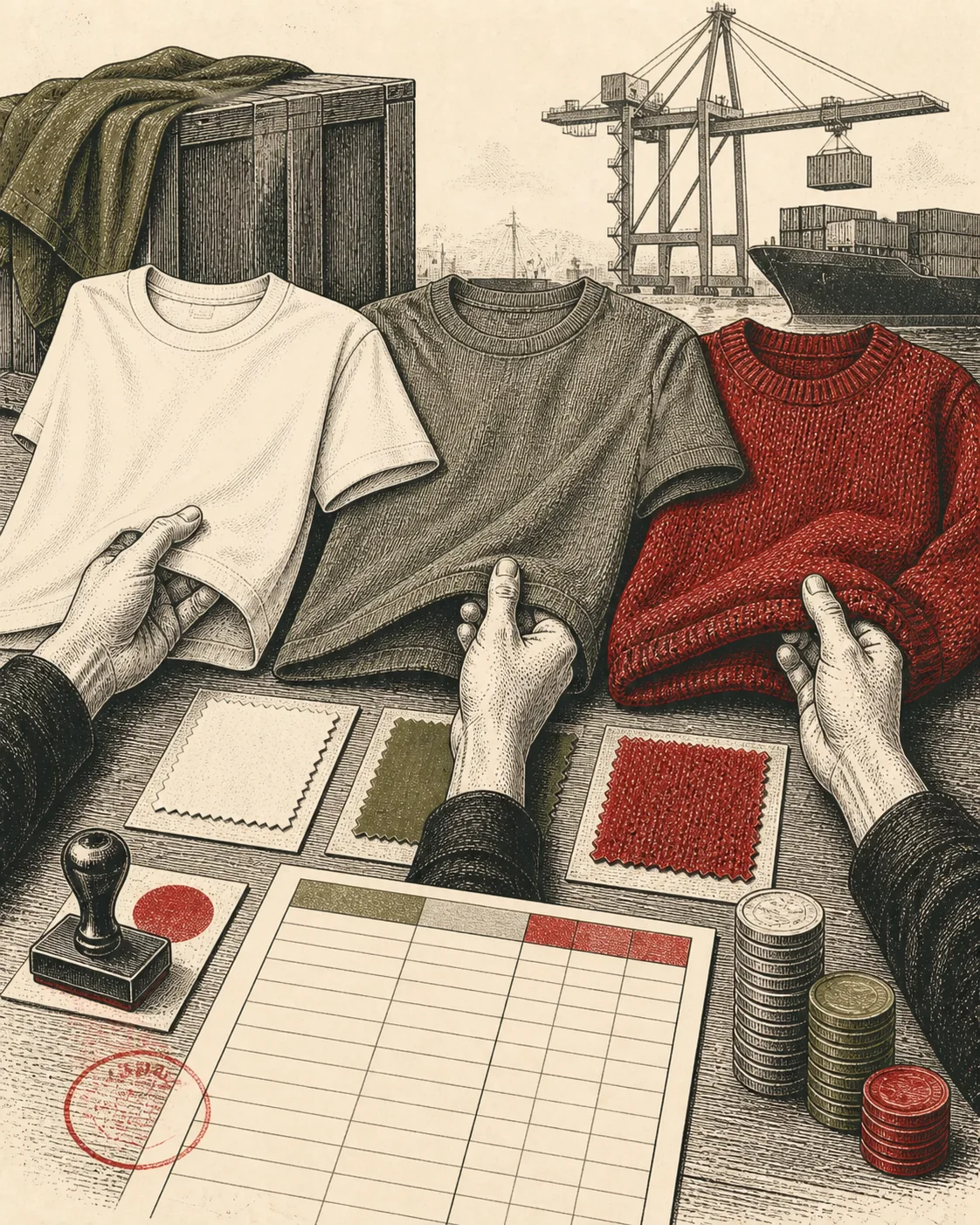
Line 6109.10.00 of the Harmonized Tariff Schedule reads, in full: “T-shirts, singlets, tank tops and similar garments, knitted or crocheted: Of cotton.” The general rate of duty printed next to it, in the United States International Trade Commission’s own published schedule, is 16.5%. That single line is where the tax on a basic cotton tee actually lives, not in a headline about a trade war, and it was 16.5% before any of the tariff fights of the last two years started.
What the schedule actually charges
The Harmonized Tariff Schedule assigns a rate to every category of import, organized by chapter, and apparel gets two chapters to itself: 61 for knitted or crocheted garments, 62 for everything woven. A plain cotton t-shirt, classified under 6109.10.00, clears customs at 16.5% of its declared value. Move to the identical garment cut from synthetic fabric instead, filed under 6109.90 as “of man-made fibers,” and the general rate nearly doubles to 32%. A men’s cotton dress shirt, woven rather than knit and filed under 6205.20.20, carries 19.7%. None of these numbers are close to the duty on most manufactured goods that aren’t apparel; a lot of machinery and electronics clears at rates near zero. Textiles kept their high rates through decades of trade liberalization that stripped tariffs off almost everything else, because the domestic mills and garment shops of the mid-twentieth century had the political weight to protect their line items when other industries’ protections got negotiated away. Apparel and textiles ran under their own separate global quota system, the Multi-Fibre Arrangement, from 1974 until the World Trade Organization’s Agreement on Textiles and Clothing phased it out over a ten-year transition ending January 1, 2005. The quotas went away on schedule. The underlying tariff lines that chapters 61 and 62 still use were negotiated in a different track and were never subject to the same phase-out, so the rates that survived the quota era are close to the rates a shopper pays today.
The schedule does not stop at fiber content. Compare the t-shirt lines to HTS 6110.12.10, sweaters classified as wholly of cashmere: general rate, 4%. A shopper buying a cashmere sweater is paying a quarter of the duty rate charged on the cotton tee in the next aisle, and an eighth of the rate charged on the polyester one. The schedule taxes fiber and construction categories set decades ago, not price, and those categories happen to sort roughly by who buys what. Cheap, mass-produced cotton and synthetic basics carry among the highest rates in the entire schedule. Fine natural fibers bought disproportionately by wealthier households carry some of the lowest.
The gap nobody voted on
Apparel’s second regressive seam runs by gender, and it is not hidden in a rounding error. Economist Edward Gresser and Elaine Wei, publishing through the Progressive Policy Institute on December 6, 2023, calculated the average 2022 tariff rate on women’s clothing at 16.7%, against 13.6% for men’s clothing, a 3.1 percentage point gap. Their earlier work using 2017 figures found the same pattern inside individual categories: women’s shirts at 19.7% against men’s shirts at 17.0%, women’s suits at 15.1% against men’s suits at 13.3%, women’s underwear at 12.8% against men’s underwear at 8.6%. Nobody wrote a rule that says women pay more. The gap survives because thousands of individual tariff lines, each covering a narrow garment category, were set one at a time across decades of negotiations, and the men’s-wear categories more often landed in the lower brackets. Gresser and Wei trace part of the pattern to the 1930s and 1940s, when men’s clothing manufacturing was the larger, more politically organized domestic industry and negotiators protected it accordingly.
Trade policy and tax policy are not the same question
Tariffs get argued about as trade policy: which countries get punished, which factories reshore, whose currency moves. That argument is real, but it is a different argument from what a tariff does the moment the container clears the port, which is function as a sales tax charged to whoever imports the goods, passed forward into the retail price. A tax that charges 32% on a synthetic t-shirt and 4% on a cashmere sweater is not neutral by income. It falls hardest on the households buying the cheapest fiber, because that is the fiber the schedule taxes most. The distributional effect is a separate, calculable question about who the schedule was built to charge more, answered by the schedule’s own numbers rather than by the trade debate.
What the duty rate does to a $10 shirt
The duty is charged on the customs value, roughly what the importer paid the factory, not on the retail sticker. A cotton t-shirt landing at a $10 wholesale cost picks up $1.65 in duty at 16.5% before it reaches a warehouse. The same shirt cut from polyester at the same wholesale cost picks up $3.20 at 32%, nearly double, for a garment that likely retails for less than the cotton one, since synthetic fabric is usually the cheaper input. A cashmere sweater costing a factory $60 to make picks up $2.40 in duty at 4%, a smaller dollar amount than the tariff on the $10 synthetic tee despite a wholesale cost six times higher. None of that $1.65, $3.20, or $2.40 stays with the importer. Retailers price to their margin targets, so the duty gets folded into the shelf price the way sales tax gets folded into a receipt total, except nothing on the price tag discloses it the way a receipt line does.
What has changed since 2026, and what has not
The chapter 61 and 62 base rates above are the long-standing schedule, not a recent policy. What has moved, repeatedly, is a set of surcharges layered on top of them. In April 2025 the administration imposed tariffs of 10% or higher on most countries under the International Emergency Economic Powers Act. On February 20, 2026, the Supreme Court ruled that IEEPA does not authorize the President to impose tariffs at all, and those duties terminated at midnight on February 24, 2026. The administration replaced them within hours with a flat 10% surcharge under Section 122 of the Trade Act of 1974, a statute that caps that kind of surcharge at 150 days. That window ran out on July 23, 2026, and the next day the U.S. Trade Representative’s office put in force a new Section 301 surcharge, this one framed around forced-labor enforcement, at 10% or 12.5% depending on the exporting country, covering roughly sixty economies. As of August 29, 2026, when this was last checked, that Section 301 surcharge is the layer sitting on top of the base rates, and it is being challenged in court by a coalition of states seeking to block it and recover duties already paid. Anyone pricing an actual shipment needs the surcharge rate in force on that day, not this one; the base chapter 61 and 62 numbers are what stays fixed while the surcharge argument keeps changing hands.
A shirt does not know which fight it is in
None of the churn above touches the 16.5%, the 32%, or the 4%. Those numbers sat in the schedule before the IEEPA case, survived the Section 122 window, and will still be sitting there whatever happens to the Section 301 surcharge in the Court of International Trade. A t-shirt crossing the border does not know or care which statute the surcharge on top of it is authorized under this month. It only knows what line it was classified under years ago, by negotiators protecting industries that in some cases no longer exist in the United States at all. The base schedule is the part of this argument that was decided years before any of it made news, in committee rooms nobody covered, and has been charging the same uneven bill ever since.