
On the night of June 3, 1943, about fifty sailors from the Naval Reserve Armory in Chavez Ravine climbed into a line of taxicabs and told the drivers where to go: downtown, then east, toward the Mexican American neighborhoods where the zoot suits were. They carried clubs. Over the next several hours they pulled young men out of theaters and off streetcars, beat them, and cut or tore the suits off their bodies, leaving the cloth in the gutter. Los Angeles police, riding along or following behind, arrested the young men for disturbing the peace. They arrested almost none of the sailors.
That night was the start of a week that historians call the zoot suit riots, and it did not begin or end with sailors. Soldiers, Marines, and off-duty police joined the following nights, and the target list grew to include Black teenagers in Watts, some of whom wore no zoot suit at all. The worst night, June 7, drew a crowd estimated at several thousand downtown, some of them adults who had come to watch. It stopped only when military authorities declared Los Angeles off-limits to servicemen on June 8 and ordered military police to pull sailors and soldiers off the streets.
The year before
The riots did not start from nothing. On August 2, 1942, a young man named José Gallardo Díaz was found dying near a reservoir south of Los Angeles known locally as Sleepy Lagoon. The Los Angeles Police Department, working from a theory of Mexican American gang warfare that predated any evidence in this case, charged twenty-two young men with his death. Twelve were convicted: three of first-degree murder, nine of second-degree, sent to San Quentin in a trial the defendants’ families said had already decided their guilt from their clothes. In October 1944 the California District Court of Appeal reversed every one of the convictions in People v. Zammora, 66 Cal. App. 2d 166, finding no evidence in the record connecting the defendants to Díaz’s death and faulting the trial judge’s conduct of the case. The reversal came a year after the riots. By June 1943 the Sleepy Lagoon prosecution had already spent ten months teaching Los Angeles newspapers to describe Mexican American teenagers in zoot suits as a gang problem, well before a single sailor threw a punch.
Why a suit, specifically
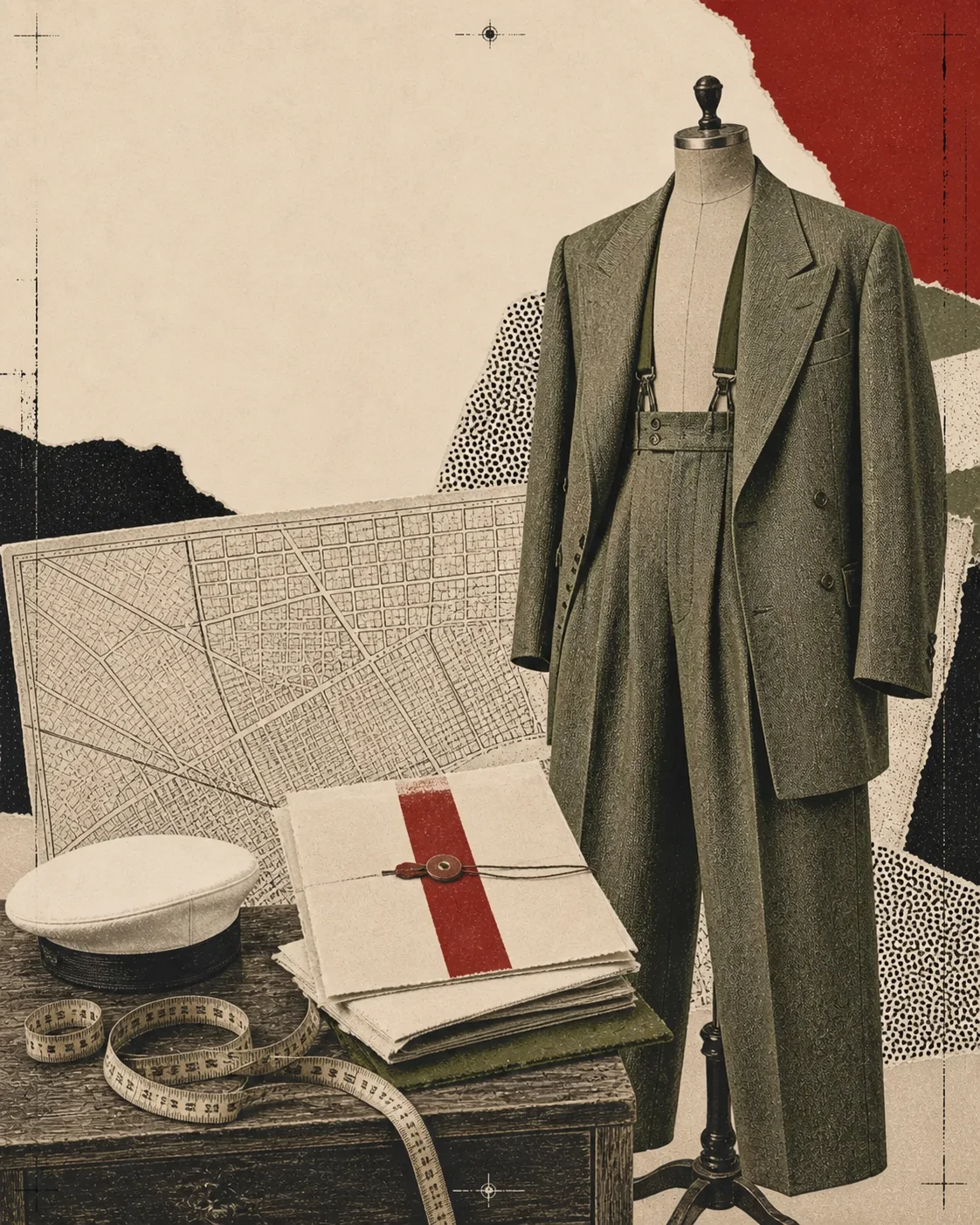
The zoot suit was a jacket cut long and full through the shoulders and chest, worn over trousers pegged tight at the ankle but ballooned through the thigh, sometimes with a watch chain hanging to the knee. It had circulated through Black communities in Harlem and Detroit through the late 1930s and reached Los Angeles’s Mexican American youth, known as pachucos, by the early 1940s. None of that made it illegal. What made it a target was a fabric rule the federal government had written the year before.
War Production Board General Limitation Order L-85, published in the Federal Register on April 10, 1942, capped how much wool, silk, rayon, cotton, and linen civilian clothing could use, citing the direct competition for those materials from military production. The order and its later amendments reached men’s tailoring specifically: no cuffs on trousers, no vests, no patch pocket flaps, no double-breasted jackets, and one pair of trousers per suit instead of the prewar two. The style the order produced, sold widely as the “victory suit,” was narrow, single-breasted, and short on extra cloth by design. A zoot suit, with its yards of drape and its pegged, oversized trousers, sat well outside that ration. Tailors who made them were, by definition, cutting suits the government had told the country not to make.
The suits kept coming from independent tailors who cut them to order, never off a department store rack that had already been restocked to L-85 specification. That distinction is what let the garment double as a badge. A store suit proved nothing; a zoot suit proved someone had gone looking for a tailor willing to cut around a federal order, on purpose, in wartime.
The correction
The zoot suit riots get remembered as a fight about fashion, servicemen offended by a loud style worn by young men who were not fighting the war. That framing survives because it is partly true and easy to picture. What it leaves out is that the suit was not just loud, it was a documented violation of a wartime materials rule, and everyone involved knew it. A young man in a zoot suit in June 1943 was wearing visible evidence that either he or his tailor had ignored a federal order written in the name of the war effort. Servicemen, restricted in their own uniforms and about to ship out, read that as more than poor taste. They read it as proof the wearer had not sacrificed anything, and some of the period’s press coverage said so outright, describing zoot suiters as draft dodgers and hoodlums in the same sentence. The rationing order is what converted a garment into a legible claim of disloyalty, and unlike the reading of the fabric as “just style,” L-85 is a document that still exists and says exactly what it restricted.
None of that made the beatings a reasonable response to a dress-code violation. The disparity in who got hurt and who got arrested runs through every account of the week. Historian Eduardo Obregón Pagán’s research into the riots documents a pattern civilian and military witnesses noted at the time: servicemen who started fights walked away, while their targets were taken into custody. The exact week’s arrest total is reported differently depending on the source and the window it counts, running from roughly one hundred to several hundred Mexican American and Black youths; what does not vary across any account is that almost no servicemen were charged with anything.
What Los Angeles did afterward
On June 8 or 9, 1943, accounts differ on the exact day, the Los Angeles City Council took up a resolution to make wearing a zoot suit within city limits a misdemeanor. Councilman Norris Nelson, who introduced it, told the council the suit “has become a badge of hoodlumism,” and argued that a city that could prosecute nudism by ordinance could prosecute the opposite. Most published accounts describe the measure as passed; other researchers of the council’s own record find it referred to the police commission and never drafted into an enforceable ordinance by the city attorney, meaning no one was formally charged under it either way. What is not in dispute is the timing: the council took the vote the same week the riots ended, aimed at the young men who had just been beaten rather than at the servicemen who had beaten them.
Governor Earl Warren convened a citizens’ committee to investigate within days of the riots ending. Its report placed responsibility on the servicemen and on biased press coverage that had spent weeks describing Mexican American youths as a crime wave before a single suit was torn. The Los Angeles Police Department’s own conduct during the week, arresting victims rather than attackers, drew separate criticism in the same report. None of it reversed anything that had already happened to the young men whose suits ended up burned in the street.
What the cloth was actually doing
Reduce the week to a fashion dispute and the servicemen’s violence looks disproportionate but explicable, a mob offended by a look. Read L-85 alongside it and the offense sharpens into something more specific: a suit that used forbidden yardage, worn by young men who were not in uniform, at a moment when the whole country’s clothing had been narrowed by government order. The suit did not cause the riot. It gave the riot a pretext that looked, to the people committing the violence, like a legal one. That is the distance between a style people found tacky and a target people felt licensed to attack, and it is measured in one Federal Register page from April 1942.