
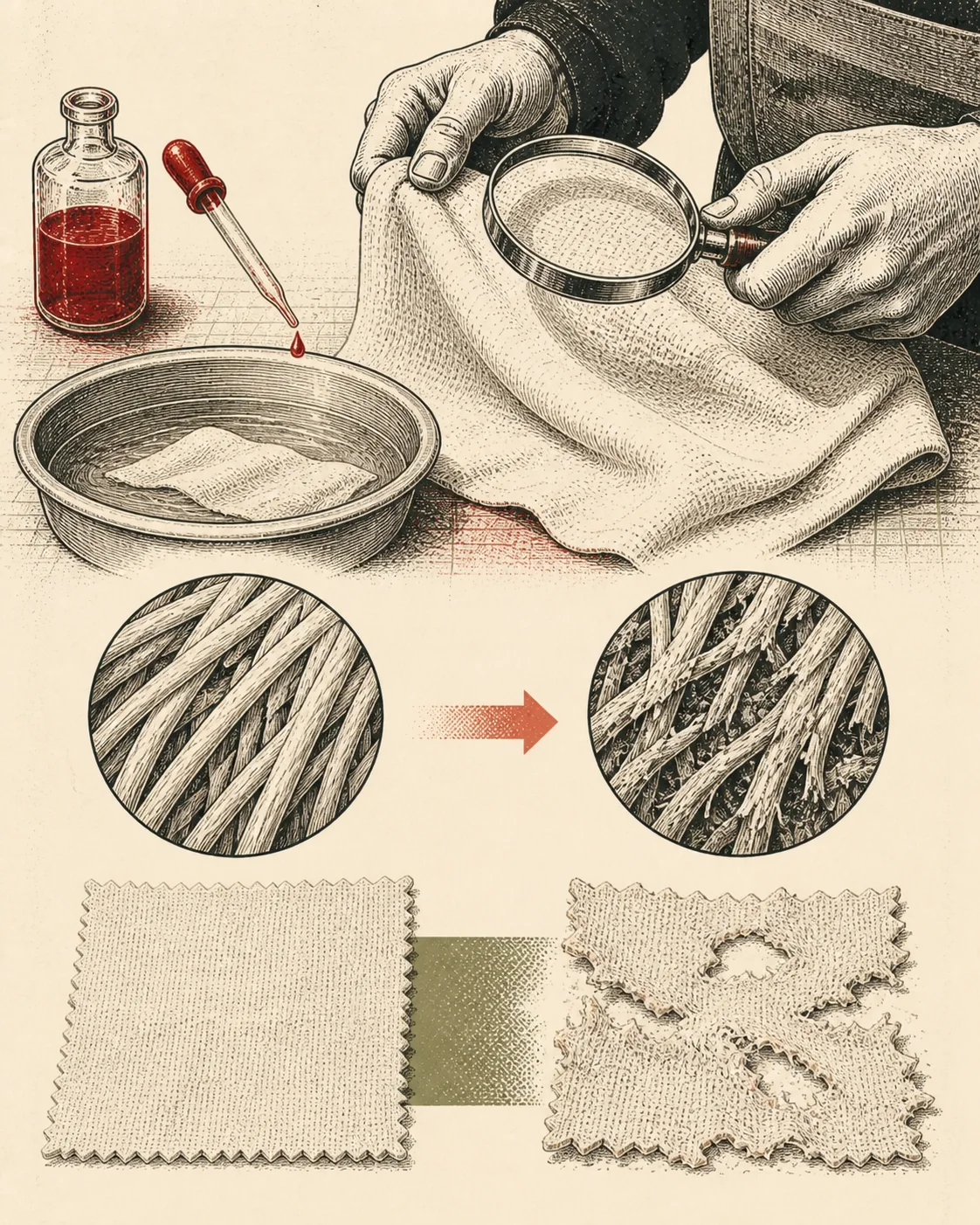
Bleach does not know the difference between a stain and a shirt. Sodium hypochlorite, the active ingredient in ordinary chlorine bleach, is an oxidizer, and oxidation is oxidation: it breaks down the colored compounds that make a stain visible by the same chemistry that it uses on the cellulose chains making up the cotton fiber itself. The bottle whitens the shirt and thins the shirt in one motion, and only one of those effects is the one anyone is trying to buy.
The reaction nobody sees happening
Cotton fiber is cellulose, a long chain of glucose units linked end to end. Hypochlorite attacks that chain directly. In a 1962 study in the Journal of Polymer Science, Menachem Lewin and J.A. Epstein oxidized cotton with hypochlorite across a range of pH from 5 to 10 and measured what came out the other side: carboxyl groups, aldehyde groups, and ketone groups forming on the cellulose in ratios that shifted with acidity, alongside breaks in the chain itself. At acidic pH they found roughly 26 oxygen atoms consumed by the fiber for every chain scission, only about 10 of which showed up as the measurable functional groups; the rest, they concluded, went into oxidizing the short fragments that broke off and dissolved away. Their phrase for it was that degradation and oxidation “occur simultaneously and, at a given pH, with similar rates.” Stain-lifting and fiber-thinning run on the same reaction, competing for the same oxygen.
The exact chemistry shifts with acidity, which matters because most laundry hypochlorite runs alkaline. Lewin and Epstein found the ratio of carboxyl to aldehyde to ketone groups forming per scission ran roughly 1 to 1.5 : 3 : 3.5 on the acid side of neutral, and shifted to about 5 : 0.8 : 0 at pH 10. Different acidity produces a different mix of oxidized groups on the cellulose, but chain scission happens across the whole range they tested. There is no pH at which hypochlorite whitens cotton without also cutting some of its chains.
The weakened material that results has a name in textile chemistry: oxycellulose. It is still cotton, still recognizable under a microscope, but its chains are shorter and its tensile strength is lower than it was before the bleach touched it. None of that shows up as a visible mark. A shirt can come out of the wash looking exactly like it did going in, whiter even, while its fiber has already lost some of the length and strength that used to hold a seam or a hem together under stress. The damage is chemical before it is ever visual.
Why the hole shows up in the next wash, not this one
Ask a dry cleaner or a commercial launderer why a customer’s shirt tore along a fold line two washes after the one where it got bleached, and most will tell you the same thing: bleach that never got fully rinsed out kept working. Hypochlorite in solution keeps reacting past the moment the washer drains, an oxidizer sitting in wet fiber until something neutralizes it: a thorough rinse, time, or a chemical scavenger. Textile manufacturers take the persistence seriously enough to formulate for it: a patent for a chlorine-scavenger fabric softener describes actives that “react with chlorine, or with chlorine-generating materials, such as hypochlorite, to eliminate or reduce” its ongoing activity on laundered fabric, precisely because leaving it alone means it keeps going.
That is the mechanism that would explain a hole appearing later rather than immediately: cumulative chain scission that crosses a failure threshold somewhere between the bleach wash and a subsequent one, tipped along by whatever unreacted hypochlorite the rinse cycle missed. It is worth being precise about what is and is not established here. The chain-scission chemistry is documented and measured. The idea that unrinsed residual chlorine specifically produces a one-wash or two-wash delay before a hole appears is trade knowledge, the kind a dry cleaner or a commercial laundry manager has seen often enough to state with confidence, but it is not a claim anyone has isolated and tested in a published study. The fabric everyone repeats a version of “the splash from three washes ago finally gave out” without ever citing a source, because there is not one to cite. The chemistry supports the pattern. Nobody has measured the pattern directly.
What oxygen bleach does instead
Hydrogen peroxide bleaches through a different reactive species than hypochlorite does. In alkaline solution, peroxide splits into a hydronium ion and a perhydroxyl anion, and it is the perhydroxyl anion that does the actual work of breaking down colored compounds. That is a milder, slower oxidation path than hypochlorite’s, and it lacks chlorine’s documented history of glycosidic-bond cleavage across a wide pH range, the kind Lewin and Epstein measured. Oxygen bleach, sold as sodium percarbonate powder or as a hydrogen peroxide solution, is generally treated as the gentler option for cotton at normal laundry strength, which is why care labels that say “no chlorine bleach” are often still fine with the oxygen kind. The tradeoff is speed: peroxide needs a longer soak, sometimes hours, to match what chlorine does in a single wash cycle, and it is genuinely weaker against a set-in colored stain.
What “used as directed” actually covers
Clorox’s own consumer guidance disputes the idea that bleach shortens fabric life at all, stating that liquid bleach “does not significantly reduce the life of fabric when used as directed.” That is a narrower claim than it sounds. “As directed” means added through a dispenser, mixed into the detergent before the wash starts, or diluted in a quart of water and added several minutes into the cycle, never poured full strength directly onto cloth, and never on wool, silk, mohair, spandex, or leather. Worth remembering, too, that this is the position of the company selling the product. None of that contradicts the chain-scission chemistry Lewin and Epstein measured; correctly diluted and thoroughly rinsed bleach still oxidizes cellulose, just at a rate and concentration low enough that a garment’s normal wear life outpaces the damage. The instruction that matters is the one on the label: how much, how diluted, how long, and a full rinse afterward. Nothing beyond that published number is a safe amount to guess at.
Treating chlorine bleach as the last step, not the first
Cornell Cooperative Extension’s home stain-removal protocol, a sequence traced back to a 1975 paper in Textile Chemist and Colorist, reflects the same caution from the practical side rather than the laboratory side. It works a stain through detergent and ammonia, then detergent and vinegar, then alcohol, before it ever reaches for chlorine bleach, and when it does, the instruction is a two-minute soak, flushed immediately, never on wool, silk, or spandex. That sequencing reflects an acknowledgment, arrived at independently of Lewin and Epstein’s chemistry but consistent with it, that chlorine bleach is a blunt tool best reached for last and used briefly, because every minute it sits in contact with cotton is a minute it is oxidizing the fiber along with whatever it was aimed at.
Living with a fiber that does not forgive shortcuts
None of this means chlorine bleach has no place in a laundry room. It is the fastest tool for a genuinely set stain and for disinfecting in a way oxygen bleach cannot match. It means treating the dose and the rinse as the whole safety margin, not an afterthought, and accepting that a shirt bleached carelessly ten times will not tell you about the damage until a thread finally lets go, usually on a day with nothing unusual in the wash at all. Heavyweight cotton buys some room here, since a denser weave has more fiber mass for the same oxidation to work through before a hole opens, which is part of why DRESS runs its tees at 6.1 ounces rather than the thinner weights that show wear first. It does not make the cloth bleach-proof. It just moves the day the seam gives out a little further out.