
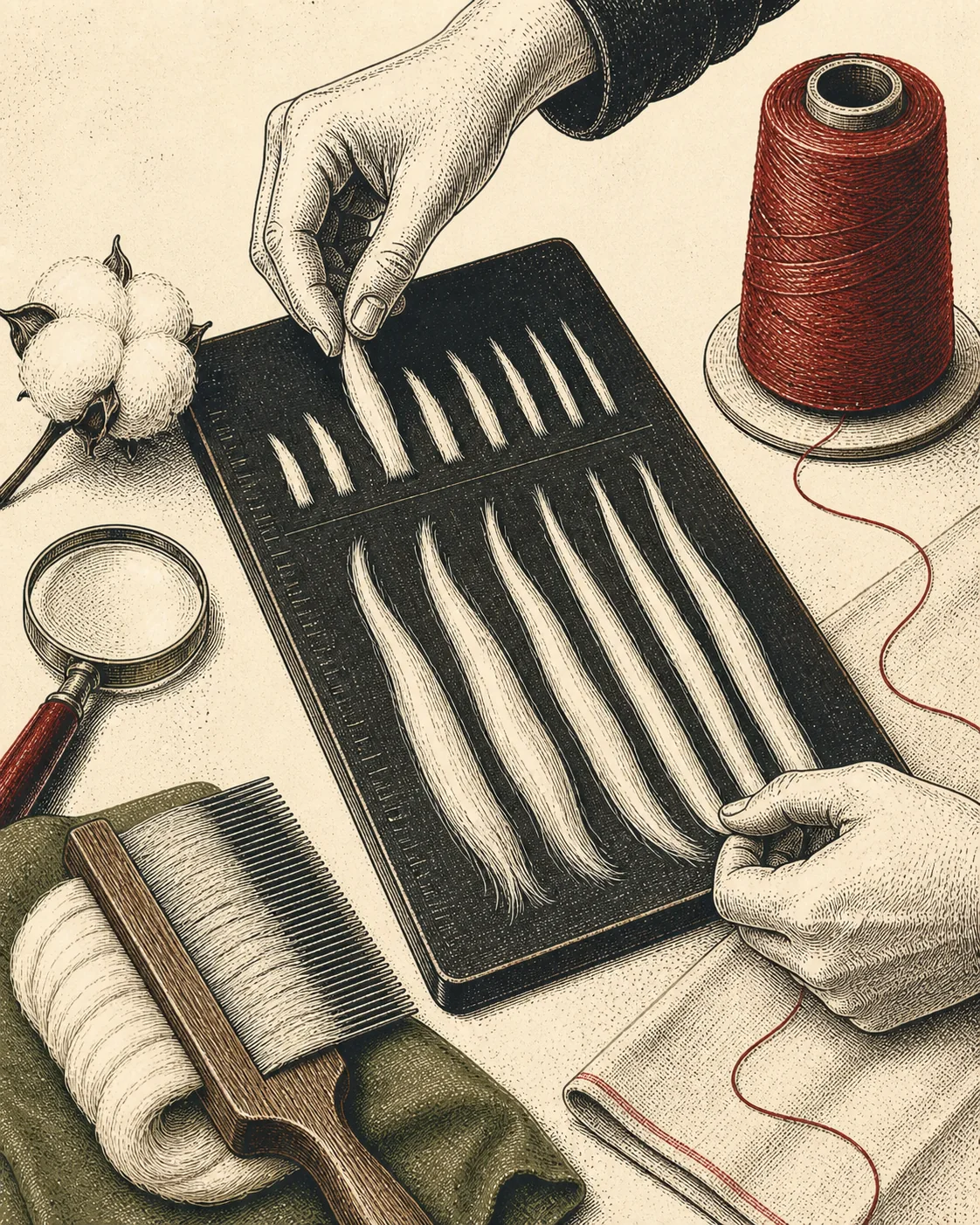
A cotton fiber’s staple length is the length of that single fiber, measured in fractions of an inch, and it is the number that decides whether a shirt can honestly call itself Pima. Not the country it was grown in. Not the price on the hangtag. The fiber, clamped and combed straight, run through a sensor at a USDA classing office. Everything else people mean by “long staple” or “Egyptian cotton” traces back to that measurement or borrows its authority without earning it.
How USDA actually measures it
USDA classes nearly every bale of cotton grown in the United States, a service authorized under the Cotton Statistics and Estimates Act, the Cotton Standards Act and the Cotton Futures Act, and paid for by the growers who use it. The agency’s high volume instrument system, or HVI, does the physical measuring. A technician pulls a small tuft of fiber, clamps it, then combs and brushes it into a flat, parallel “beard.” That beard passes through an optical sensing point, and the instrument reports the upper half mean length: the average length of the longer half of the fibers in the sample, not the average of all of them. USDA’s own classification handbook, Agricultural Handbook 566, spells this out exactly and gives the conversion chart classers still use, in thirty-seconds of an inch running from 24 (0.79 inches and shorter) up to 44 and above (1.36 inches and longer). The same handbook records the tolerances USDA holds itself to: fiber length measured to within eighteen thousandths of an inch of true value, checked against calibration cotton every two hours on every instrument line.
This is not a boutique measurement. At the height of the season USDA classes up to two million bales a week, and the length reading on that ticket is one input into what a mill will pay for the bale, alongside strength, micronaire and color. Length affects how a yarn spins because shorter fibers leave more loose ends exposed on the yarn’s surface, and every exposed end is a place where the yarn can pill, break, or catch light unevenly. A longer fiber means fewer twists needed to hold the yarn together and fewer ends poking out, and that mechanical fact, not marketing, is why long-staple cotton feels smoother in the hand before anyone has said the word “luxury.”
The instrument also reports a second, related number: length uniformity, the ratio of the mean fiber length to that upper half mean length, expressed as a percentage. If every fiber in a sample were exactly the same length, uniformity would read 100. It never does, because cotton is a plant and plants vary, but a sample above 85 percent counts as very high and a sample below 77 percent counts as very low. A bale can have a respectable staple length and still spin poorly if its uniformity is bad, because a wide spread of fiber lengths means a higher share of short fiber mixed in, and short fiber is what breaks the spinning process down. Staple length is the headline number. Uniformity is the one that tells a spinner whether the headline can be trusted.
USDA has been doing this work since well before the instruments existed. The push for uniform standards came out of a 1907 meeting of cotton industry representatives in Atlanta, called to settle price disputes that varied by market because nobody agreed on what “good cotton” meant. The resolution that came out of that meeting asked for standards precise enough to put a grower “in a better bargaining position,” and Congress followed with the laws that still authorize the classing service today. The instruments changed from human eyes to optical sensors; the reason for the measurement did not.
Two species, two length ranges
The staple-length story starts with which plant the fiber came from, and there are only two that matter for US production. Gossypium hirsutum, native to Mexico and Central America, is what the classification handbook calls American Upland cotton, and it accounts for more than 95 percent of everything grown in the United States. Handbook 566 gives its fiber length as running from about seven-eighths of an inch to one and five-sixteenths inches. Gossypium barbadense, a separate species of early South American origin, is classed in the US as American Pima, also called extra long staple or ELS cotton, and it runs longer: about one and a quarter inches to one and nine-sixteenths inches. A third botanical group, native to India and eastern Asia, runs shorter still and is not commercially grown in the United States at all.
USDA does not class Pima the way it classes Upland. The color standards differ, because Pima’s natural color runs a deeper yellow than Upland’s. The grading scale differs too: Pima gets six official grades against Upland’s twenty-five. Even the gins differ. Pima is roller ginned, which leaves a slightly less smooth appearance than the saw ginning used on Upland, a cosmetic difference the classer has learned to read past. None of this is marketing language. It is procedure written into a federal handbook because a Pima bale and an Upland bale genuinely are not comparable products, and pretending otherwise would make the classing data useless to the mills that rely on it to price a purchase before they have touched the fiber.
The correction: a place is not a license
Here is where the two words people actually shop by stop meaning the same kind of thing. “Egyptian cotton” names a country. Any bale of Gossypium barbadense grown in Egypt can carry that name regardless of its measured staple length, its uniformity, or whether the fiber in the finished sheet set is Egyptian at all once it has passed through several hands on the way to a label printer. Nothing enforces the claim at the point of sale. That gap is exactly what let counterfeit and substituted “Egyptian cotton” move through major retailers for years before DNA testing on finished goods caught it in 2016, a story that belongs to the fiber’s chain of custody rather than to staple length and is told in full elsewhere.
“Supima” names something narrower and enforceable: a trademark. It is owned by the Supima Association, founded in 1954, and it is licensed, not automatic. A mill, manufacturer or brand has to be granted the license to print the word on a swing tag, and the license only covers product actually made from American Pima, the US-grown Gossypium barbadense described above. Since 2018, Supima has backed that license with forensic testing through a partnership with Oritain, a company that verifies a fiber’s origin by matching trace elements absorbed from the soil and water where it grew, a method that works because those elements differ predictably by region and cannot be faked by relabeling a bag. In 2022 Supima extended that system with a digital tracking platform built with TextileGenesis, giving licensed goods a transaction-level record as they move from gin to garment, a program that launched under the name AQRe in 2023. A license under that system is non-transferable: it belongs to the specific licensee, not to the fiber generically, and that structure is what makes the name checkable at all where “Egyptian” is not.
Both names ultimately point at Gossypium barbadense and the same long-fiber physics described above, so the real gap between them is not staple length. One of the two words is backed by an entity with an incentive and a mechanism to catch a lie. The other is backed by nothing but the printer who ran the tag.
What the fiber does once it is yarn
None of this measuring exists for its own sake. A spinner buying long-staple cotton is buying fewer breaks per mile of yarn, a finer possible yarn count for the same strength, and a smoother surface that takes dye and light more evenly, because there are simply fewer fiber ends per inch of yarn to catch on anything. That is a mechanical outcome of the length measured on the HVI beard, not an association a marketer invented afterward. A short-staple Upland fiber spun well can still make a durable, perfectly good yarn; length is one input among several USDA measures, alongside strength in grams per tex and a fineness reading called micronaire, and a cotton weak in the other two will disappoint no matter how long its fiber runs.
What staple length will not do is tell you anything about where the bale actually ended up. A measurement system that has worked, unglamorously, since 1907 answers one question; a licensing system with forensic teeth had to be built on top of it to answer the other.