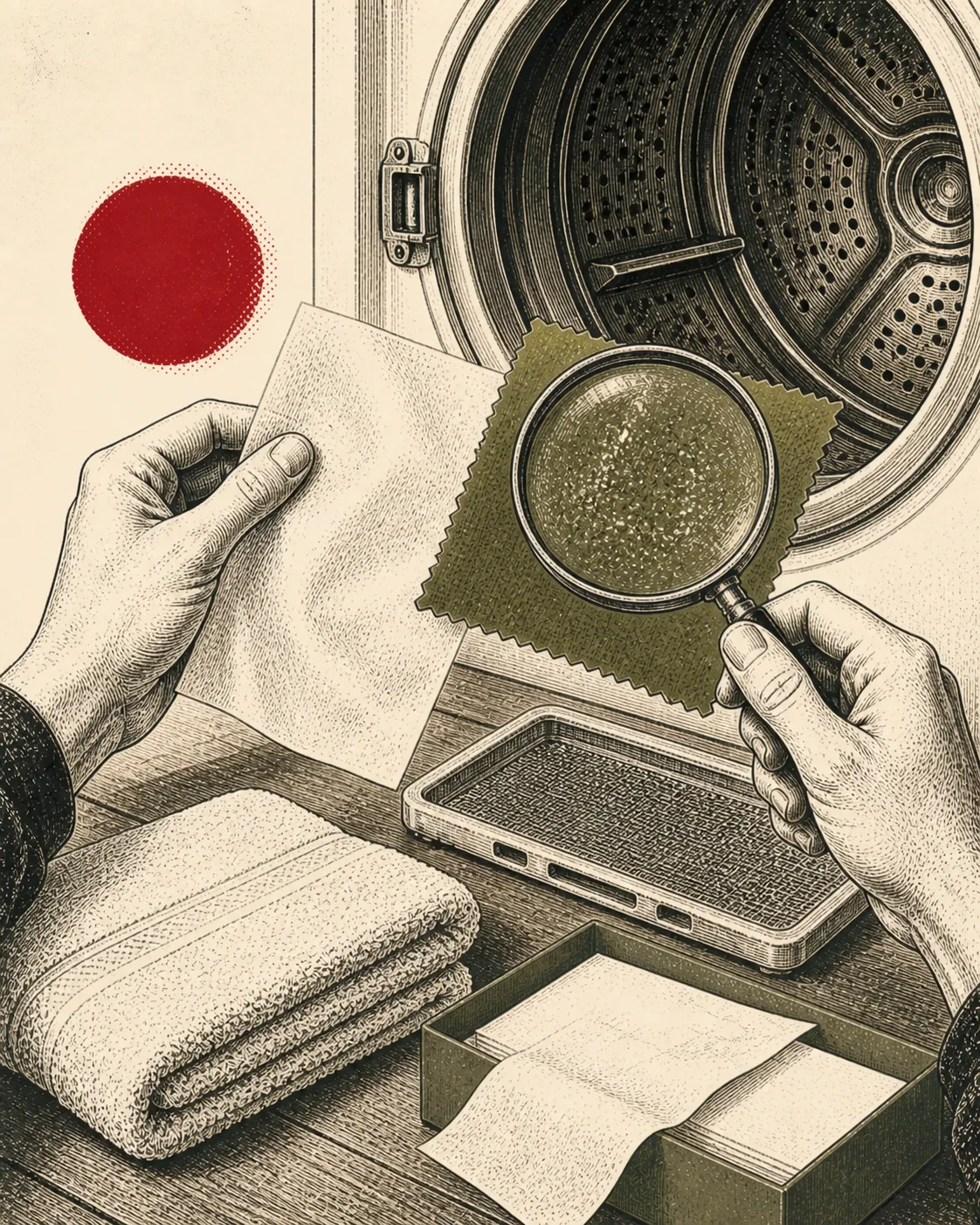
A dryer sheet goes into the drum dry and stiff and comes out spent, thin, faintly waxy under the fingers. It looks used up, like it burned off in the heat the way a scent might. It did not. Most of what was in the sheet is now on the clothes, not gone, and understanding what that residue is explains everything else the sheet does: the softness, the static kill, the towel that gradually stopped drying you off, and the warning printed on the box that most people have never read past the brand name.
What is actually on the sheet
A dryer sheet is a thin nonwoven substrate, usually polyester or rayon, coated with a fabric conditioning agent built around a tallow-derived quaternary ammonium compound. US Patent 7,943,566, filed by Procter & Gamble for a biodegradable version of the sheet, describes the mechanism this way: “At an activation temperature that is achieved during a drying cycle in a dryer at least a portion of the fabric conditioning agent transfers from the nonwoven substrate to the laundry to impart fabric conditioning properties to the laundry.” The activation range the patent gives is about 120 to 185 degrees Fahrenheit, which is ordinary tumble-dry heat. The compound melts at that temperature, tumbling spreads it across the fabric surface, and it resolidifies as the load cools. Nothing evaporates in the process. The sheet is a wax delivery system, and the wax ends up on the shirt.
Quaternary ammonium compounds carry a permanent positive charge, and cotton and most synthetic fibers carry a slight negative charge on their surface once they have been through a wash. Opposite charges attract, so the compound binds to the fiber rather than rinsing away, which is also why static drops: a charged fiber surface is what causes clothes to cling and crackle in the first place, and neutralizing that charge neutralizes the cling. The same binding is why the coating persists through the dry cycle and shows up, load after load, as a buildup rather than a one-time treatment.
The absorbency trade-off is real and it is measured
The softening mechanism and the water problem are the same mechanism seen from two sides. A quaternary ammonium compound coats each fiber in a thin layer of long fatty chains. Those chains lower the friction between fibers, which is what makes fabric feel soft. They also make the fiber surface hydrophobic, which blocks the capillary channels that pull water into cotton in the first place. A towel does not absorb water through some passive sponge action; it wicks water along fine channels between and inside the fibers, and a waxy coating over those channels interrupts the wicking regardless of how clean the towel looks.
Kao Corporation researchers Takako Igarashi and Kumi Nakamura documented the trade-off directly in a 2021 paper in the Journal of Oleo Science, opening with the plain statement that water absorbency, the standard mark of quality in a cotton product, “significantly decreases when any of the currently existing softeners is used.” Their paper does not dispute the effect. It proposes a fix, adding a hydrophilic particle alongside the softener to restore some of the lost wicking, which is itself evidence the industry treats the absorbency loss as an established cost of the product rather than a myth to debunk. One dryer sheet on one towel barely registers. A towel that goes through a sheet every wash for a year is carrying dozens of thin coats of the same wax, and coats accumulate the way any repeated deposit does.
Why activewear starts holding odor
The same coating explains a complaint that shows up on a different kind of fabric. Technical and athletic fabrics are usually built to wick sweat away from the body through the same capillary action a towel uses to wick water, moving moisture to the outer surface where it can evaporate. A waxy film across that surface defeats the design the same way it defeats a towel’s absorbency, except the consequence on a synthetic wicking layer is not slower drying but trapped moisture next to bacteria, which is what produces the odor that will not wash out. Most activewear care tags that say “no fabric softener” are naming this mechanism without explaining it. The instruction and the chemistry point at the same fact.
The sleepwear warning is on the box for a reason
Federal rule, not brand caution, is why fabric softener packaging carries a warning against flame-resistant garments. Children’s sleepwear sold in the United States is governed by two flammability standards, 16 CFR Part 1615 for sizes 0 through 6X and Part 1616 for sizes 7 through 14, both requiring a permanent care label that warns against agents or treatments known to reduce the garment’s flame resistance. The Consumer Product Safety Commission’s own 2000 rulemaking record, published in the Federal Register, documents the underlying finding: testing showed reduced flame resistance in a polyester sleepwear fabric after laundering with liquid fabric softener, and the same record notes that packaging for both liquid and sheet fabric softener already carried a warning against use on garments labeled flame resistant. The coating that makes a towel less absorbent is the same class of compound, and on a fabric engineered to self-extinguish, a waxy fuel layer works against the exact property the garment exists to have.
The fire claim that does not check out
Search “dryer sheets” and “fire hazard” and the internet converges on a specific claim: that softener residue building up on the lint screen mesh is a leading cause of home dryer fires. It is a plausible-sounding mechanism, and it borrows real credibility from a real fact, that dryer fires are common and that lint is the documented cause. But the two claims are not the same claim. The National Fire Protection Association’s dryer fire data, as cited by fire departments including the North Lake Tahoe Fire Protection District, attributes the leading cause to failure to clean lint buildup in general. Nothing in that data isolates dryer sheet residue as a distinct contributor, and no fire investigation report turned up in researching this piece names softener film specifically as a mechanism, as opposed to ordinary fiber lint, which every load produces with or without a sheet. A clogged screen of any kind restricts airflow and makes a dryer run hotter for longer, which is a real risk. Blaming that specifically on dryer sheets, rather than on the lint that would be there regardless, is the part of the claim nobody has actually sourced.
What to do with a coating you cannot see
None of this requires giving up dryer sheets everywhere. It argues for keeping them off two categories: towels and anything meant to wick, and anything labeled flame resistant, where the warning is not marketing caution but the direct output of a federal test. A wool dryer ball does the static and softness job through friction and air movement instead of a chemical coating, and it leaves a towel’s capillary structure alone. For a heavyweight cotton tee, the coating mostly changes hand-feel rather than function, which is a smaller trade to make.
Ours are 6.1-ounce cotton, union made, and the care instruction on every product page is wash cold and hang dry, which sidesteps the sheet question along with the fabric damage a hot dryer causes on its own. The wax was never going to hurt a garment-dyed tee the way it hurts a towel. It just was not doing anything for it either.