
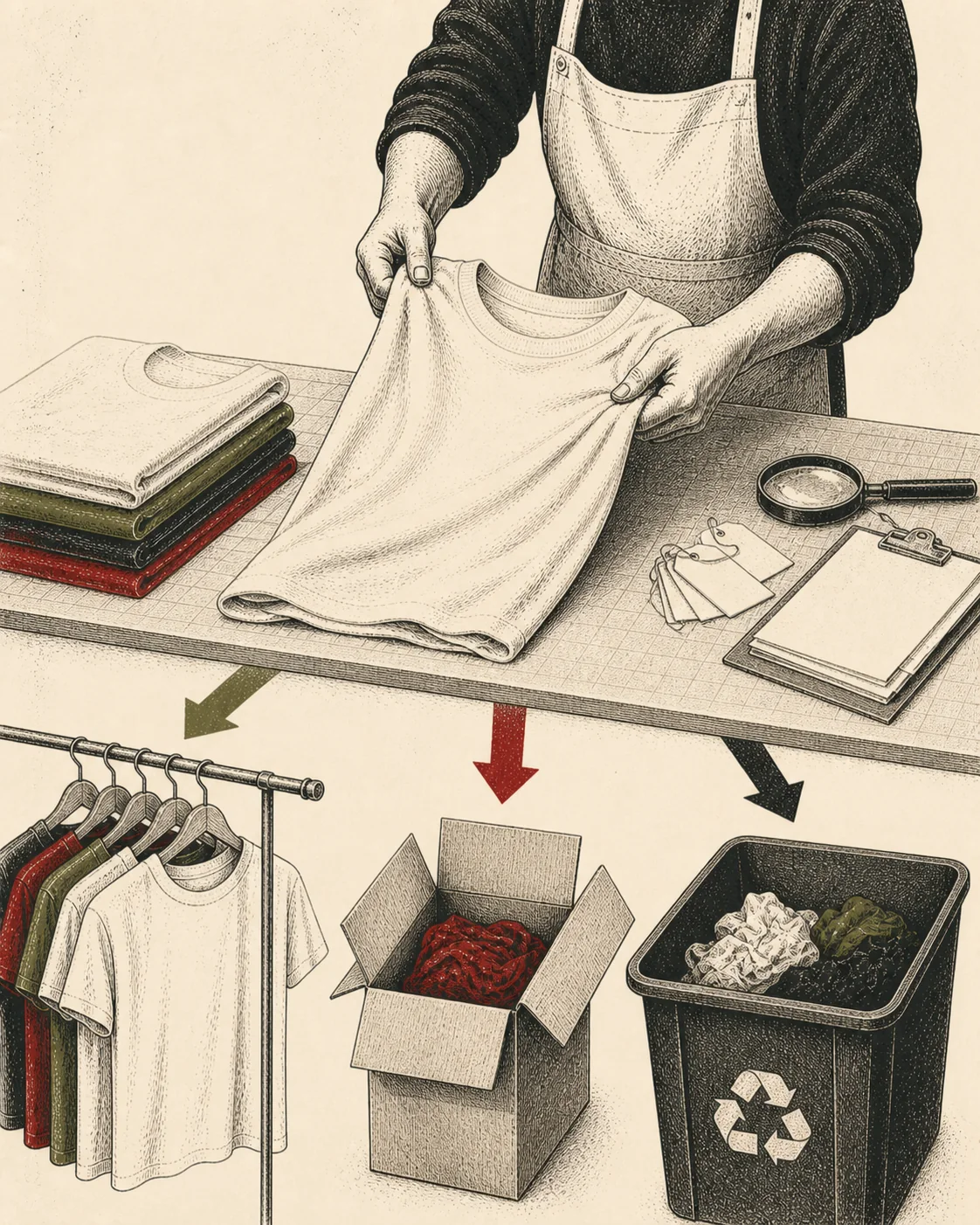
Most of it does not go to a landfill. It goes into a sorting process that tries, in order, to sell it at full price, sell it at a markdown, sell it wholesale to a liquidator, salvage the fabric, or give it away, and only reaches destruction when none of that pays off. That process is real, it costs money at every step, and the step everyone assumes is first is actually last.
What happens between the box and the refund
A returned shirt starts at a returns center, where staff check it against the order: right item, tags on or off, worn or unworn, damaged or not. That inspection is the expensive part. SPS Commerce, which builds the software retailers use to move goods through this pipeline, cites an industry figure that processing a single return costs an average of 30 percent of the item’s original price once handling, shipping, and labor are counted. A shirt that sold for 30 dollars can cost 9 dollars just to take back before anyone decides what to do with it.
What happens next depends on condition. A shirt in resalable shape with its tags on goes back onto the shelf or the website at full price. One with a folded crease or a missing tag goes out as a markdown. A shirt with a stain, a broken button, or a slightly wrong finish gets sold in bulk, by the pallet, to an off-price buyer or a liquidator. B-Stock, a San Mateo wholesale auction platform that runs return and overstock lots for retailers including Amazon, Target, and Walmart, is one of the larger venues where that pallet changes hands: a reseller bids on a mixed lot of returned clothing without opening it first, then sorts what it actually contains once the pallet arrives. Only what fails resale, markdown, and the pallet auction moves to salvage, recycling, or a landfill. The order matters because every step before destruction makes the retailer money and every step at the end costs it more, so the business incentive already points away from throwing shirts away.
Why a retailer sometimes tells you to keep it
The strangest-looking part of the returns economy, at first glance, is the retailer that refunds a customer’s money without asking for the item back at all. Arithmetic drives it, not generosity. Reverse-logistics vendor goTRG’s chief executive has put the total cost of processing a return, once shipping both directions, inspection, and repackaging are added up, as high as 75 to 100 percent of the item’s own value. Below roughly 20 dollars, several major retailers, Amazon and Wayfair among them, now issue a returnless refund by default rather than pay to ship, sort, and try to resell a shirt worth less than the shipping label.
That threshold explains a real pattern shoppers have noticed: cheap items get waved off, expensive ones get a prepaid label. The expensive item is the one that clears the cost of processing it, and the retailer’s stated regard for either item has nothing to do with it.
The number everyone repeats, and what it actually measures
Optoro, a US company that sells returns-management software to large retailers, reported in its own 2023 Impact Report that 8.4 billion pounds of retail returns went to landfill that year. That number gets cited constantly as evidence that most returns are trashed. It is not that. Optoro’s report does not state what share of total US returns 8.4 billion pounds represents, and the company that produced it also sells the software meant to reduce that figure, which is a reason to read the number carefully rather than to dismiss it.
A separate and more rigorous figure comes from the European Environment Agency, a European Union body, which estimates that 4 to 9 percent of all textile products placed on the EU market, unsold retail stock and consumer returns combined, are destroyed before ever being worn. That range, published as part of the European Commission’s own justification for new EU rules, works out to an estimated 264,000 to 594,000 tonnes a year. It is a real, sourced, government-backed number, and it is still a range spanning more than double itself, because measuring destruction across an entire continent’s supply chain is genuinely hard to pin down precisely.
These two figures get treated as if they describe the same thing. They don’t. Optoro’s number is US retail returns of every category, not just clothing, measured in pounds with no denominator given. The EEA’s number is European textiles specifically, unsold and returned together, measured as a percentage with a stated range and a named agency behind it. Neither one supports the flat claim that most returned clothes are destroyed. Both support the narrower, truer claim that destruction is a real and non-trivial part of the system, worth regulating, and worth naming honestly rather than rounding up.
The EU decided the argument by writing a rule
As of July 19, 2026, large companies operating in the European Union are legally barred from destroying unsold clothing, footwear, and clothing accessories, under the Ecodesign for Sustainable Products Regulation. The ban’s scope is specific on a point that matters here: it covers goods that were never sold and goods that customers sent back under their right of withdrawal, treating a returned garment the same as one that sat unbought on a shelf. Medium-sized companies get until 2030 to comply. A company caught destroying covered stock now has to publish what it destroyed and why, which is the kind of disclosure rule that exists because voluntary reporting wasn’t happening on its own.
The law does not ban destruction outright. It requires disclosure and steers companies toward resale, donation, or recycling first, the same hierarchy the reverse-logistics industry already uses when the economics favor it. What changes is that “the economics favored the shredder” stops being a private decision a brand never has to explain.
Where the arithmetic points for the industry as a whole
The National Retail Federation and Happy Returns, in their jointly published 2025 Retail Returns Landscape report, put the 2025 US retail return rate at 15.8 percent of total sales, down slightly from 16.9 percent in 2024, with online returns running much higher at 19.3 percent. Total returns for the year are projected at 849.9 billion dollars. Those numbers describe a genuinely large reverse-logistics problem, one big enough to support an entire industry of grading, liquidation, and resale platforms built around it. They say nothing, on their own, about where any individual shirt ends up, because that depends on the condition it comes back in and which of the six steps above catches it first.
What a made-to-order return actually is
DRESS accepts returns the same way any retailer does: unworn, unwashed items come back free by mail within 30 days of delivery for a full refund to the original payment method. What is different is what a returned shirt is, structurally, once it lands back with us. A conventional retailer’s returned shirt re-enters a pool of identical units already sitting in a warehouse; ours was printed for one order in one size and one colorway, so a return is not restock, it is a finished, single piece that no longer has a buyer. We accept that cost because we would rather absorb it than pressure anyone to keep a shirt that doesn’t fit, and we try to make it rare with accurate sizing up front rather than by making the return process harder than it needs to be.
Every returns process, ours included, ends somewhere. That somewhere is a sorting chain with resale at the top and a shredder at the bottom, worked in that order because the order is cheaper, not because anyone is handling a customer’s old shirt with any particular care for its own sake.