
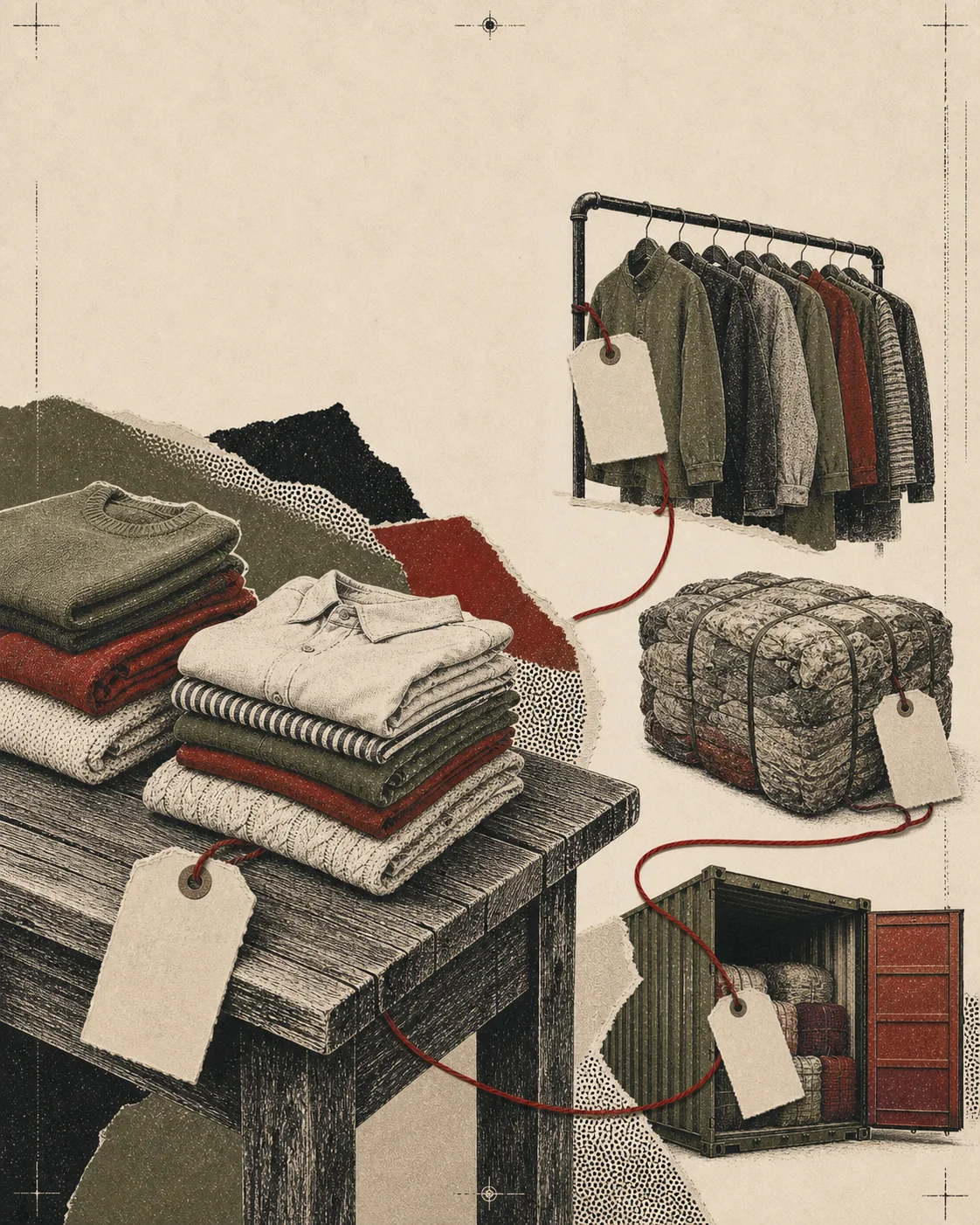
Most donated clothing gets graded, compressed into 45 to 60 kilogram bales, and shipped abroad to a sorter who will open that bale and sell it again. No more than roughly 10 percent of what goes into a donation bin is sold in the country that donated it, according to a 2016 study for the Nordic Council of Ministers by researchers David Watson, David Palm, and Louise Brix.
The bin is the first sort, not the last
A donation bag dropped at a thrift store or a curbside bin enters a business, not a landfill diversion program. Staff and volunteers pull what will sell on the shop floor, which by the Nordic study’s math is a small fraction of total intake. Everything else is sold by weight to a textile grader, who sorts it into dozens of categories: first-quality resale, wiping rags, insulation fiber, and export grades bound for specific regional markets. This sale is how most charity shops fund their own operations, and it is standard practice across the industry rather than a hidden scandal at any single one.
UN Comtrade’s trade data, filed under the harmonized code for worn clothing, shows the United States was the world’s largest net exporter of used clothing by 2019, ahead of Germany, the United Kingdom, and China. The bales move by container ship to sorting hubs in Eastern Europe, South Asia, and West Africa, where local traders buy them sight unseen at auction, a bet the trader loses or wins bale by bale.
Kantamanto is where a lot of those bales land
Accra’s Kantamanto market is the destination the trade keeps returning to in conversation, and the OR Foundation, the nonprofit that has surveyed the market’s traders since 2016, says about 15 million garments arrive there every week. Roughly 30,000 people work in the market doing the second sort: opening bales, ironing, mending, tailoring pieces down to a size that will sell, screen-printing over stains. The OR Foundation’s Stop Waste Colonialism campaign puts the community’s annual spending on bales at 325 million dollars, of which 182 million dollars went to exporters in the Global North in 2020.
A bale is a gamble the trader takes without opening it first. Some bales are mostly wearable and sell fast. Others are heavy with garments too damaged, too stained, or too far out of season to move, and the trader has already paid for the whole bale regardless. What doesn’t sell has to go somewhere, and that somewhere is the piece of this chain nobody prints on a donation-bin sticker.
Obroni wawu
Ghanaians have a name for this clothing that predates any nonprofit’s campaign. In Twi it is obroni wawu, literally “dead white man’s clothes,” a phrase that assumes no living white person would give away a coat that good, so its owner must have died. The OR Foundation now runs an annual festival called Obroni Wawu October in the market, treating the phrase as a fact about the trade rather than an insult to soften. The name is older than the statistics fight and will outlast it either way.
The number everyone quotes, and why it’s argued over
The figure that circulates most, that roughly 40 percent of the average bale becomes waste, comes from the OR Foundation itself: fieldwork, trader interviews, and observation of sorted garments conducted since 2016, not an independently audited count of what leaves the market. That distinction matters because the number has become shorthand for the entire secondhand trade, repeated in outlets that rarely credit whose fieldwork produced it or note that it has not been replicated by an outside body.
The pushback is real and comes from an organization with its own stake in the answer. SMART, the Secondary Materials and Recycled Textiles Association, a US trade group representing textile recyclers and exporters, published statements as recently as March 2026 rejecting the framing of the secondhand trade as a disguised waste stream, and it cites an industry figure that roughly 95 percent of textiles collected in the US are reusable or recyclable in some form. Both figures can be true at once and still describe different things: SMART’s number covers everything collected at the point of donation, before it is baled and gambled on; the OR Foundation’s number describes what happens after a specific bale reaches a specific trader’s stall in Accra and fails to sell. Neither side has published a joint, independently verified count of what actually leaves Kantamanto as waste, which is the honest state of the evidence as of this writing.
Where the unsold clothing goes
What the OR Foundation’s own reporting is specific about is the disposal chain once a garment is judged unsellable. The organization partners with the Accra Metropolitan Assembly to haul textile waste to what it describes as a sanctioned dumpsite away from the coastline, and it runs a team called Tide Turners that has pulled roughly 18 tons of textile and plastic waste from Accra’s beaches in a single week. In 2024 it launched Kanta Keepers, a market collective of more than 30 waste pickers whose job is separating textile waste inside Kantamanto itself before it can reach open drains or the shoreline. None of that infrastructure would exist if the volume of unsold clothing were trivial, whatever the exact percentage turns out to be.
The OR Foundation’s own answer to the funding gap is a campaign called Speak Volumes, launched in 2023, which asks apparel brands to disclose how many garments they produce each year and to pay into an extended producer responsibility fund sized to that volume. Shein signed onto an EPR agreement with the foundation, and the foundation’s own newsroom update on that arrangement credits it for funding the Kanta Keepers waste collectors and other on-the-ground programs. A brand paying into that fund is buying down a liability it created at the factory gate, not making a donation, and the OR Foundation’s public materials describe it that way rather than as charity.
On January 1, 2025, a fire tore through large sections of the market, destroying stalls, merchandise, and tools that thousands of traders, tailors, and porters depended on. The OR Foundation committed 1 million dollars in emergency relief and, through its longer-running Secondhand Solidarity Fund, says it has distributed more than 500,000 dollars in direct grants to over 1,500 market members since 2020. The market has rebuilt in sections since, one stall at a time, the same way it sorts every bale that arrives: by hand, one garment at a time, at a rate of about 15 million a week.