
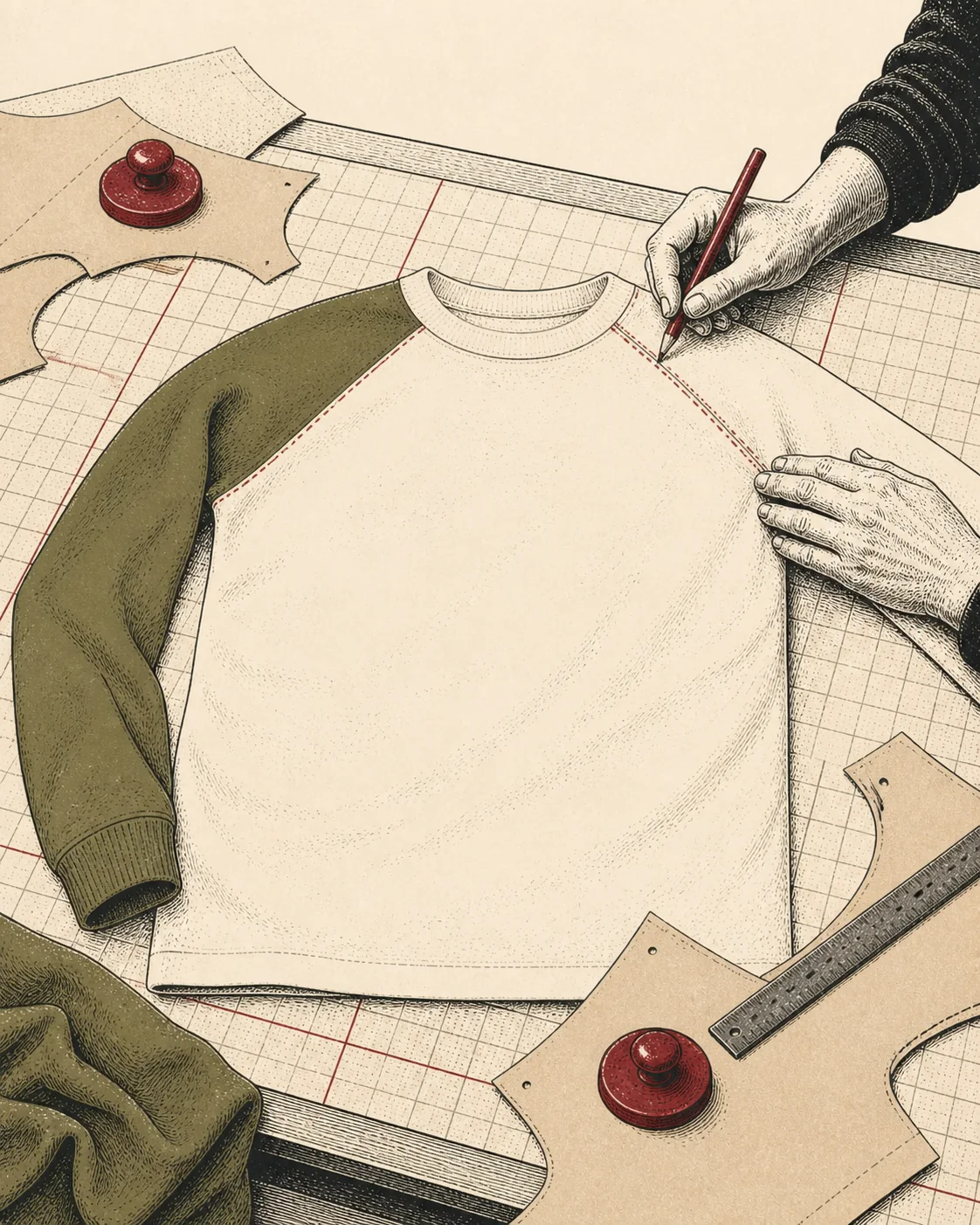
A raglan sleeve is cut in one piece from the cuff all the way to the collar. Instead of a seam that caps the shoulder, the way it does on most t-shirts, the seam runs on a diagonal from the underarm up to the neckline. There is no shoulder seam at all. Everything else about the raglan, the name, the baseball connection, the fit, follows from that one line moving.
Where the diagonal seam comes from
A standard tee is built from a set-in sleeve: a tube of fabric sewn into a roughly oval armhole, with the seam sitting on top of the shoulder where a soldier’s epaulette would go. A raglan pattern removes that seam entirely and folds the top of the sleeve into the yoke of the garment instead, so the collarbone and the top of the shoulder are covered by the same piece of fabric as the arm. Cut the front and back pattern pieces that way and the seam has nowhere else to go but diagonally, from somewhere near the armpit up to the collar. Pattern drafters describe deriving a raglan block from an ordinary sloper by redrawing the armhole and merging it with the sleeve cap, and they also note it fits less predictably than a set-in sleeve and usually takes a couple of test garments to get right, according to the pattern-drafting guide SewGuide.
The Lord Raglan story, and how solid it actually is
The style is named for FitzRoy Somerset, 1st Baron Raglan, a British officer who served as military secretary to the Duke of Wellington. At the Battle of Waterloo in June 1815 he was wounded and his right arm was amputated, according to his Wikipedia biography, which draws on standard nineteenth-century military records. He went on to command British forces in the Crimean War and died in 1855. The popular version of the story has Raglan needing coats cut to accommodate the missing arm, with a looser shoulder that skipped the usual seam that a one-armed man could get on and off more easily, and the tailoring trade naming the cut after him.
That much of the story is plausible and widely repeated. What is hard to find is a contemporary document, an order book, a tailor’s advertisement, a diary entry, that ties the cut to Raglan while he was alive to wear it. The English word itself shows up later than the story implies: Merriam-Webster dates the first known use of “raglan sleeve” in print to 1864, nine years after Raglan’s death, and the term did not enter a major dictionary until the New English Dictionary, the direct predecessor to the Oxford English Dictionary, picked it up in 1903. A name attached to a garment nearly a decade after the man died is not proof the attribution is false. Naming conventions in Victorian tailoring often lagged the person by years, and “cardigan” followed the same pattern after the Earl of Cardigan. But it does mean the Raglan sleeve should be treated as the traditional account, not a documented one: the injury and the amputation are recorded fact, and the leap from there to a specific coat commissioned for a specific man is tailoring folklore that nobody has produced the receipt for.
What the seam actually does
Whatever its origin, the construction earns its keep on its own terms. Because the raglan seam sits away from the top of the shoulder joint, the arm can swing through a wider arc before the fabric pulls tight across it. A set-in sleeve reaches its limit quickly once the arm goes above shoulder height, because the seam itself, and the armhole it is set into, resist the stretch. A raglan garment has more give built into the same movement, which is why pattern guides and sportswear makers describe it as the better choice for active wear specifically, not for fashion reasons but for range of motion at the shoulder.
The same seam also does something for fit that has nothing to do with athletics. Because the shoulder line is not fixed by a seam, a raglan top drapes more forgivingly across a range of shoulder shapes, sloped or square, narrow or broad, than a set-in sleeve tailored to one shoulder line. That is a real fitting advantage, and it is also why raglan sleeves show up on maternity wear, outerwear meant to fit over layers, and oversized silhouettes generally: the pattern tolerates more variation in the body underneath it than a fitted set-in sleeve does.
The baseball tee
The sleeve’s most visible home now is the three-quarter-sleeve tee, contrast sleeves in one color and body in another, that gets called a baseball tee or a raglan tee interchangeably. That name is earned. Raglan construction became standard on baseball undershirts because a pitcher or a fielder throwing overhand needs exactly the shoulder range the seam provides, and a shoulder seam sitting directly under a jersey seam is one more point of friction and restriction a thrower does not need. The style then migrated from the undershirt to the outer garment, and by the 1970s the three-quarter raglan tee was its own established casualwear category, sold in the same silhouette it still is today: contrast sleeves, crew neck, no shoulder seam.
None of that requires the Lord Raglan story to be airtight. The seam works because of where it sits on the body, not because of who supposedly wore it first, and a pattern that gives a pitcher’s shoulder more room to move was always going to outlast the argument over its name.