
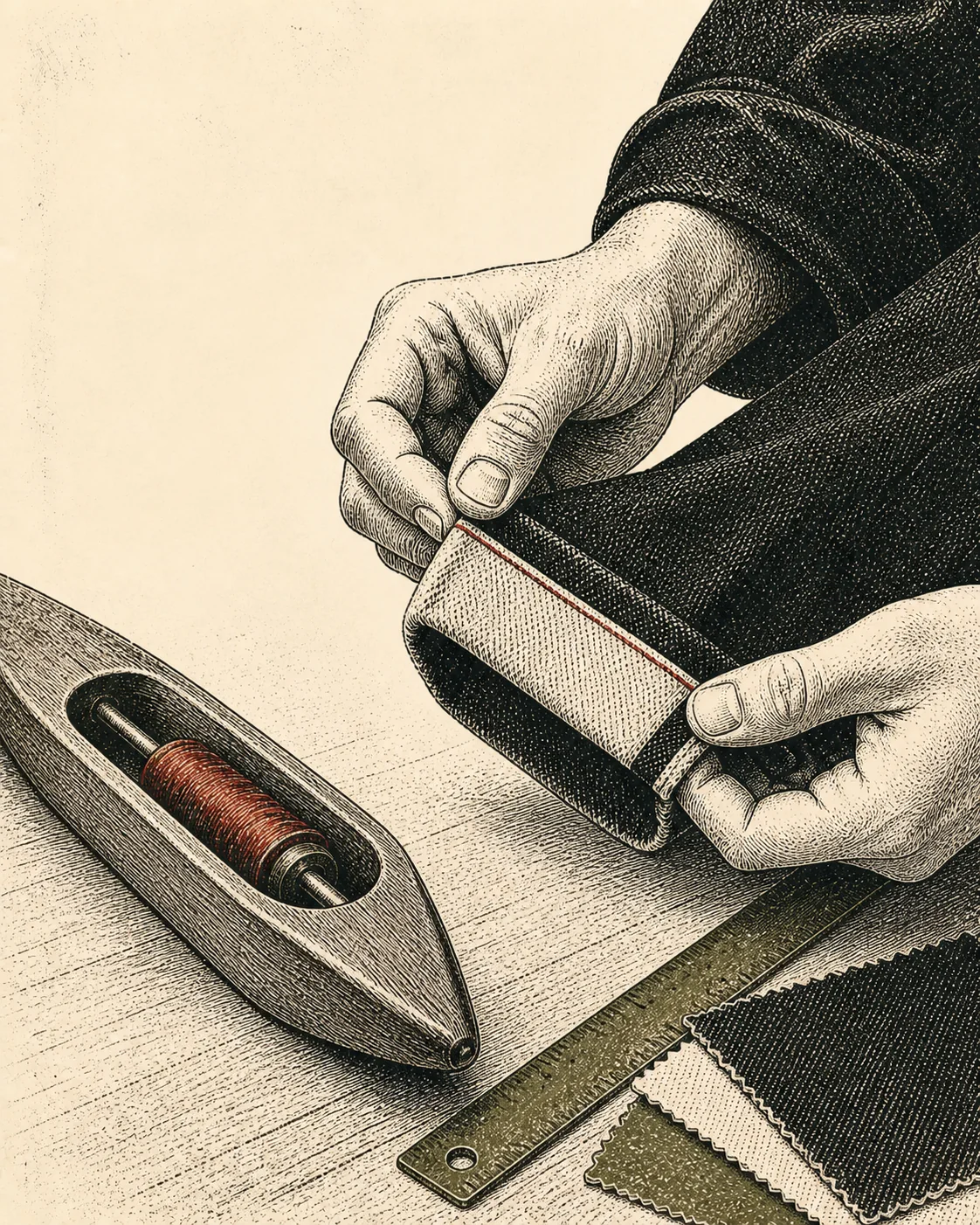
Selvedge denim is cloth woven on a shuttle loom, a machine that drags a single weft thread back and forth across the width of the fabric instead of cutting it at each pass. That back-and-forth motion finishes both edges of the cloth as it’s made, no overlock stitch required. The word is a contraction of “self-edge,” and it describes exactly what it says: an edge the loom finished, not one a machine sewed shut later.
What the loom actually does differently
A shuttle carries the weft yarn on a small bobbin, shoots across the warp threads, and comes back the other way on the return pass, looping at each side and leaving a tight, continuous edge. Because the same length of thread travels the whole width and returns, the weft never gets cut mid-bolt: one continuous strand runs the entire length of a roll, turning at each selvedge. A projectile or rapier loom, the kind that runs almost all denim made today, fires a length of weft across in one direction and cuts it at the far side. That cut edge frays unless a mill overlocks it afterward, so non-selvedge denim needs a second finishing step that selvedge denim simply skips. Each pass back and forth is a pick, the unit mills use to describe how fast a loom runs and, indirectly, how tight the resulting weave is.
Width and speed pay for that skipped step. Shuttle looms weave narrow: roughly 29 to 36 inches across, with 30 to 32 inches the figure that comes up most often for the vintage American machines still in use. A projectile loom weaves 60 inches or wider in a single pass, doubling or tripling the cloth per hour before the speed difference is even counted. And the speed difference is large. A shuttle loom runs at around 150 picks (rows of weft) a minute. A projectile loom runs 600 to 1,000 picks a minute or more, ten times the throughput on cloth that’s already wider. A mill floor running shuttle looms produces a fraction of the yardage per hour that a modern floor produces, not because the old iron is romantic but because it’s slow, and every yard of narrow, slow-woven cloth carries that labor cost forward to the price tag.
Why the industry left shuttle looms behind
Denim demand climbed through the 1950s and into the 1960s and 1970s, and mills that wanted volume switched to shuttleless looms because there was no way to weave enough cloth on the old machines to meet it. By the 1980s, projectile and rapier looms had become the standard across the US denim industry, and Levi’s itself moved its mainline production to them during that decade. Cone Mills’ White Oak plant in Greensboro, North Carolina, founded in 1905, kept a floor of vintage Draper X3 shuttle looms running long after every other American mill had converted, supplying Levi’s red-line selvedge denim for decades. It closed on December 31, 2017, the last US mill still weaving selvedge denim at scale, with roughly 40 of those looms still operating on the day the line shut down. Some of that equipment didn’t go to a scrapyard: Mount Vernon Mills later acquired the Draper X3 looms from White Oak with plans to restore them for a dedicated selvedge line, which says something about how narrow the remaining market for this cloth actually is: small enough that a buyer chases specific looms through a corporate sale instead of scrapping them for metal.
What’s real in the durability claim, and what isn’t
The claim shows up on nearly every retailer’s denim page: selvedge is more durable because the weave is tighter. There’s a mechanical story that supports it. A shuttle loom runs slowly, under steady, even tension, which plausibly produces a denser weave than a machine firing weft across at ten times the speed. Slower, tighter weaving is a real variable in cloth strength.
What doesn’t exist, at least not published anywhere searchable, is a controlled test that isolates the loom as the variable: same weight, same cotton, same finishing, selvedge cloth against non-selvedge cloth, run through an abrasion test like the Martindale or Wyzenbeek method and compared. Every durability comparison found in the trade press folds the loom together with fabric weight, yarn quality, and dye process, all of which affect how long a pair of jeans lasts independent of which loom wove them. A heavy, well-spun projectile-loom denim will outlast a light, poorly spun selvedge denim, loom heritage notwithstanding. The honest version of the claim is narrower than the marketing version: the selvedge edge itself, sewn into a garment’s outseam, cannot fray the way a cut edge can, which is a real and provable durability advantage at that one seam. Whether the body of the cloth wears longer because of the loom, rather than because of the weight and yarn a mill chose for it, is not something anyone has demonstrated with a test.
That’s a narrower claim than the one printed on most hangtags, and it matters for a buyer trying to spend well. Two textile abrasion methods, Martindale and Wyzenbeek, exist precisely to settle exactly this kind of question by cycling a fabric sample against a standard abrader until it wears through, and either would answer the selvedge question directly if run on matched cloth. Absent that test, weight and yarn quality remain the two variables with actual evidence behind them, and a buyer comparing two pairs of jeans learns more from the ounce weight on the tag and how the yarn was spun than from whether the outseam shows a colored line at the cuff.
The line that shows when you cuff the hem
Selvedge is sewn into a garment where it still does something: mills route the finished edge into the outseam of the leg, where one flat seam can close it without an overlock line adding bulk. Roll the cuff and the edge shows, usually with a colored guide thread woven a half inch or so in from the edge, a mark mills used to identify their own cloth on the factory floor before it ever became a badge for wearers to display on purpose. Cone’s line ran red. Other mills ran their own colors, and a collector who knows the palette can name the mill from a glimpse of cuff.
That’s the part of selvedge denim that has nothing to do with strength and everything to do with provenance: a narrow strip of thread that used to be a production detail and is now the entire reason some jeans cost four times as much as others cut from cloth that, ounce for ounce, might wear exactly the same.