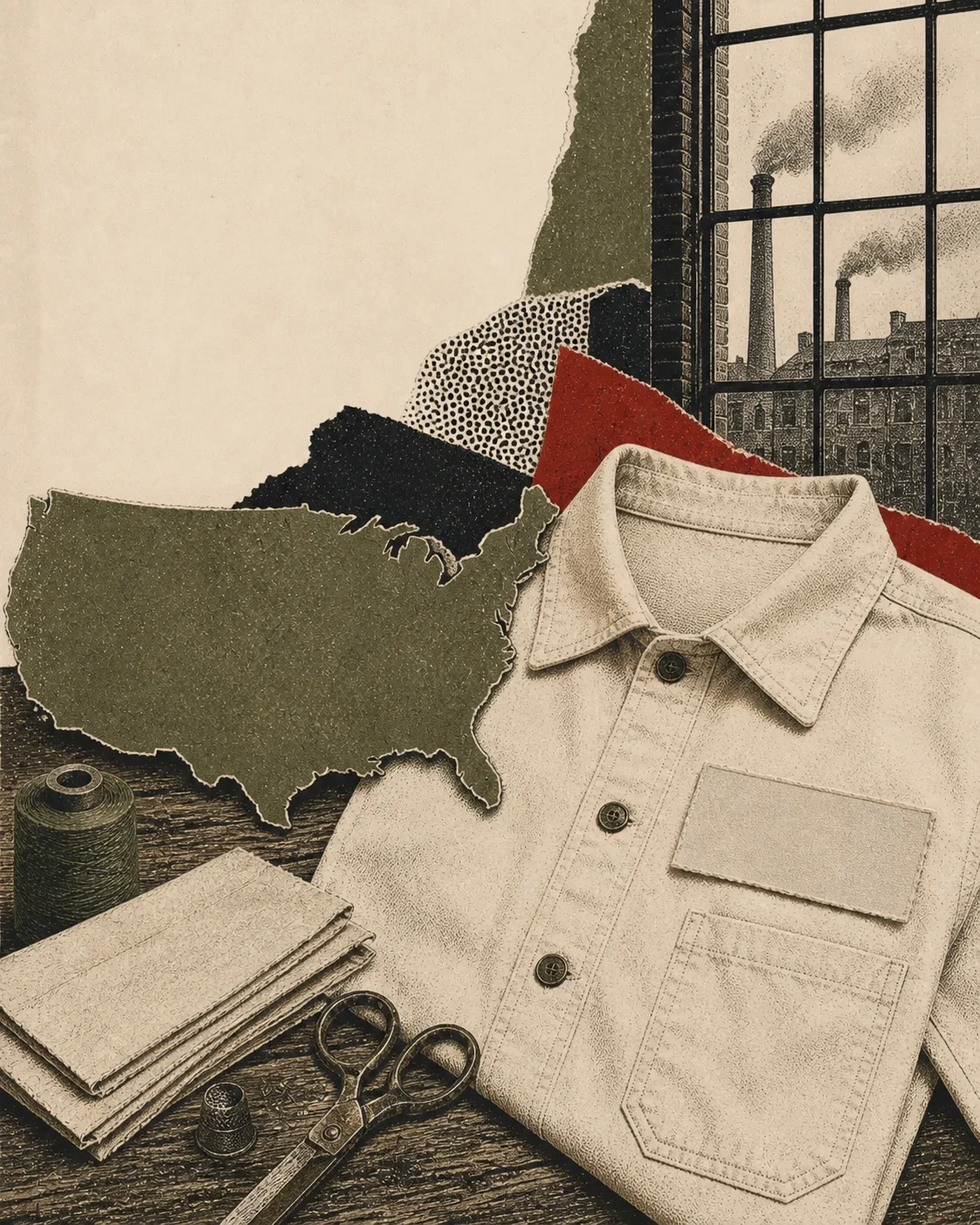
Made in USA is a legal claim before it is a marketing one. Since July 14, 2021, when the Federal Trade Commission published the Made in USA Labeling Rule at 16 CFR Part 323 in the Federal Register, an unqualified Made in USA label has meant something specific: final assembly in the United States, all significant processing in the United States, and all or virtually all components made and sourced in the United States. The FTC’s own guidance puts it in six words: the product should contain no, or only negligible, foreign content.
What “all or virtually all” actually requires
The rule’s operative language, at 16 CFR 323.2, says it is an unfair or deceptive practice to label a product Made in the United States unless three things are true at once: the final assembly or processing happens here, all significant processing happens here, and all or virtually all ingredients or components are made and sourced here. Three conditions, not one. A shirt cut and sewn in North Carolina from fabric woven in Vietnam does not clear the bar just because a domestic sewing machine did the last step. The fabric is a component, and the rule counts it.
This is stricter than most people assume. A garment brand can be genuinely proud of its domestic cut-and-sew operation and still not be entitled to an unqualified Made in USA label, if the yarn, the thread, or the zipper pull came from somewhere else. The FTC does not grade on a curve for effort. It grades the finished product against the all-or-virtually-all line, and a negligible amount of foreign content is the only room the standard leaves.
What Assembled in USA means, and why it’s a different sentence
“Assembled in USA” reads like a softer Made in USA, but it is a separate, narrower claim built for a specific situation: a product with foreign parts where the US assembly step is itself substantial, and where that assembly is the product’s last substantial transformation. A couch frame from Mexico with leather from Italy, stitched and finished in a Carolina workshop, can honestly say “Assembled in USA” if the assembly there is real work, not a final staple. It cannot say Made in USA without qualification, because the components didn’t clear the all-or-virtually-all bar.
The FTC’s own guidance gives a run of examples that make the distinction concrete: “Couch assembled in USA from Italian Leather and Mexican Frame.” “Designed in USA, Made in Finland.” “Bound in U.S., Printed in Turkey.” Each one names the part that isn’t domestic instead of leaving the reader to assume, in the same sentence as the claim itself, so nobody has to dig for the asterisk.
Why there’s a rule now, not just guidance
Before 2021, “Made in USA” enforcement ran on the FTC’s Enforcement Policy Statement on U.S. Origin Claims, which set the same all-or-virtually-all standard but carried no direct penalty of its own; the agency had to build a full deception case to act. 16 CFR Part 323 changed that. A violation of the rule is treated as violating a Section 18 rule under the FTC Act, 15 U.S.C. 57a, which brings it inside the Commission’s civil penalty authority under 15 U.S.C. 45(m)(1)(A). That figure gets adjusted for inflation on a schedule set at 16 CFR 1.98, and as of the adjustment effective January 17, 2025, it sits at $53,088 per violation. A company that runs a false Made in USA claim across a catalog, a website, and a hangtag isn’t necessarily looking at one violation. It can be several, each carrying its own exposure.
That’s the mechanism the rule added: not a new definition of honesty, but a consequence for the old one. The all-or-virtually-all test was already the law of deceptive advertising. What changed in 2021 is that the FTC no longer has to prove a full unfair-practices case before it can fine someone for saying it.
Reading our own labels against the standard
Here is the plain accounting for DRESS. Every garment we sell carries a provenance record with two fields: where the blank came from, and who did the decoration. Right now, across our current catalog, the decoration field is filled in and the blank field is not. What that means in practice: the screen printing and embroidery on every DRESS piece is done by union labor in the United States, and we can say that plainly, because it’s the part we’ve confirmed. Where the blank garment itself was cut and sewn is not something we have documented well enough yet to make a Made in USA claim about it, qualified or not, and so this piece doesn’t make one.
That’s a narrower thing to say than “Made in USA,” and it’s worth being exact about why. Under 16 CFR 323.2, the blank is a component, the same way the frame is a component of the couch in the FTC’s own example. Where the yarn was spun, where the fabric was knitted, and where the pieces were cut and sewn are all facts that would need to be documented and true before an unqualified claim about the whole garment holds up, not facts that get inherited from a strong claim about the print. Printing a wordmark on a domestically decorated but unverified blank doesn’t clear the all-or-virtually-all line, and a brand that implied otherwise, by saying “union made” or “Made in USA” about the whole shirt on the strength of the printing alone, would be making exactly the kind of claim the rule exists to catch.
The honest version of our own label, today, is smaller than the ambitious one. We’d rather publish the smaller version, decoration confirmed and union-done, blank still being documented, than the one we can’t back up if someone asks for the paperwork. That’s not a hedge. It’s the same discipline the FTC is asking every label to practice: say the part you’ve verified, and don’t let the reader fill in the rest.
What to check before you believe a label
A shopper who wants to verify a Made in USA claim has more to work with than the label itself. The FTC accepts complaints and has sent warning letters over unsupported claims; a brand that has actually documented its sourcing can usually produce a straight answer about where the fabric came from, not just where it was cut. The absence of that answer, or a non-answer dressed up as one (“proudly American,” “ethically made,” no mention of a country), is itself information. The rule gives the sentence its meaning. A label that avoids the sentence is choosing not to make the claim, which is a different thing from having earned it.