
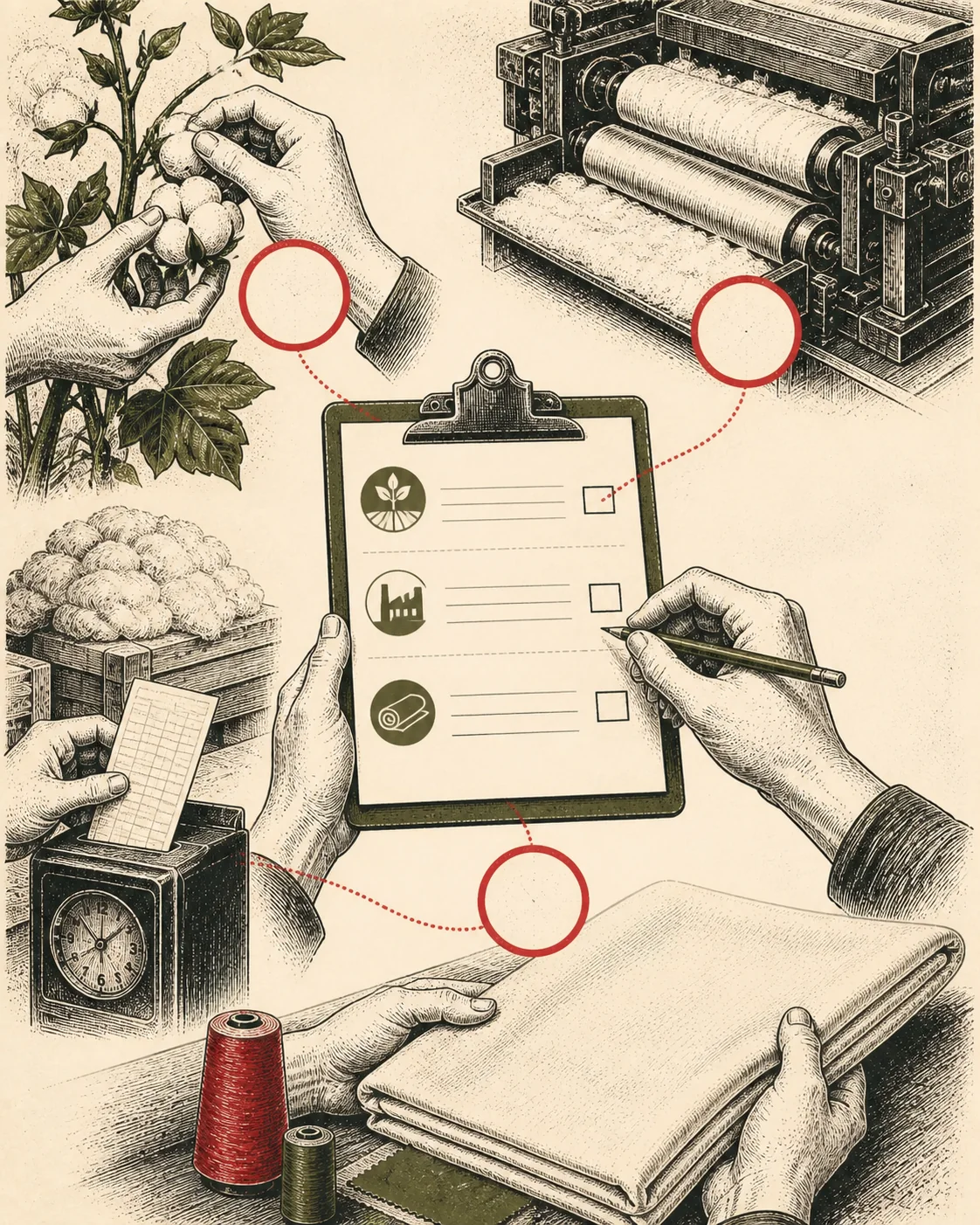
Organic cotton certification is at least three separate promises, made by three different organizations, and a hangtag that just says “organic” does not tell a shopper which one they are getting. The Global Organic Textile Standard governs how the fiber is processed and, in part, how the people processing it are treated. The Organic Content Standard checks only that the organic fiber percentage on the label is true, and stops there. The USDA National Organic Program certifies the cotton as a farmed crop and has no standard at all for what happens to it afterward. None of the three, on its own, is a complete guarantee, and the gaps between them are exactly where a shopper’s assumptions tend to land.
GOTS: the only one that touches the factory floor
The Global Organic Textile Standard, now on version 7.0, released March 6, 2023, is the scheme doing the most work. Its label grades are specific: a product marked “organic” needs a minimum of 95% certified organic fiber, and “made with organic” covers the range from 70% up to that 95% line. The remaining fiber, on the lower grade, has to come from a defined list of permitted additional materials, not just whatever was on hand.
GOTS also regulates the processing itself. Wet processing, dyeing, and finishing have to meet restricted chemical input lists, and wastewater from certified facilities has to be treated before discharge. And GOTS is the only one of the three with mandatory social criteria, built on International Labour Organisation conventions: prohibitions on forced and child labor, freedom of association and collective bargaining, wages that meet at least the national legal minimum or industry benchmark, and working hours capped in line with ILO standards. Version 7.0 went further than earlier revisions, adding a requirement that certified entities calculate the gap between what they pay and a living wage, and show a plan to close it, along with new provisions covering homeworkers and migrant labor recruitment. GOTS certifies a supply chain, not a bale of cotton, and that is the distinction the label is actually making.
The chemical side runs on a similar logic: restriction rather than a blank ban. Certified operators work from an approved and prohibited input list covering dyes, auxiliaries, and finishing agents, azo dyes that release restricted amines are excluded outright, and every processing stage from ginning through the sewn garment has to stay inside the same certified chain, which is why GOTS calls itself a whole-supply-chain standard rather than a fiber standard with a chemical footnote attached.
OCS: a fiber-content check, nothing more
The Organic Content Standard, published by Textile Exchange, is a narrower tool built for a narrower job. Its own scope language is direct about what it does not do: OCS does not certify the raw material itself, and it does not address processing chemicals, environmental impacts, or social or legal compliance. What it verifies is chain of custody, that the organic fiber content a brand claims on a label can actually be traced back through every transaction to a farm certified under a recognized national organic standard. A shirt can carry an OCS 100 label, meaning its fiber traces cleanly back to certified organic cotton, and say nothing whatsoever about the dye house that finished it or the wages paid on the cutting floor. That gap is the standard working as designed: it was built to solve one problem, fiber fraud, and that is the only problem it claims to solve. The confusion starts when a shopper reads “organic” on an OCS-certified tag and assumes it carries GOTS’s social and chemical criteria along with it.
What the USDA actually reaches, and where it stops
Organic cotton can also be a USDA-certified crop, under the same regulation, 7 CFR Part 205, that certifies organic corn or organic apples. A cotton farm can be inspected and certified the same way any other organic farm is. But the regulation’s own definitions show where the USDA’s authority runs out. Section 205.2 defines an “agricultural product” as one “marketed in the United States for human or livestock consumption,” and its definition of “processing” is a list built for food: cooking, baking, curing, drying, mixing, freezing, and similar operations, with packaging and canning named specifically. Spinning, weaving, dyeing, and sewing appear nowhere in it. The USDA has never written a textile processing standard, and its own May 20, 2011 policy memo, PM-11-14, makes the boundary explicit: a GOTS-certified textile product can be sold as organic in the United States, but it cannot carry the USDA organic seal or claim NOP certification, because NOP certified the fiber crop, not the finished garment. A finished textile could carry the seal if every processing step happened to meet NOP’s own handling rules, but those rules were written for food manufacture, and a printed, dyed, or sewn garment essentially never clears them. The seal ends up belonging to raw fiber and the occasional undyed, minimally processed good, rather than to a finished shirt.
The correction: organic reads as a labor claim, and mostly isn’t one
This is where the assumption breaks. Organic certification, in food, arrived in most shoppers’ minds already carrying a halo of general virtue: better for the land, better for the people growing it. Textile organic certification inherited that halo without earning it uniformly. A garment carrying an OCS label, or one built on nothing but USDA-certified organic fiber, has made a claim about the cotton plant and, in OCS’s case, about the paperwork trail behind it. It has made no claim about who cut the fabric or how long they worked that week. Only GOTS’s social criteria reach that question, and even within GOTS, a product can carry the “made with organic” grade at 70% fiber content while still meeting the full social criteria, or a brand can layer OCS-verified fiber onto a supply chain GOTS never touched. The organic claim and the labor claim are not the same claim, and a hangtag rarely tells the reader which one, or which combination, it is making.
When the paperwork itself was fake
Certification only works if the transaction certificates behind it are real, and in November 2020, GOTS and its accreditation partner IOAS found that they weren’t, at scale. A surveillance audit following fraud rumors uncovered roughly 20,000 metric tons of ordinary Indian cotton that had been certified organic through forged Raw Cotton Transaction Certificates, some carrying counterfeit QR codes and pointing to a cloned copy of the website belonging to India’s Agricultural and Processed Food Products Export Development Authority, the government body that authenticates the real certificates. GOTS canceled the fraudulent transaction certificates up the chain, banned eleven companies from certification, terminated its contract with one certification body, and referred its findings to the Indian authority for investigation. It also rebuilt its own verification process so incoming transaction certificates are authenticated centrally rather than trusted at the point of issue, and it referred the matter to APEDA for criminal investigation rather than treating it as a purely internal compliance problem. India held more GOTS-certified facilities than any other country at the time, 2,411 of them in 2019, which is both why the fraud found room to operate and why the fix mattered.
What a label is actually telling you
None of this means organic cotton certification is worthless. It means the word “organic” on a garment tag is doing less specific work than the same word on a bag of coffee, where one federal standard covers the whole product. A shopper who wants to know whether the people who made a shirt were paid a legal wage has to look for GOTS by name, not for the word “organic” alone. A shopper who wants to know only that the fiber itself traces to a certified farm can trust OCS for exactly that, and nothing past it. The three schemes are three different, narrower claims wearing the same word on the label rather than competing versions of one claim, and the fraud case in India is a reminder that even the narrowest of those claims still runs on paperwork somebody has to check.