
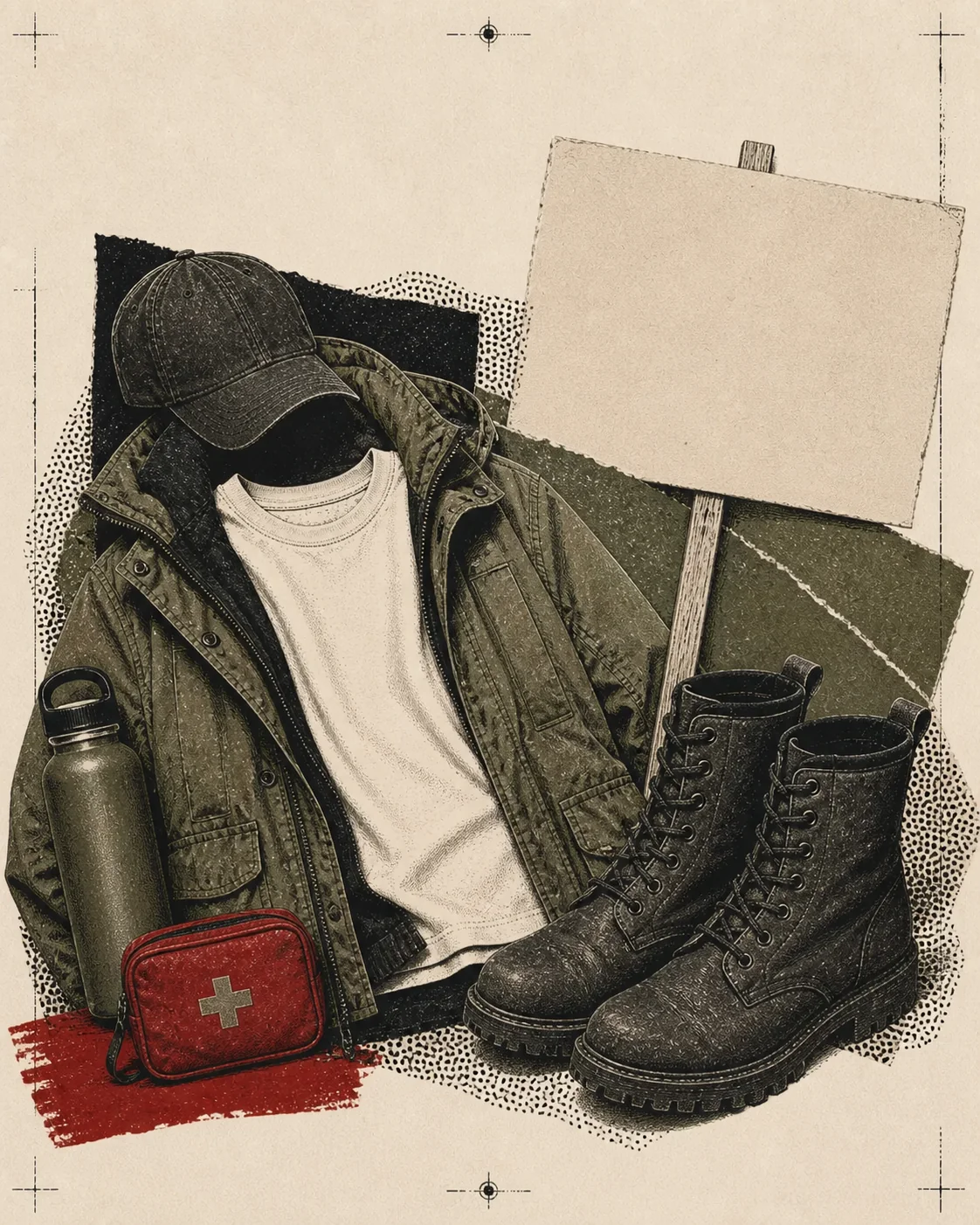
Wear what you’d wear for a long day outside on your feet, and pack for the weather you’ll actually get, not the weather you hope for. That covers most of the packing list. The rest of this is the detail behind it: what holds up in a crowd, what a legal organization actually recommends writing on your arm, and what to leave in a drawer at home.
Dress the way you would for any long day outdoors
A demonstration is, physically, an endurance event before it is anything else. You may stand for an hour, walk for three, or move quickly for thirty seconds and then wait again. Clothing that works for a long hike or a full day at an outdoor job site works here for the same reason: layers you can add or shed, nothing that restricts your stride, nothing you’re precious about.
Closed-toe shoes are the one non-negotiable, and they should be shoes you’ve already broken in. A demonstration is the wrong day to learn that a new pair of boots rubs a blister by hour two. Sandals and open shoes leave your feet exposed to a crowd that is, by definition, dense and sometimes moving faster than you’d choose. If the forecast includes rain, bring something waterproof rather than something merely water resistant; a soaked layer stops insulating and starts working against you.
Synthetic fabrics that trap heat close to the skin are a poor choice on a hot day for the same reason they’re a poor choice on a run: they don’t breathe. Natural fibers or a technical wicking layer do better. On a cold day, the layering logic is the same one that applies to any outdoor activity: a base layer, an insulating middle layer, and a shell, so you can adjust as your body temperature changes rather than committing to one heavy coat for the whole day.
Glasses, not contacts, if you have the choice
If your eyes are exposed to smoke, dust, wind-blown grit, or any other airborne irritant, a contact lens can trap that irritant directly against the eye, where a blink would otherwise help clear it. Glasses sit farther from the eye and give you a barrier a lens doesn’t. If you wear contacts day to day and own a pair of glasses, that’s the day to switch. If you don’t own glasses and rely on contacts, that’s worth knowing well in advance, not something to solve the morning of.
Sunglasses do the same job on a bright day and add nothing controversial to a bag: eye protection from sun and grit is eye protection, full stop.
Water, food, and the weather you’ll actually get
Bring more water than you think you need. A few hours outdoors, especially standing in direct sun or moving with a crowd, dehydrates faster than a normal day at a desk or in a car. A refillable bottle is lighter to carry than it sounds and solves a problem that is easy to prevent and unpleasant to fix once it’s underway. A small, non-perishable snack, the kind you’d pack for a long flight, covers the gap if the day runs longer than planned.
Check the actual forecast the morning of, not the forecast you checked three days earlier. Sunscreen on a clear day, a hat either way, and a layer for after sundown if the event runs into evening. None of this is specific to a protest. It’s the same planning a person does for a day at a fairground or a long outdoor errand, applied here because the setting doesn’t change what a body needs.
What a legal support number is and why it goes on your arm
The National Lawyers Guild, a legal organization that trains and deploys volunteer Legal Observers at demonstrations, recommends writing a legal support hotline number directly on your skin in permanent marker before you leave the house, in a spot you can see and where sweat or weather won’t smear it off. The Guild’s protest tools page states the number should go somewhere you can look at but that won’t be erased by sweat or the weather. A phone can be lost, confiscated, or run out of charge over a long day; ink on a forearm does not depend on a battery.
The specific hotline number is a local one. NLG chapters maintain their own lines region by region, and an organizer planning an action with a real risk of arrest can contact a local chapter ahead of time to request Legal Observers or other support, according to the Guild’s own program page. Finding your chapter’s number, or the number an event’s organizers have published, is a five-minute task worth doing the night before rather than the morning of.
What the law actually protects, and what it doesn’t answer for you
The ACLU’s Protesters’ Rights guide states plainly that the First Amendment protects the right to assemble and express views through protest, while noting that police and other government officials are allowed to place certain narrow restrictions on the exercise of those speech rights. That’s a legal framework, not a packing list, and it’s also where a clothing guide should stop. Questions about carrying identification, recording law enforcement, or what happens if a demonstration is declared unlawful vary by state and by situation in ways this piece isn’t equipped to answer. The ACLU’s own know-your-rights page and a local National Lawyers Guild chapter are the places built to answer them, and they’re worth reading before the day of the event rather than during it.
What to leave at home
Leave anything you’d be genuinely upset to lose track of: heirloom jewelry, irreplaceable items, more cash or cards than the day requires. A crowd is a crowd, things get jostled and dropped, and the goal is to carry only what you can afford to have out of your hands for a few hours. That’s a smaller list than it sounds like once you write it down: a phone, a little water, a snack, keys, and whatever the forecast demands.
A bag with both hands free to carry it beats a bag you have to hold. A backpack or a crossbody sits against your back or hip and leaves your arms loose, which matters if you’re on your feet for hours or moving through a dense crowd. Anything with a long strap that can catch on a fence, a railing, or another person’s arm is worth leaving behind for the same reason a loose scarf is a bad idea near machinery: it’s a snag waiting to happen, not a hazard specific to a protest.
None of this requires special gear. A heavyweight tee and a pair of shoes you already trust do the job as well as anything marketed for the occasion; DRESS makes garment-dyed cotton pieces meant to be worn hard and washed often; that’s a fabric fact, not a sales pitch for the day.
The night before, the only two tasks that matter are the ones easy to skip: check the actual forecast, and write the number on your arm.